
Active Client Tab
How Credit Repair Works
- We send out customized letters to the credit bureaus to challenge for removal of negative items off your file and clean up your report. Things like charge-offs, collections, bankruptcies, late payments, inquiries, derogatory, evictions and even repossessions.
- You will Be required to pay $33/month To monitor your Credit until we’re done with your profile. It’s like a credit karma but it’s more accurate and shows everything we need to see.
- You will have access to your own personal client portal to track the progress as we go! 24/7 access! You will also receive a pdf update after each round.
Each round of results take 45 days ( 1 and a half month ) for a new update. The average client goes through a Minimum 4-7 rounds of credit repair before they have completed their program. These 4-7 rounds as a whole typically takes between 6-10 months & sometimes up to 1 Year for more severe cases. If additional rounds are needed we will provide them at NO EXTRA CHARGE.
By law we have to give the credit bureaus that time frame to view clients file and validate the debt/inaccuracies! Please be patient with our team while we get each client results.
Never judge an ENTIRE PROCESS based off 1 or 2 rounds. Just like a basketball game is 4 quarters, If it takes 3 or more rounds that’s completely normal. It’s all Apart Of The Process. You can expect certain rounds & sometimes back to back rounds With No Change. Believe It Or Not It Actually Helps With You Getting Deletions Because It Helps Us Catch The Credit Reporting Agencies & Debt Collectors Up In Violation Even More Than They Already Were.
I know you’re trying to buy a house, move into a new apartment, get a loan, & maybe get a new car… But understand IT’S NOT ABOUT WHAT YOU WANT. It’s about HOW IT WORKS! Establishing GOOD CREDIT itself is its own process, and CREDIT REPAIR is also its own process. Realistically you should have prioritized this 2 years in advance! 😩👏🏾
It’s not fair to wait until the last minute and then put pressure on me to rush the process because you need something done ASAP. I don’t work at the bureaus, I can’t control what they will delete in a round, my job is simply to make sure your next disputes gets out to them every round. ‼️
You didn’t mess your credit up overnight, so please don’t expect it to be fixed overnight either. Credit repair is a PROCESS! Some people see results quickly, while others may take more time depending on what’s on their credit profile.
Give us time to WORK. 🙌🏾
Credit improvement is a process that requires time, consistency, and client cooperation, I promise, the process is so worth it when you stay consistent and stick it out. 💜✨
We are committed to providing a professional, compliant, and results-driven credit service.
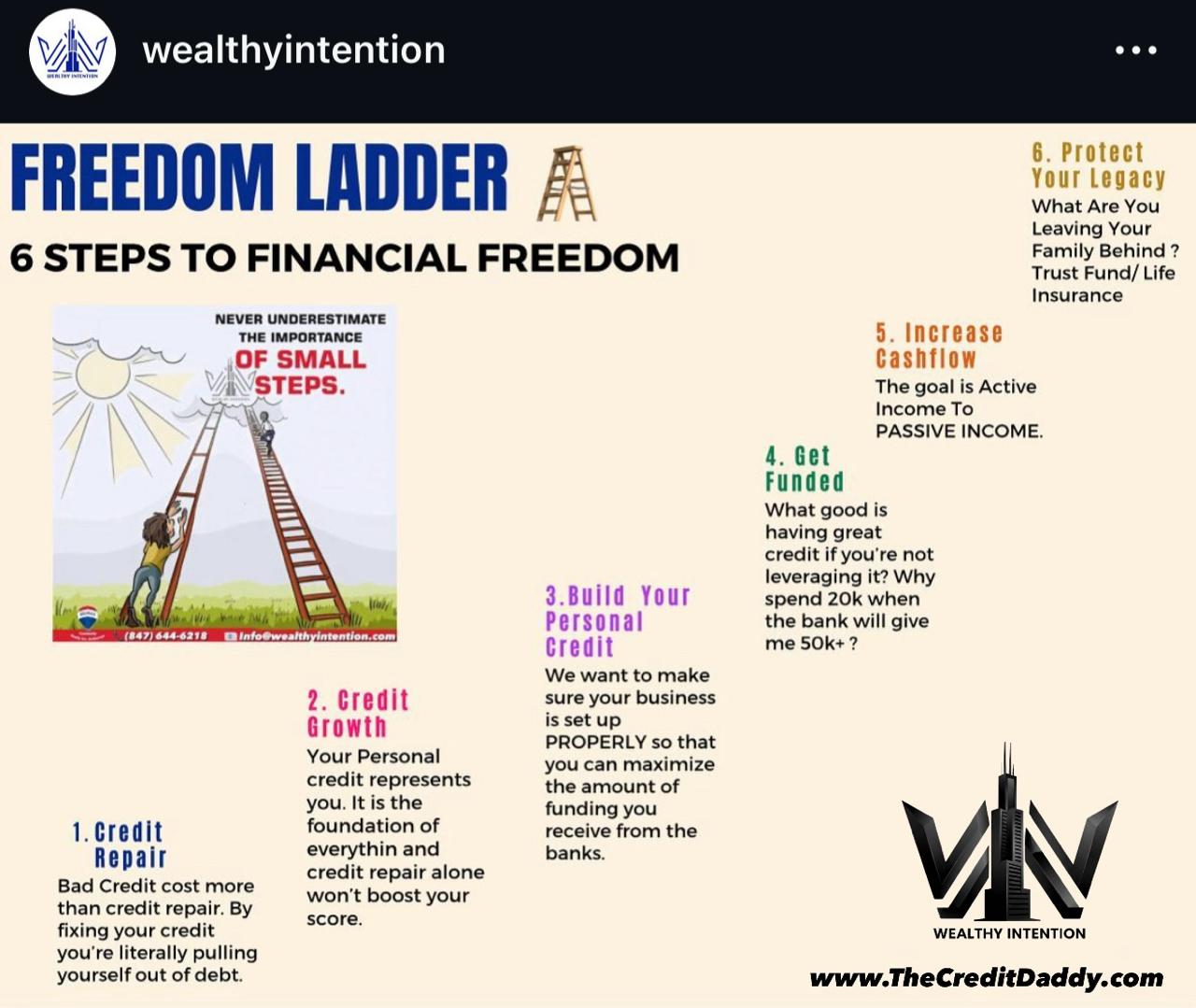
The purpose of the Active Client Tab is to provide guidance and set clear expectations throughout your credit restoration journey. This section contains important information designed to help you understand the process and what to expect moving forward.
Most credit repair specialists, usually dispute the negative items from your credit report and you have to figure out the rest ON YOUR OWN. And To be honest THAT’S WHAT CREDIT REPAIR IS. I try to be a little different. I do try to at least provide the Education & Resources you may need along the way, and you can always recommend more in the suggestion box below. That said Steps 2-6 are included & available TO THOSE WHO WANT IT. But understand what you are paying for is Step 1: CREDIT REPAIR. That is the only requirement. To dispute inaccurate, unverifiable, and negative items on your credit report. THAT’S IT, THAT’S ALL.
I provide steps 2-6 simply BECAUSE I CARE. My goal is for my clients to understand credit the same way I do, not just fix it temporarily. Without the proper knowledge, you won’t understand where you went wrong and can easily end up right back where you started. I don’t want that for you. If it happens… that’s fine, you’ll just have to pay me again, and 9/10 you don’t want that either.
But just TO BE CLEAR! I DO NOT have to tell you how to increase your scores, build a strong profile, build a relationship with a bank. Set up a LLC, apply for a business loan etc, the list goes on. That’s not what Credit Repair Is. All of these are ADDITIONAL BENEFITS and should not be taken for granted.
If you are interested in steps 2-6 Please take the time to carefully review each category in full, rather than skimming or skipping sections, as many common questions are addressed here. If you have a question, we encourage you to review the Educational & Frequently Asked Questions Section FIRST. If you are unable to locate the information you need, or is still confused about something, you are welcome to schedule a FREE CONSULTATION for further assistance.
Tab Categories
Choose a category below to access specific information, guidelines, and resources
Book A Consultation
How To Contact Me
Please DO NOT message me on social media. Also Most of the time i am completely booked so I DO NOT answer random phone calls. This dropdown will explain exactly how to get in contact with me if needed.
Rules & Expectations
Payment agreements, service policies, refund terms, and important client obligations.
Help Us Help You
(THINGS YOU SHOULD BE DOING ON YOUR END)
Common issues that delay results and how to avoid them. Stay on track with your credit repair journey.
Frequently Asked Questions
Get answers to common questions about the credit repair process, timelines, and what to expect.
Educational
Learn about credit scores, reports, and profiles. Understand how credit works and how to improve it.
TO DO LIST
(THINGS YOU SHOULD BE DOING ON YOUR END)
Action items to help boost your credit score, including recommended credit building accounts.
TO DO LIST ZOOM RECORDINGS
Access recorded Zoom sessions and walkthroughs to guide you through your to-do list steps.
Resources
Links, tools, and additional resources to support your credit repair journey and financial growth.
Refer A Friend
Know someone who needs credit repair? Refer them and earn rewards when they sign up.
Tap the gift box to share your ideas
Book A Consultation
Schedule consultations and learn how to contact our team
How To Contact Me
My Schedule & Business Hours
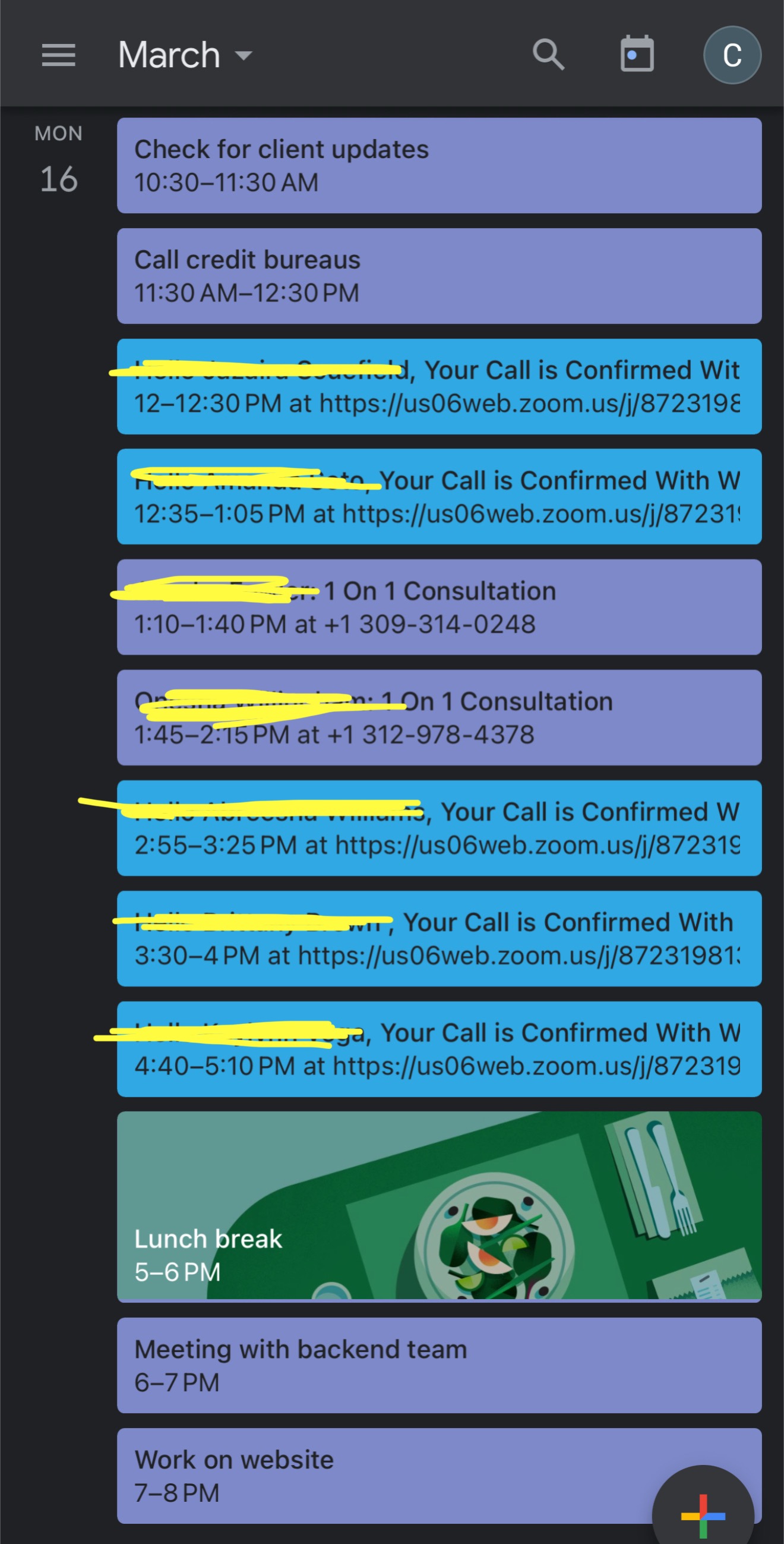
The screenshot above reflects my current calendar availability. As shown, my schedule is typically fully booked.
⏱ Business Hours: 12:00 PM – 5:00 PM CST — Monday through Thursday
Not available during ALL HOLIDAYS
These are the official business operating hours for both myself and my staff. These hours should NOT be confused with personal assumptions of what may be considered standard business hours or appropriate availability.
Please note that both my phone and this timeframe is exclusively dedicated only to clients who have taken the time to book a consultation and is not monitored for general text messaging or random calls.
During consultations, my phone is placed on “Do Not Disturb” to ensure each client receives my full, undivided attention. Responding to messages during scheduled appointments would be both unprofessional and unfair to those who have reserved that time.
My website has all the information you may need. Additionally, you may utilize the Support Chat Box, conveniently located on the bottom right-hand side of the website, for faster responses or further assistance. I also have a Suggestion Box if you feel there is any information that should be added to my website.
Boundaries & Rules
Everyone should have my Booking Link, the Support Number, and Support Email. These are the proper channels for all business communication.
- Please DO NOT call after 8:00 PM (Central Standard Time) under any circumstances. While calls outside of business hours are already discouraged, contacting me after this time is completely unacceptable.
- It is important to respect my personal time and professional boundaries, as well as my private life and relationships.
- Please DO NOT CONTACT ME through social media regarding business matters. In many cases, social media usernames do not match a client's legal name, making it difficult to properly identify who I am communicating with.
- Additionally, if I am active on social media outside of my business hours, that time is reserved for personal use. I am not available to discuss business matters during that time. Especially Friday–Sunday & ALL HOLIDAYS. For all business-related inquiries, including all QUESTIONS, COMMENTS, & CONCERNS, please use the appropriate booking link or official communication channels.
- As an active client, you are entitled to schedule consultations at no additional cost. Thank you for your understanding and cooperation.
Outside Of Operating Hours
Outside of MY business hours, both my staff, and also me myself will be unavailable and do not have access to my business phone. Especially Friday–Sunday & ALL HOLIDAYS. For this reason, it is important to book a consultation to ensure your questions and concerns are properly addressed in a timely and professional manner.
If questions arise outside of business hours, please take note of your questions and schedule an appointment for the next available time slot to ensure they are properly addressed.
I Work Late & Am Unavailable During Business Hours
If you have a late work schedule and are unavailable during standard business hours (Monday–Thursday, 12 PM–5 PM), I am willing to accommodate after-hours consultations.
However, I kindly ask that you provide at least 24 hours' notice to arrange this accommodation.
For example, if today is March 28th (Saturday) — a non-business day where neither myself nor my staff are available — please follow the steps below:
Step 1: Write down your questions to ensure nothing is missed.
Step 2: Book a consultation for the latest available time slot on the next business day (e.g., Monday, March 30th).
Step 3: Text the support number 312-584-9969 to request the specific time you prefer for that day.
All after-hours requests must be scheduled in advance • Requested times must be after 5 PM • Not available before 12 PM
Expectations
What I expect from each client is to schedule an appointment whenever they have any Questions, Comments, Concerns, Or Just Need Assistance. For example, if you've reached a specific step or reviewed a recording and need clarification, you can book a consultation and say, "I'm currently on Step 3 and need help understanding a certain part."
In those situations, I am more than willing to take the time to walk you through everything in detail and stay on the call as long as needed to ensure you fully understand — because you have done your part. At that point, it is my responsibility to do mine.
But I Just Have A Quick Question
Again, My website has all the information you may need. Additionally, you may utilize the Support Chat Box, conveniently located on the bottom right-hand side of the website, for faster responses or further assistance. I also have a Suggestion Box if you feel there is any information that should be added to my website.
The best way to reach me or get your questions answered is to book a consultation.
When you book, it guarantees that your concerns will be addressed during your scheduled time. If I have downtime before then, I may reach out sooner — but if not, you'll still have my full attention during your appointment.
Just because it's a quick question doesn't mean it's a quick answer.
For this reason, all questions, comments, and concerns must be addressed through a booked consultation to ensure no one goes unanswered.
I understand sometimes you may just have a quick question but realistically, I cannot repeatedly stop throughout the day to answer or return hundreds of unscheduled calls and text messages each day. Especially if they have already been addressed in the provided resources. Most of your questions will be answered in the FAQ, Rules & Expectations or Educational tab.
Doing so would disrupt workflow, delay progress, and ultimately take away from my ability to deliver the level of service and results that all clients deserve. It would also be unfair to those clients who are actively following the process and respecting the structure in place.
The screenshot above reflects my current calendar availability. As shown, my schedule is typically fully booked.
Booking Link
Contact Information
☎️ Support: 312-584-9969
📧 Email: Support@wealthyintention.org
Social Media
Yours Truly, TheCreditDaddy
Rules & Expectations
Important policies and agreements for all clients
Different Websites And Logins
Just so There is no confusion about the Websites and logins. Understand that are only 3 websites and logins.
1. Credit Monitoring Platform (Required)
When you first got started with our program you enrolled into a credit monitoring services: ( which is called IdentityIQ ( IDIQ )
If you have not already enrolled SIGN UP HERE:
https://member.identityiq.com/creditpreferred.aspx?offercode=431297LA
Login Here: • IdentityIQ – https://member.identityiq.com/
This platform is used to:
• Monitor your credit
• View your full credit report
• Assist in generating dispute activity
Password Requirement:
Please set your password to: Credit@2025
________________________________________
2. Client Education & Resource Hub
The second platform is TheCreditDaddy.com
This website is used for:
Frequently Asked Questions (FAQs) Education & Training Booking Link With Financial Advisor Rules & Expectations Client To-Do List
24 Hour Support Chat
Booking 1 On 1s With Cordell
Refer A Friend
Suggestion Box
Available Resources
Important Things That Can Hold You Back
All of this information can be found under the “Active Client” tab.
Access Password: Credit123!
_________________________________________
3. Client Portal (Scorexer)
The final platform is your personal client portal: ( also Available on a app called Credit Tracking )
Scorexer – https://ceoacademy.scorexer.com/Portal/login.jsp
This portal is used for two primary purposes:
1. Track Your Progress
• Monitor dispute activity
• View updates on your account
2. Upload Important Documents
Upload Documents we request from you or that you feel like may help us with the process. Such as;
• Proof of Address (POA)
• Driver’s License / State ID / Passport
• Proof of payment for accounts in collections
• Identity theft documentation (e.g., police reports)
• Relevant screenshots, emails, or mailed letters, or correspondence letters
All of these should be uploaded into your Client Portal.
Important Notice:
You must sign the agreement after logging in before everything becomes available. Also If we are unable to access your credit monitoring account, we will not be able to update your progress within your client portal.
Password Setup:
You will receive a temporary password via email but may create your own password for this platform, as it serves as your personal and secure client portal.
Payment Agreement & Continuation of Services
When a payment agreement is established with a defined timeline, it is essential that the terms of that agreement are honored.
The fee charged covers the entire credit improvement process, not an individual dispute round. While payment plans are not required, one was extended as a courtesy.
If a scheduled payment is missed, all work on your account will be paused immediately, and no updates will be provided until the outstanding payment has been received.
If our team attempts to contact you regarding a missed payment and does not receive a response within 24 hours, the process will be fully suspended. In order to resume services, the remaining balance must be paid in full.
CLEAR UNDERSTANDING:
The amount you were charged represents the cost of the entire process. Any work completed up to that point is considered final and non-refundable.
This is similar to financing a vehicle. When you enter a financing agreement—for example, over a five-year term—you are expected to fulfill the agreed-upon payments for the duration of that contract.
Even if you make payments consistently for 3 years, failure to continue those payments can result in consequences such as the vehicle being disabled (in some newer models), repossession, and potential negative reporting to your credit.
The payments already made are not refunded, as they covered the time and usage of the vehicle during that period.
Now granted you're not buying a car, but I expect the same level of respect for my business. You wouldn't call the dealership and mention how you've already made payments for 3 years in a row. Because you understand you've broken the agreement so they no longer have to give you access.
Likewise, in this process, payments made reflect the services rendered up to that point. Therefore, they are not eligible for reimbursement, And I am not required to continue service at that point.
Once services have been stopped due to missing payments—the remaining balance must be PAID IN FULL, In order to resume services.
These policies are not personal. They are necessary to protect the integrity of our business operations and ensure fairness across all client accounts.
Payment Methods
When sending payment PLEASE DO NOT PUT FOR CREDIT REPAIR OR CREDIT CONSULTATION. Simply just put "THANK YOU FRIEND" for the memo.
CashApp, Apple Pay, Chime, PayPal, etc. are supposed to be for friends and family — not business. However, a lot of people don't have real bank accounts or just prefer to pay that way, so I'm just trying to work with what's easier for each client.
Inactive Client Policy & Reactivation Fee
At Wealthy Intention, we value every client and are committed to providing high-quality, consistent service. To maintain efficiency and ensure fairness to all active clients, we’ve implemented the following Inactive Client Policy:
Inactive Client Policy
Clients who have been inactive for 60 days or more—meaning no response to messages, no document submissions, or no engagement with our support team—will be considered inactive and temporarily removed from our active client roster.
Please note that multiple reminders via email and text are sent before an account becomes inactive. We understand that life happens-unexpected events, busy schedules, and personal matters can sometimes take priority. That's why we send multiple reminders before marking any account as inactive. Even if you communicate the reason you are unable to maintain your credit monitoring subscription, or upload certain documents, it does not eliminate the issues associated with becoming an inactive client. If your account becomes inactive as a result, your file may still be subject to the $300 reactivation fee in order to resume services.
At the end of the day Credit repair is a collaborative process. Not only were you informed on my website about the things that can delay the process and make you become inactive. We also sent out multiple email & text reminders. When clients go silent or no action is taken after repeated contact attempts, it affects our ability to manage our workload efficiently. It creates workflow and scheduling challenges for our team and backend systems. This policy ensures that active, engaged clients receive the attention and priority they deserve.
Your Profile Is Costing Us Money
While an account is inactive, we are unable to continue work on the credit profile. However, we must still retain a client's file records of what was disputed or deleted in case a client later requests updates or verification of prior activity before becoming inactive. Which requires us to maintain your profile in our system and preserve all past correspondence, which results in monthly fees. Also storage costs for backed up emails and text for keeping old conversations for proof that reminders have been sent out. So in conclusion Even when no active work is being performed. We still have to pay for your files unless we delete all history.
To reactivate your account and resume services, there is a $300 Reactivation Fee. This fee covers administrative time, file review, and re-entry into our system.
For your convenience, we proudly accept Afterpay, & Klarna as flexible payment options.
Once the reactivation fee is completed, your account will be restored, and we will promptly continue your service process.
If you have any questions or would like to reactivate your account, please contact our support team at support@wealthyintention.org or text (312) 584-9969.
New Negative Items Policy 🚨
🚨
When you begin the credit repair process, my goal is to dispute and address all negative items currently listed on your credit report. If new negative items appear during the process - such as new collections, inquiries, or late payments - please understand that I am not required to work on those new items. However, I do understand that there is a difference between an old account appearing later than expected vs applying for things & adding new inquiries or late payments.
As part of my service process, if a new collection account appears or a previously deleted collection reappears while you are actively enrolled in the credit repair program, it will automatically be included in the next dispute round at NO ADDITIONAL COST. That said, this is a professional courtesy, not an obligation. I handle it this way in good faith to help keep all clients on track and maintain the progress of their credit profile.
After Program Completion:
Once all negative items have been removed and your file has been successfully completed and closed, the service is considered finished. If a collection account later appears or reappears after the completion of the program, there will be a $300 reactivation fee to reinitiate credit repair services.
To set clear expectations:
Again. I understand life happens. If you absolutely can’t wait until we are done with the process. I cannot force you to wait. Search for “ When can I start applying for things “ And also search for “ How To Avoid Unnecessary Inquiries “ this should at least let you know if you have a chance of approval.
If you need further assistance don’t hesitate to Book an appointment. This ensures we stay aligned, protect your credit, and avoid setbacks in your results. My goal is to deliver strong results, and that requires us to work together strategically.
If we've already discussed the importance of keeping your accounts positive and you continue to receive new inquiries or negative items, an additional charge may apply for continued credit repair services.
If I decide to charge for additional work, I will inform you first and ask whether you wish to move forward.
If you choose not to, all work on your file will be paused or stopped entirely. Repeatedly applying for new credit while your disputes are in progress adds unnecessary inquiries, lowers your scores, works against your progress, and creates additional work that makes my team’s job significantly harder.
Why can’t we just continue to dispute your original negative accounts?
Realistically it wouldn’t matter. If it has got to this point we would be simply working backwards. You still have more negative items and every new inquiry lowers your scores even more. This extends the overall timeframe and it also makes me look like I'm not doing my job. Then the first thing you would say as a client is “ I’ve been working with him for 2 years and I haven’t gotten any results” I simply can't have that. Especially if you were the problem. Respectfully.
Refund Policy
We are committed to providing professional, compliant, and results-driven credit services. Because credit improvement is a process that requires time, consistency, and client cooperation, the following refund policy applies to all clients.
100% Money-Back Guarantee
If a client completes four (4) full rounds of disputes as outlined in their service plan and receives zero (0) deletions, a 100% refund of the Service charge paid for credit repair only will be issued. (this does not include the $33/month for your credit monitoring) This guarantee applies only when all program requirements and guidelines have been fully followed by the client.
No Refunds Once the Process Begins
Once services have started, no refunds will be issued due to a change of mind. If you are someone who's married or typically makes decisions with your partner, Please ensure you have discussed this decision with your spouse or decision-maker PRIOR to payment completion.
If you choose to stop services before completion, that is your right; however, no refund will be issued if you do not allow us to complete the agreed-upon process. I shall only be responsible for a refund if I DID NOT DO MY JOB. Not because someone stopped me from doing my job which is get you DELETIONS.
Client Responsibility & Non-Refundable Conditions
Refunds will not be issued if the client interferes with the credit repair process or fails to follow required guidelines, including but not limited to:
- Clients who have been inactive for 60 days or more—meaning no response to messages, no document submissions, or no engagement with our support team—will be considered inactive and temporarily removed from our active client roster. – See Inactive Client Policy & Reactivation Fee section.
- Continuously adding new negative items to their credit profile
- Ignoring instructions or deadlines
- Failing to provide required documentation or access
- Taking actions that delay, disrupt, or prevent the completion of services
Any work completed up to that point will be considered final and non-refundable.
Fairness & Accountability: This policy exists to ensure fairness and accountability for both parties. Our goal is to help you rebuild and protect your credit, but success requires active participation, honesty, and cooperation from the client.
Once again. I shall only be responsible for a refund if I DID NOT DO MY JOB. Not because someone stopped me from doing my job which is get you DELETIONS.
⚠️ Hard Truth:
You can't pay for credit repair then:
- Ignore or skim through instructions
- Stop responding
- Ignore emails and text messages
- Keep adding new inquiries, or late payments
- Skip credit building
Then come back 3 months later saying you haven't heard anything, seen any changes, requesting a refund, & proceed to blame my company or the process.
Credit repair works only when WE work.
I'm not a miracle worker, I'm a strategist. You have to do your part as well.
Please take your credit seriously-it represents your financial credibility.
Canceling Your Credit Repair Service
If you KNOW you’re trying to buy a house, move into a new apartment, get a loan, or get a new car… But understand you should have prioritized 2 years in advance! 😩👏🏽
It’s not fair to wait until the last minute and then put pressure on me to rush the process because you need something done ASAP. I don’t work at the bureaus, I can’t control what they will delete in a round, my job is simply to make sure your next disputes gets out to them every round. ‼️
You didn’t mess your credit up overnight, so please don’t expect it to be fixed overnight either. Credit repair is a PROCESS! Some people see results quickly, while others may take more time depending on what’s on their credit profile.
Give us time to WORK. 🙌🏽
I promise, the process is sooo worth it when you stay consistent and stick it out. 💜✨
The average client goes through a minimum 4-7 rounds of credit repair before they have completed their program. Each round of results take 45 days ( 1 and a half month ) for a new update. These 4-7 rounds as a whole ranges between 6-10 months & sometimes up to 1 Year for more severe cases.
By law we have to give the credit bureaus that time frame to view clients file and validate the debt/inaccuracies! Please be patient with our team while we get each client results. If additional rounds are needed we will provide them at no extra charge.
Never judge a whole process based off 1 or 2 rounds. Just like a basketball game is 4 quarters If something takes 3 or more rounds that’s perfectly normal. It’s Apart Of The Process, You Can Expect Certain Rounds & sometimes back to back rounds With No Change. Believe It Or Not It Actually Helps With You Getting Deletions Because It Helps Us Catch The Credit Reporting Agencies & Debt Collectors Up In Violation Even More Than They Already Were.
We are committed to providing professional, compliant, and results-driven credit services. Because credit improvement is a process that requires time, consistency, and client cooperation, the following refund policy applies to all clients.
If you choose to stop services before completion, that is your right; however, no refund will be issued if you do not allow us to complete a minimum 7 rounds of the agreed-upon process due to you changing your mind. I shall only be responsible for a refund if I DID NOT DO MY JOB. Not because someone stopped me from doing my job which is get you DELETIONS.
Whenever you wish to stop the process just simply text 312-584-9969 with your first and last name and let us know that you no longer wish to move forward with the process and that you will take it from here. We will then stop the process for you immediately and whatever work that has been done up to that point will be considered final!
Setting Up Your Client Portal
⚠️ Important Notice: Anytime you upload any documents inside your portal you must notify us to check it at 312-584-9969 or Support@wealthyintention.org. We only check the client portal when notified!!
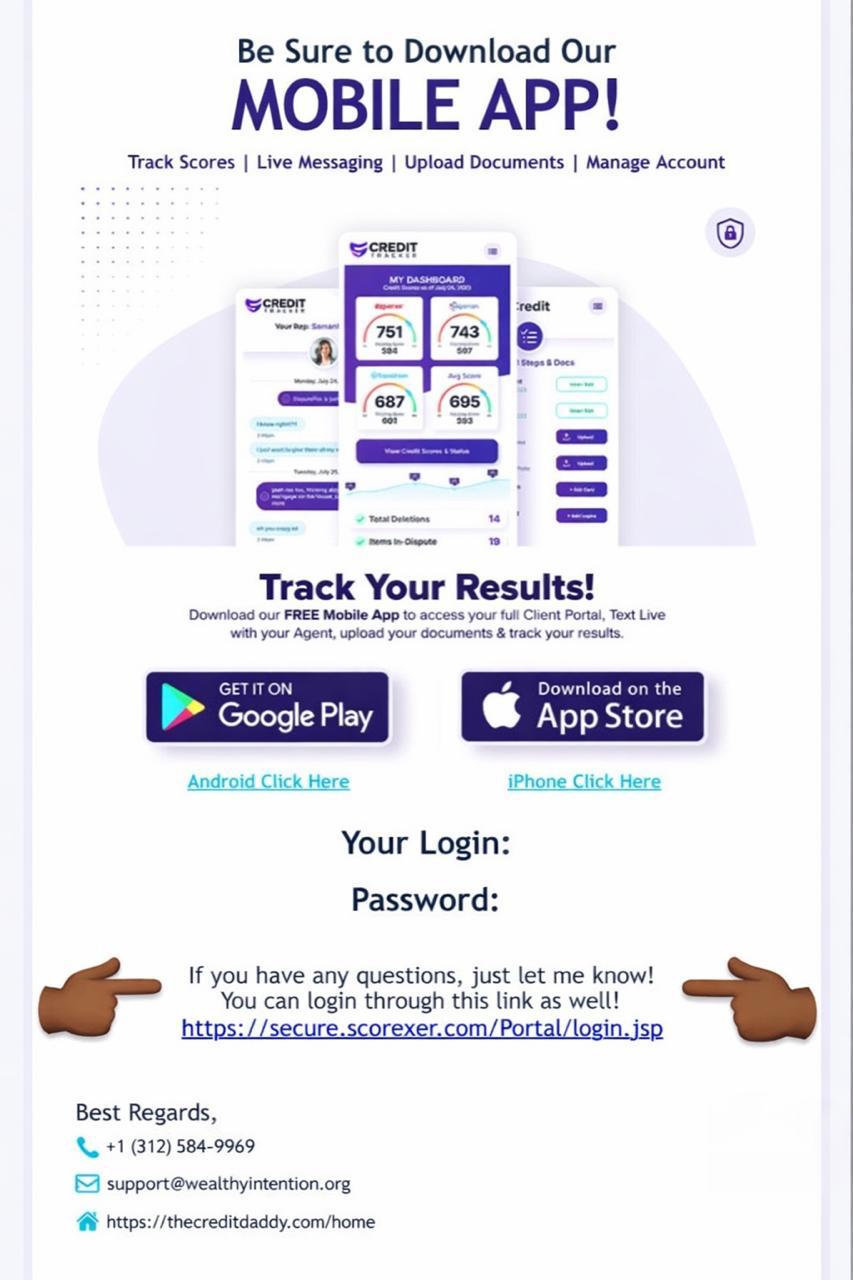
Within 4 Business Days After Getting Started my support team should have sent you a email for you to access your portal. The sole purpose of your client portal is to track your own progress and upload documents when necessary. Search for TRACK YOUR RESULTS or CLIENT PORTAL LOGIN in your email and spam. If you do not see the email with the username and password for your online client portal please text my team to make sure it gets resent out. (312) 584-9969
Important Notice: Anytime you upload any documents inside your portal you must notify us to check it at 312-584-9969 or Support@wealthyintention.org
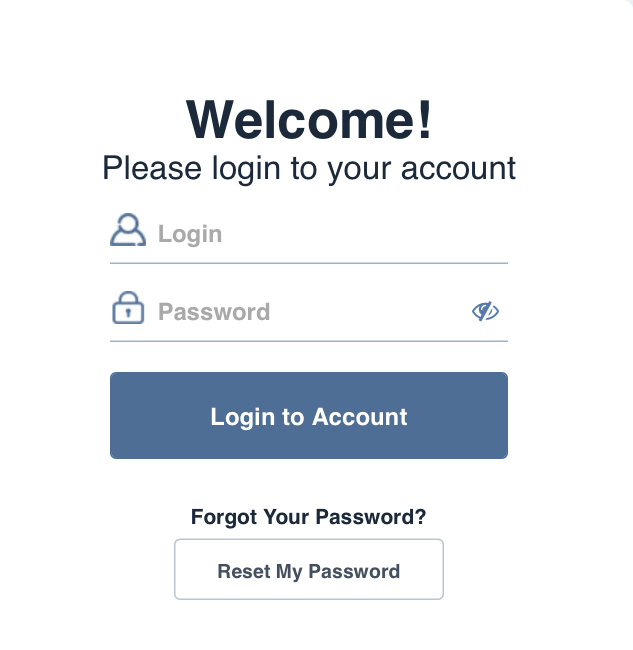
Log into your portal directly on the website: https://secure.scorexer.com/Portal/login.jsp
As your credit journey continues you can expect phone calls, emails or mail from:
- The original creditors of whoever you have done business with
- Various Debt collectors
- Credit reporting agencies such as Transunion, Equifax, And Experian
YOU DO NOT have to answer any calls or respond to any emails or mail. We will notify you via text or email if there is anything you need to do on your end. Any mail or emails you receive you can upload them inside of your portal.
Also if you feel like you may have something that may help us with the process. Such as; proof you or your insurance company paid off certain accounts that are in collections, proof that you were a victim of identity theft like a police report. Screenshots of messages, emails, or letters that you may have gotten in the mail that is important to your situation; FEEL FREE TO UPLOAD THEM INTO YOUR PORTAL.
Change Your Password To Your Client Portal Or Upload Documents Here
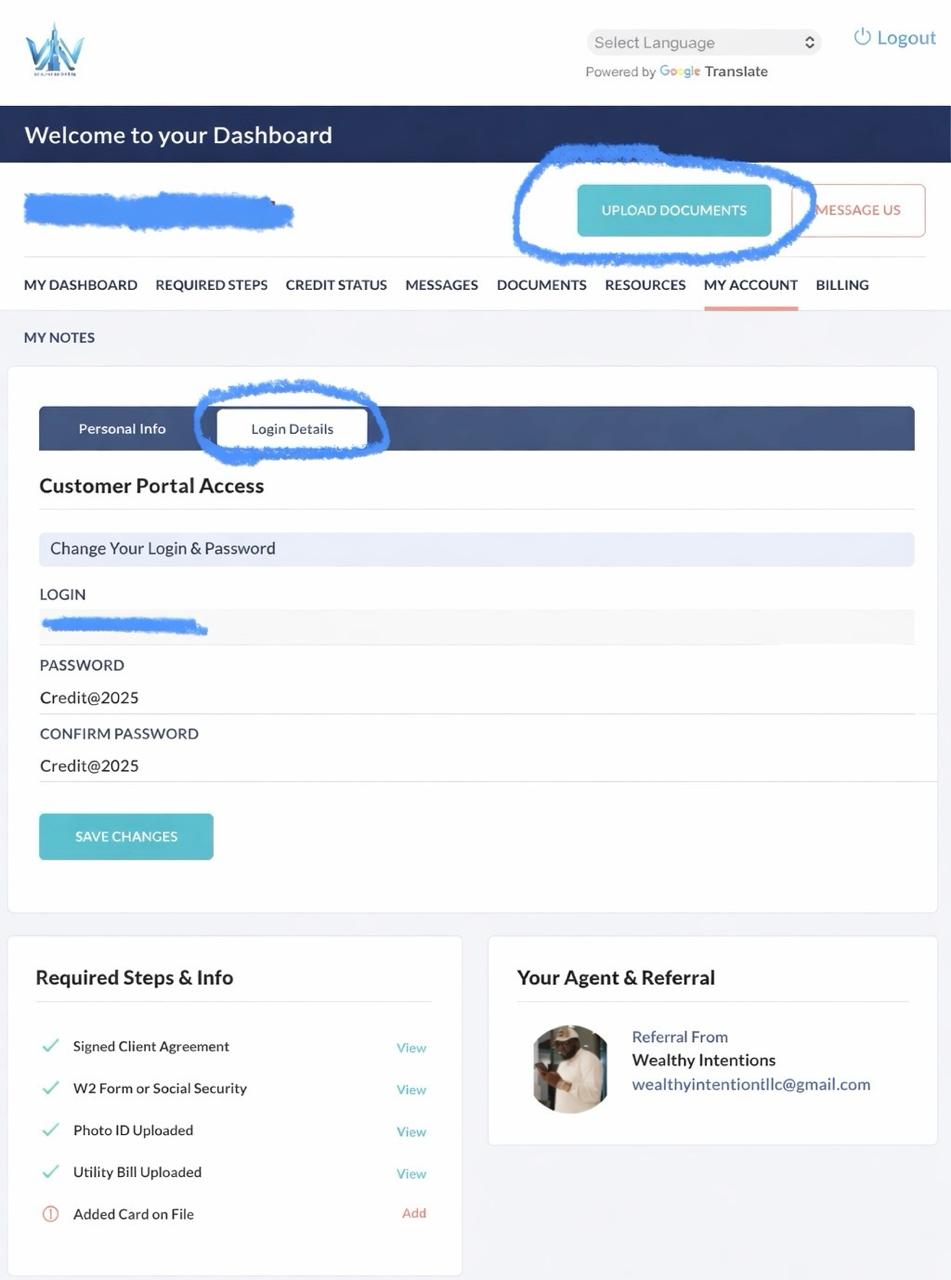
Whenever uploading something into your portal PLEASE MAKE SURE ALL DOCUMENTS ARE CLEAR:
- Not Too Light Or Too Dark
- No Blurry Photos Or Screenshots
- No shadows or light flashes blocking words in the documents
- Pictures MUST BE FULL PAGE (Meaning Take it out of the mail and unfold it)
- Screenshots Must Also Be FULL PAGE (meaning MAKE SURE ALL 4 CORNERS ARE IN THE PIC)
These things can cause your docs to come back as NON VERIFIABLE which can prolong you getting fast and efficient results.
Help Us Help You
Common issues that delay results and how to avoid them
(THINGS YOU SHOULD BE DOING ON YOUR END)
Primary Issues That Can Hold You Back
Common Issues
• Expired Driver’s License Or State ID
• Outdated credit monitoring reports
• Inaccessible or incorrect credit monitoring login credentials
• Missing or invalid Proof of Address (POA) documentation
• Full or inaccessible email inbox (clean up space or buy more storage if needed)
• Phone settings that block or silence unknown numbers. Please save 312-584-9969 in your contacts to ensure uninterrupted communication.
• NOT NOTIFYING US BY TEXTING THE SUPPORT NUMBER AFTER A ISSUE HAS BEEN HANDLED.
IMPORTANT MENTAL NOTE:
Due to the high volume of clients we serve—over 500 individuals, it is not feasible for our team to repeatedly follow up with hundreds of clients each day regarding the same issue. It is also unfair to active clients and takes away from the attention they deserve. Our priority is to continue assisting clients who are actively completing the required steps in the program.
Please understand that once we have notified you of the issue, we have fulfilled our responsibility on our end. For this reason, WE WILL NOT revisit the client’s file unless we are notified that the issue has been resolved. We will just assume the matter is still pending.
These are the primary issues that delay results for most clients. By proactively managing the items listed above, you set yourself up for a smooth and successful experience.
Whenever an issue arises—such as a POA matter or a login-issue concern etc—our first step is to promptly notify the client so they are aware of the matter and can take the necessary steps to resolve it. By doing so you are tagged within our system. Once tagged, automated messages with CLEAR INSTRUCTIONS are sent to you via email & text every 10 days. You will no longer receive these notifications after a maximum of three reminders are issued, or until we are notified that the issue is resolved—whichever occurs first.
These reminders are simply a courtesy to ensure you don't forget & nothing is overlooked, as we understand that schedules can be busy. After providing this notification, our team proceeds with assisting other clients.
If you receive an email or text message regarding any of the items above, it is not sent without cause and is not a system error.
In most cases, either:
• Our team was not notified that the issue has been handled, ( most of the time this is the case )
• The issue has resurfaced and requires immediate attention.
• The login information provided were invalid.
• The submitted documentation is invalid.
That Said—These notifications should NEVER be ignored.
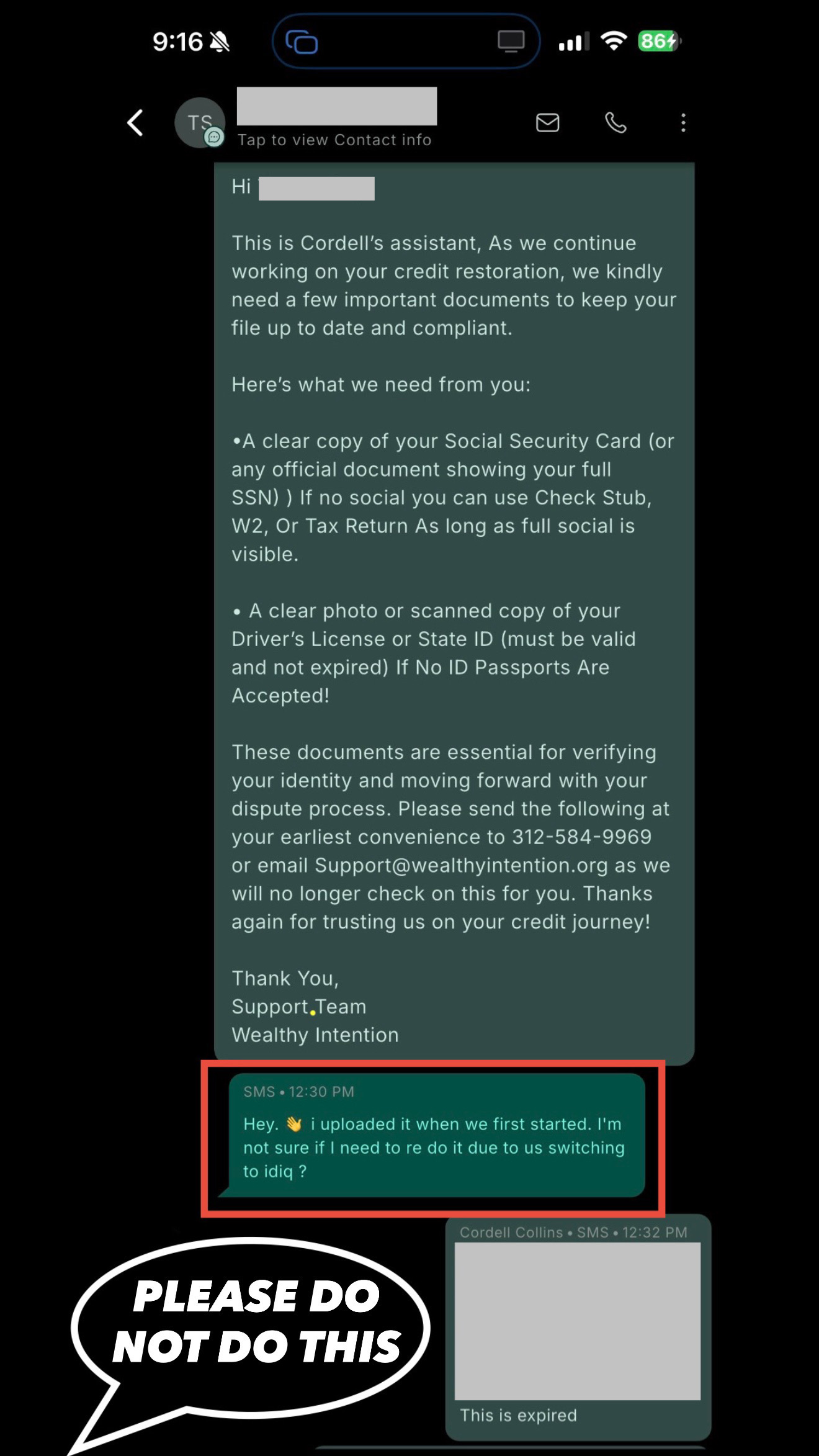
Before responding with “I’ve already completed this,” please take a moment to verify first, and provide a screenshot as proof if you believe the issue has already been resolved.
Log directly into your credit monitoring account to confirm the report is current
Confirm all documents are clear dates & all submitted documents are accurate and up to date.
Verification ensures accuracy, prevents delays, and keeps your account active and progressing as intended. Notify 312-584-9969 whenever you have taken care of an issue.
POA (Proof Of Address)
Whenever we request your Proof of Address
(POA), we ARE NOT asking whether you have moved from your current residence. We understand that your address may remain the same. What we are specifically requesting is the MOST RECENT updated documentation that VERIFIES you are currently residing at that address.
Acceptable documents include: ( Please do not send any documents that is not one of these )
We Only Need 1. You do not have to send all four.
• A utility bill
• A bank statement
• A rental or lease agreement
• Mortgage Statement
Whenever we send our dispute letters we have to verify your identity & your address. Because of that, This POA Is MANDATORY. If You Cannot Provide This Monthly, We Won’t Be Able To Dispute On Your Behalf.
Valid Vs Invalid
| VALID ✅ | INVALID ❌ |
|---|---|
| Utility bill, Bank statement, Rental/Lease agreement, Mortgage Statement | Car insurance, tax return, collection paper, medical bill, random piece of mail |
| Visible Full first and last name | business name or nickname |
| Shows your COMPLETE current residential address | Doesn’t show your current address |
| If paper document: we can see ALL 4 CORNERS. Meaning Take it out of the mail and UNFOLD IT. | Pictures of mail inside envelope, Zoomed in picture of only your name and address & not the rest of the document. Bottom part of the document is missing, Not showing the full page. |
| Clear Photo | Blurry, too light, too dark, shadows blocking words on the documents |
| Dated Within Preferably LAST 30 DAYS. But 60 Days Max. | Older Than 60 Days… Do Not Send A POA from JULY if it’s OCTOBER . That is 3 Months Old & INVALID |
Option A: Bank Statement
All Bank Statements Are Accepted. Even if you are in chexsystems you can still use Chime, Cashapp, Varo, or Apple Pay. Credit Card Statements Are Also Acceptable.
Option B: Utility bill.
Utilities include Light, Gas, Water, or Trash.
Please note that the address on your utility bill or bank statement DOES NOT NEED TO MATCH the address listed on your State ID Or Driver's License — that is not what we're verifying.
What matters is that the address on your Utility Bill Or Bank Statement accurately matches your CURRENT PLACE OF RESIDENCE, as this serves as your OFFICIAL PROOF OF ADDRESS (Remember the address you put on the form when you got started.) THIS IS WHAT WE'RE VERIFYING EVERY MONTH.
If the address on your utility bill or bank statement DOES NOT MATCH the CURRENT address where you are actively living, you have Three (3) options:
Suggestion #1: ( Highly Recommended )
Update the address directly online using your mobile app before downloading the new PDF document.
If the New PDF doesn’t display your edits immediately you may have no choice but to wait until they new one is ready. Which should be at the beginning of the new month. ( I believe chime bank statements update immediately after editing )
Suggestion 2 ( Faster results )
Download a pdf editor app and change the address to your new address & then send it over.
Suggestion #3 ( Completely Optional )
If you cannot edit your Utility Bill or Bank Statement yourself you can Submit a $20 editing fee, which covers the cost for my partner to update the document on your behalf.
You have Two (2) options:
Suggestion #1 ( Faster results )
Download a pdf editor app and change the dates & then send it over.
Suggestion #2 ( Completely Optional )
If you cannot edit your Utility Bill or Bank Statement yourself you can Submit a $20 editing fee, which covers the cost for my partner to update the document on your behalf.
You Have Two Options.
Option A: Upload Into Your Client Portal.
Client Portal Link: https://secure.scorexer.com/Portal/login.jsp
Send to Support@wealthyintention.org
Important Notice: Anytime you upload any documents inside your portal you must notify us to check it at 312-584-9969.
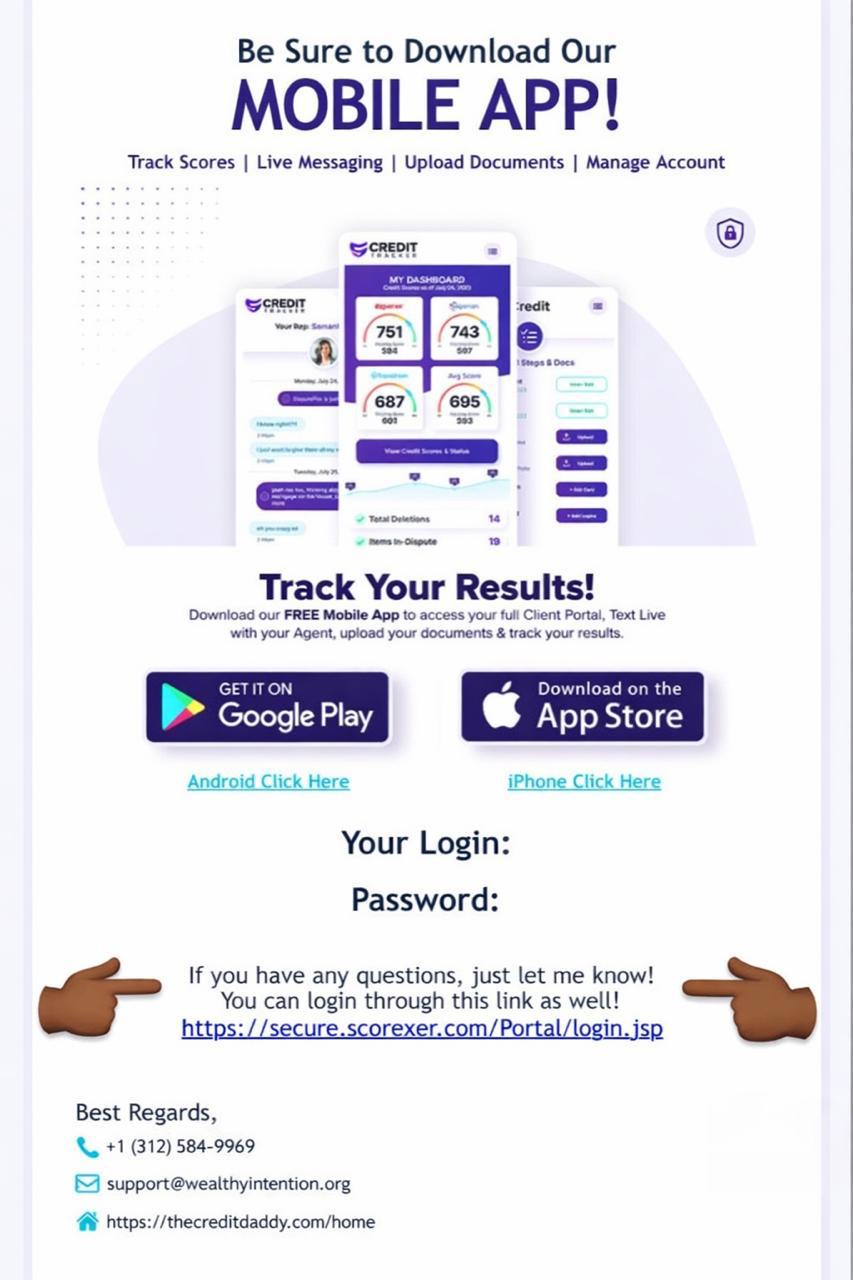
My support team should have sent you a email for you to access your portal. Search for TRACK YOUR RESULTS or CLIENT PORTAL LOGIN in your email and spam. If you do not see the email with the username and password for your online client portal please text my team to make sure it gets resent out. (312) 584-9969
Utility bills and bank statements are often delayed, and by the time the next update cycle arrives, a previously submitted document may already be expired. If the document is older than 60 days, it is considered outdated and cannot be used. For this reason, we strongly recommend submitting a new POA EVERY MONTH as soon as it becomes available. This can help avoid unnecessary delays for both you and our team.
If you have a rental or lease agreement, that is ideal, as it typically remains valid for an extended period and eliminates the need for monthly submissions.
If you fail to send your POA, Your Dispute Process Is Paused For Inactivity IMMEDIATELY. After 60 Days of inactivity, You Will Be Placed On Our Inactive Client Roster And YOU WILL HAVE TO PAY A $300 Re-Activation Fee TO GET BACK STARTED. Please note that multiple reminders are sent via email and text before a profile becomes inactive. When no action is taken after repeated contact attempts, it creates workflow and scheduling challenges for our team and backend systems.
Phone Settings - DND
Please add our support number — 312-584-9969 — to your phone contact favorites for both calls and text messages. This helps ensure that our communications reach you successfully and are not mistakenly blocked or filtered by your phone. It is common for mobile devices to have settings enabled that silence or block unknown numbers. Please note that 312-584-9969 is the official number used by our customer service team. We kindly ask that you save this number to ensure you receive all necessary communications.
Do NOT Reply "STOP"
Please do not reply with "STOP." Doing so will automatically block all future text messages and emails from our system, which may prevent you from receiving important updates. This could delay your progress and result in your account becoming inactive.
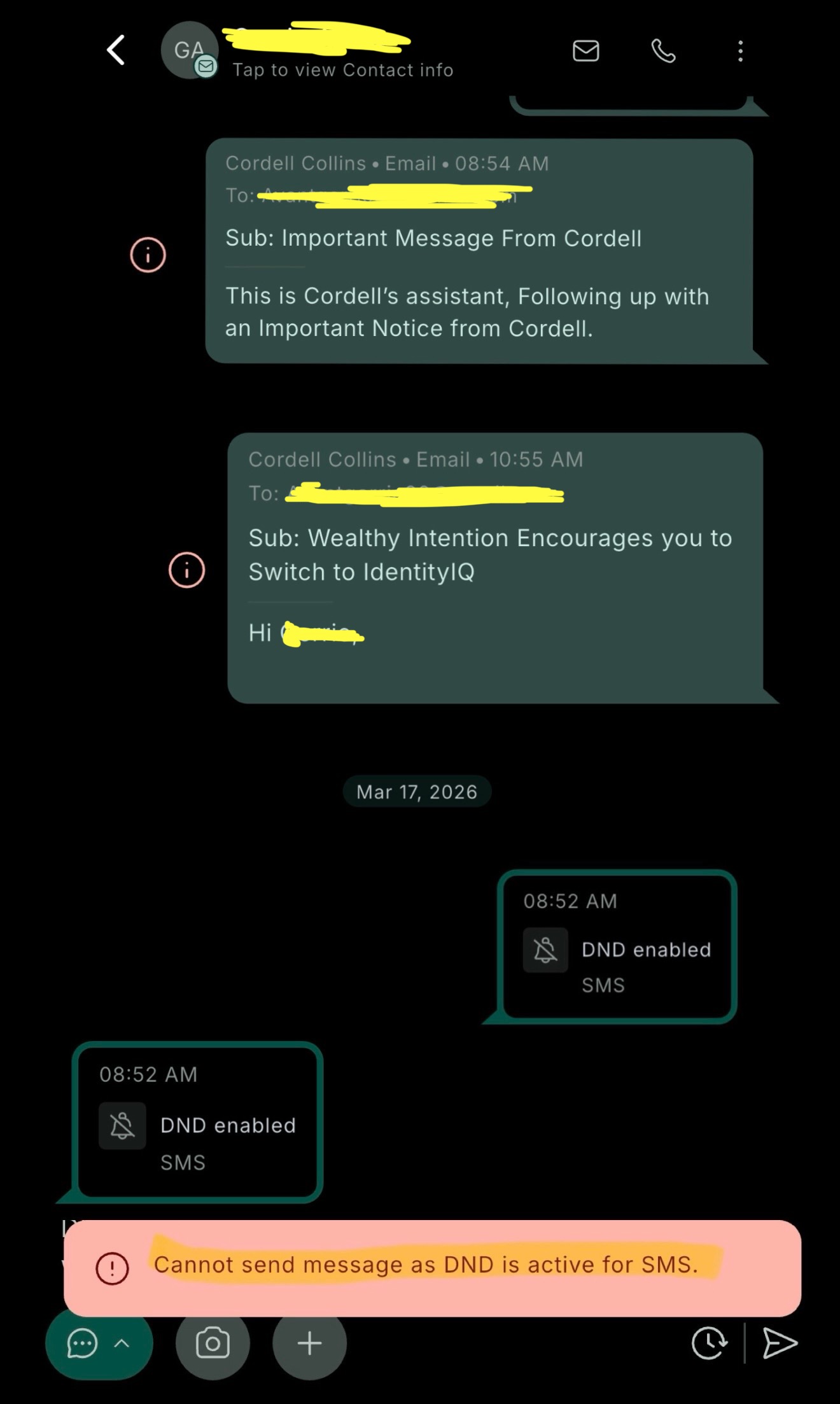
If you have already replied "STOP" to this number, please text a message back to 312-584-9969 to start back receiving updates & notifications via email & text.
If you ever get a new number or prefer us to send messages to a different number, please notify us at support@wealthyintention.org with your First & Last Name and new number so we can update your contact information in our system to avoid any interruptions in service. This also applies for a new email.
EMAIL Notifications & Storage
It is impossible to call/text 400+ people everyday so most of our communication will be through via email. To ensure you receive all important updates regarding your account, please add our emails support@wealthyintention.org & wealthyintentionllc@gmail.com to your contacts and mark it as a priority or VIP sender in your email settings.
📱 How To Add As VIP (iPhone/Apple Mail):
- Open your Mail app → go to your Mailboxes screen
- Tap VIP in the list
- Tap Add VIP
- Search for and select support@wealthyintention.org
- Repeat for wealthyintentionllc@gmail.com
This will help prevent our messages from being sent to your spam or promotions folder and ensure you receive all updates, dispute results, and important notifications in a timely manner.
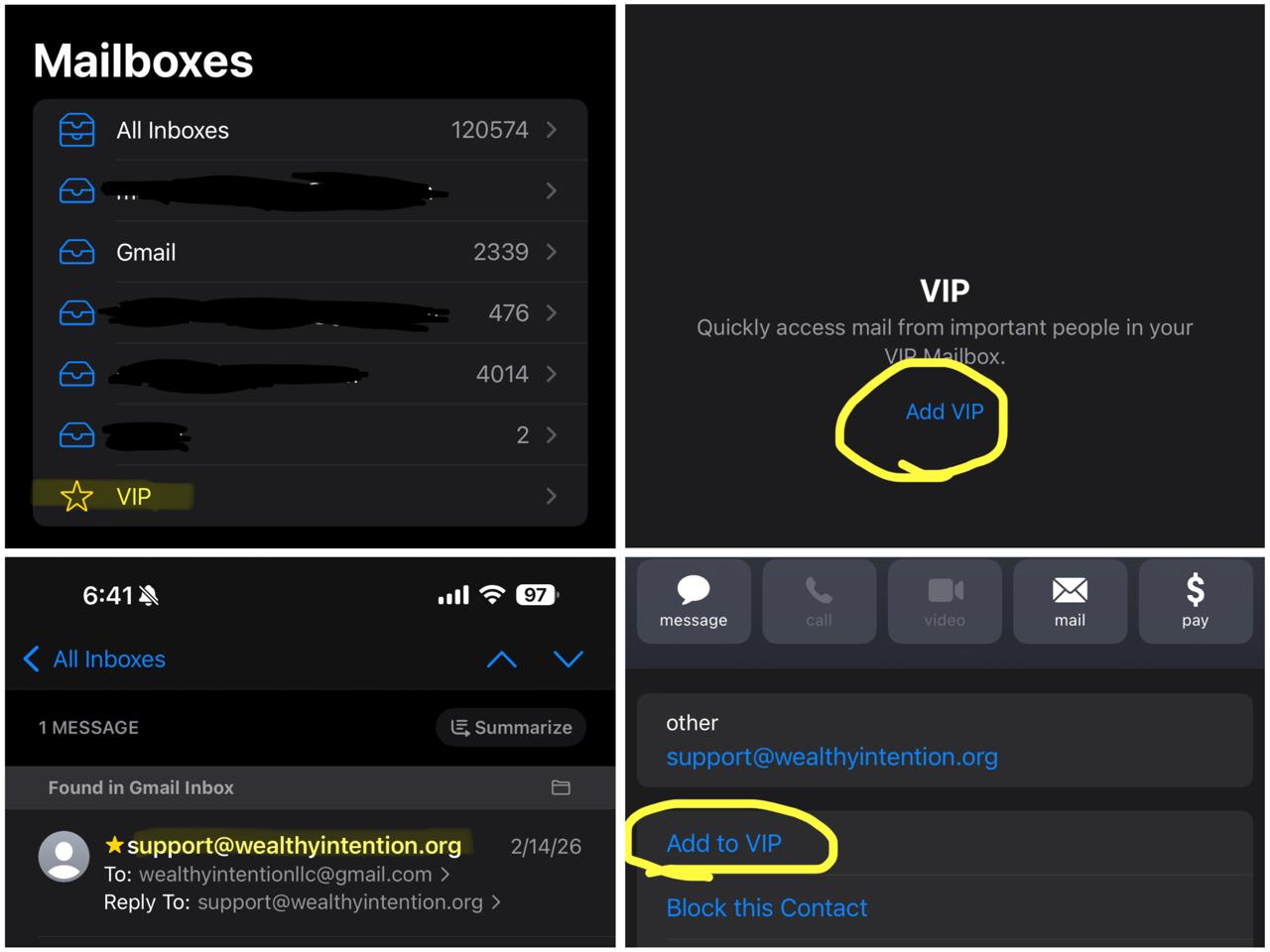
Just to be on the safe side — be sure to check your emails & spam weekly if not daily.
It is just as important to make sure that your email storage isn't full. This will prevent us from being able to email you and it will also prevent you from being able to email us. I don't want a situation where both parties are doing their part but the emails aren't going through.
⚠️ Recipient Inbox Full Error:
If you or we receive a "Recipient inbox full — your message couldn't be delivered" error, it means your email storage is maxed out. Please immediately clean up your inbox or purchase more storage to ensure communication isn't disrupted.

If you ever get a new email or prefer us to send notifications to a different email please notify us at 312-584-9969 with your First & Last Name and new email. This also applies for new phone numbers.
Login Credentials
MAKE SURE YOUR PASSWORD IS Credit@2025
with a Captial “C” if that is not your password please change it.
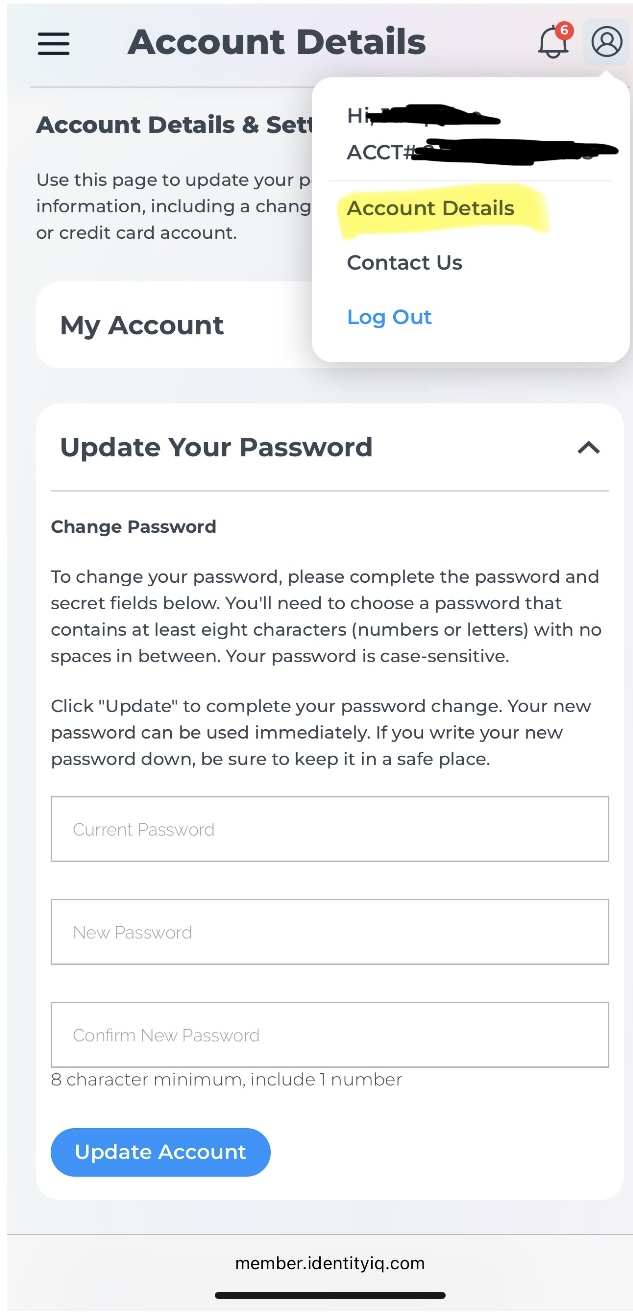
If you can’t use Credit@2025, add a period at the end so Credit@2025.
If That Doesn’t Work Please Use Credit@2025!
Please Do Not Make Your Own Password. It Makes Our Jobs A lot easier when we can have all clients have the same password. If none of these passwords work out please text our support number to see what password we recommend.
Monday - Friday
7AM - 6PM CST
Saturdays
8:30AM - 5PM CST
Sunday
Closed
IdentityIQ Customer Service. (877) 875-4347
Please Be sure to text 312-584-9969 with your first and last name and the new password after you have change it.
Credit Monitoring Payment Issue
Just to have a clear understanding, yes the fee you paid me directly covers the work I perform on your credit profile. However, in order to do that, we must have access to all three credit reports and scores. This requires a separate credit monitoring service, which comes with a monthly fee — and that fee was disclosed to you during the sign-up process before you got started.
This platform is used to:
Monitor your credit, View your full credit report, Assist in generating dispute activity, Compare and contrast previous reports, Contact creditors on your behalf, and Identify inaccuracies on your credit report.
That said, please understand that there is absolutely NO WAY for me, you, or anyone else to work on your credit without having access to your credit reports.
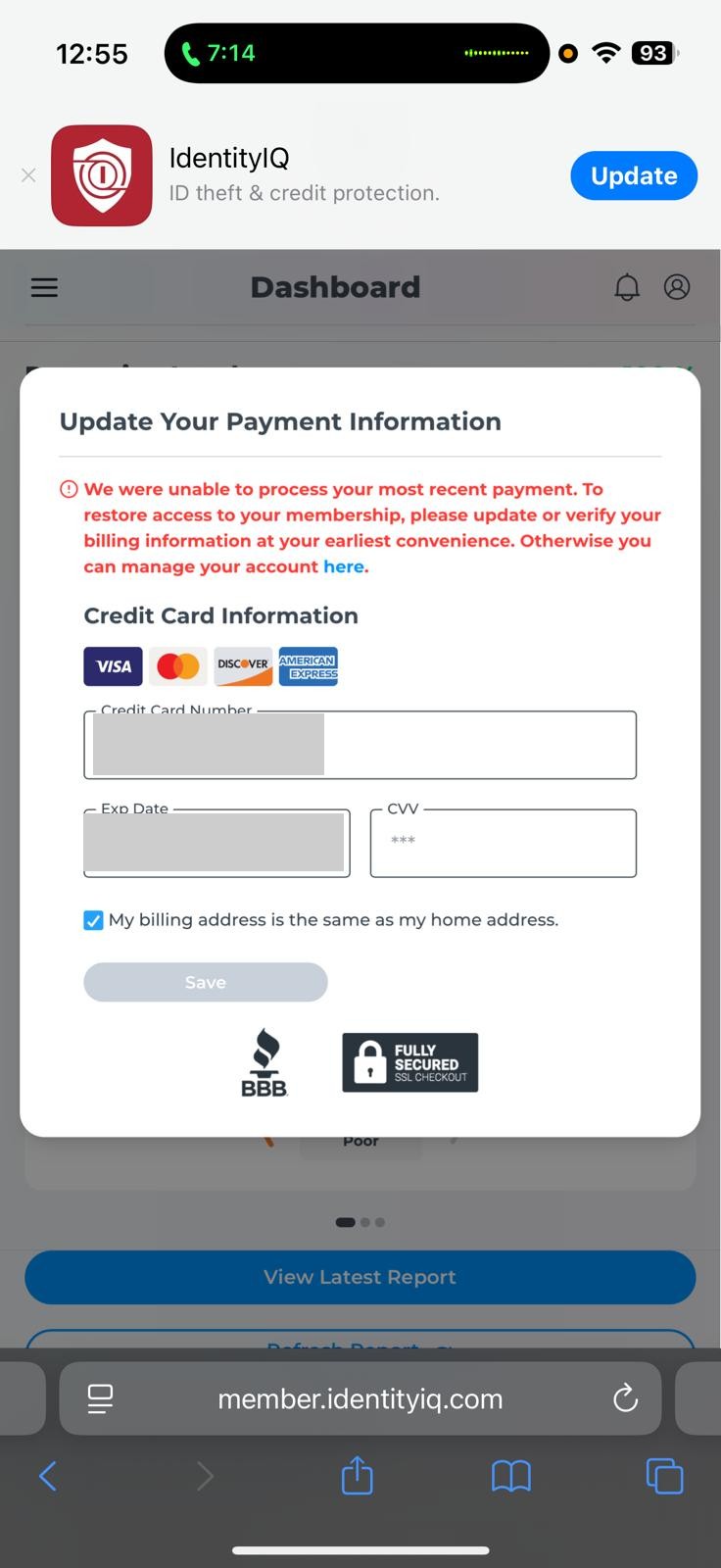
If we can't access the report we can't see what information has been deleted or updated.
If we can’t see what information has been deleted or updated, we can’t provide you with a Valid Update.
We also can't contact the creditors & debt collectors about your negative/ inaccurate accounts on your profile.
If we can’t contact the creditors, we can’t prepare our dispute letters for your next round.
If we can’t prepare our dispute letters, we can’t dispute any remaining items.
If we can’t dispute any remaining items we can’t continue services. We can’t do ANYTHING.
Please understand that if you fall behind on this, that DOES NOT MEAN you don't have any results. I just can't tell you what's going on with your status or continue services if I cannot access your credit report.
So if we try to log into your credit report and can't access it due to missing payments, it will prolong the process for you. And that would be 100% your fault.
For security and privacy reasons, we do not have access to your card information and will never request it from you. Therefore, we are unable to complete this small step on your behalf.
Step 1. Every 40 days I want you to go to the website for your credit monitoring account — NOT THE APP.
Log into your report and the same message should appear. If it does, please pay your subscription at your earliest convenience.
Step 2. Notify us with your first & last name at 312-584-9969 that your account is back active. ( Remember just because you make a payment do not always mean your report will automatically update, sometimes you have to manually refresh the report )
If it has been more than 45 days since your last PDF update, you shall receive one within 4 business days from notifying us.
Monday - Friday
7AM - 6PM CST
Saturdays
8:30AM - 5PM CST
Sunday
Closed
IdentityIQ Customer Service. (877) 875-4347
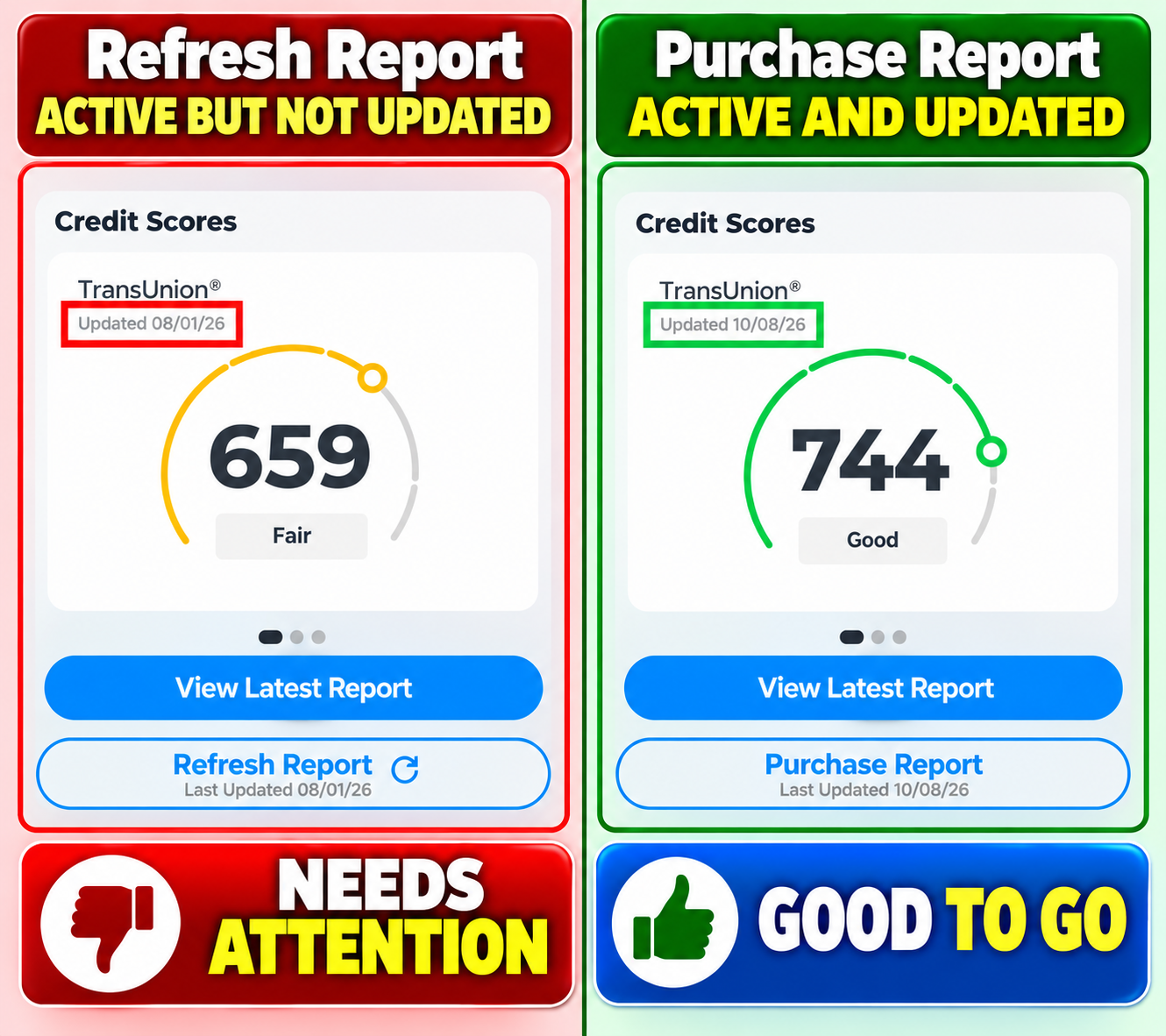
Before responding with “ I have already completed this” please take a moment to verify first: Log directly into your credit monitoring account to confirm the report is ACTIVE AND UPDATED. If you are correct, we apologize for the mistake and all you have to do is send us a screenshot of the scores on your dashboard. If it doesn’t say REFRESH REPORT. You are good to go.
If you fail to reactivate your account., Your Dispute Process Is Paused For Inactivity IMMEDIATELY. After 60 Days of inactivity, You Will Be Placed On Our Inactive Client Roster And YOU WILL HAVE TO PAY A $300 Re-Activation Fee TO GET BACK STARTED. Please note that multiple reminders are sent via email and text before a profile becomes inactive. When no action is taken after repeated contact attempts, it creates workflow and scheduling challenges for our team and backend systems.
Credit Monitoring Reactivation Notice
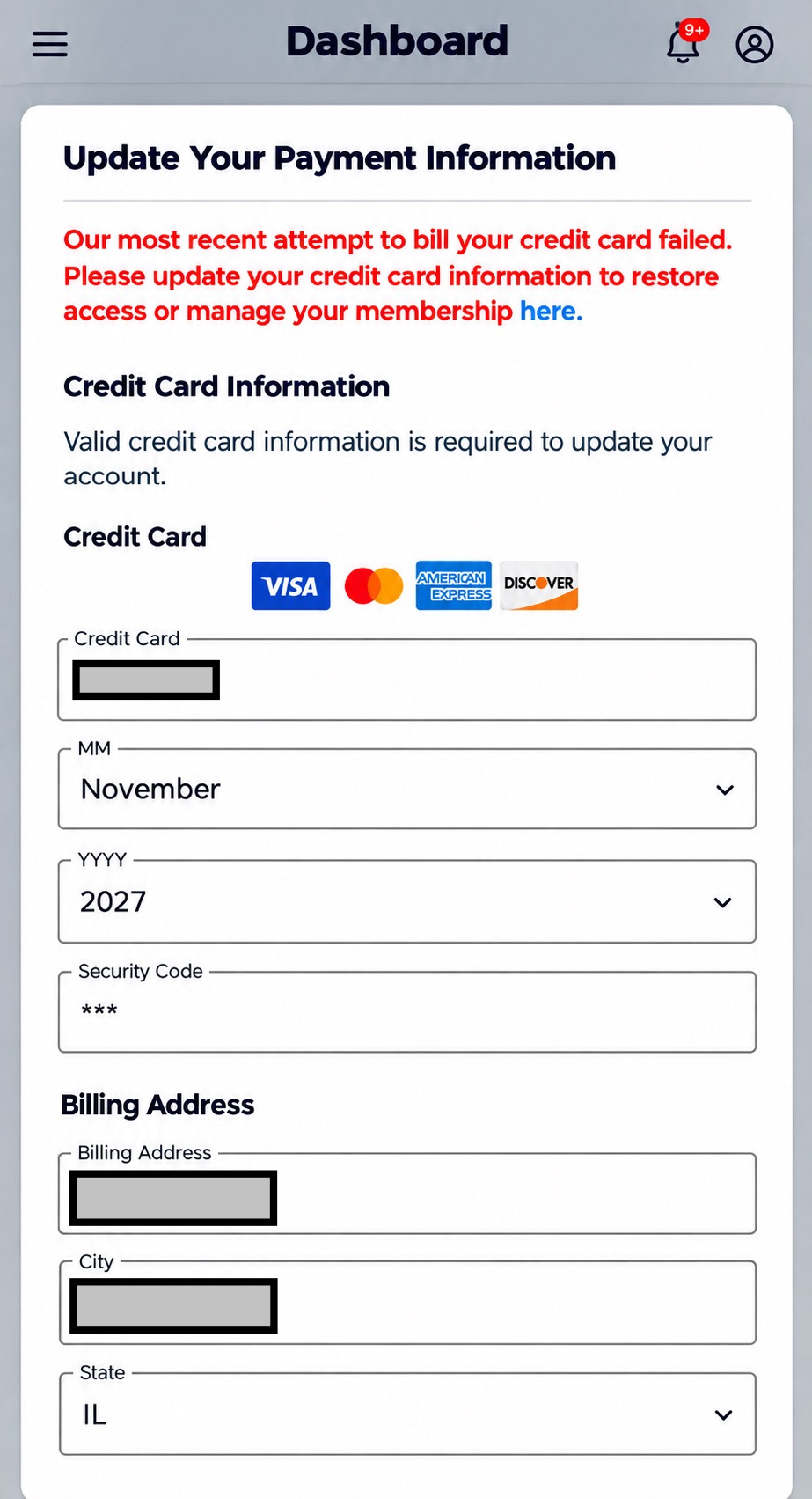
From time to time, your credit monitoring account may require reactivation for security purposes. Please understand that this DOES NOT necessarily indicate a missed or incomplete monthly payment. In most cases, it simply means that you need to verify the payment method on file, which may include re-entering your card’s CVV code.
When this occurs, it temporarily delays our ability to access your credit report, which can delay the progress of your file.
Please note that if your account is not ACTIVE. Meaning you have previously missed a payment. The system WILL CHARGE YOU. For security and privacy reasons, we do not have access to your card information and will never request it from you. Therefore, we are unable to complete this small step on your behalf.
To resolve the issue, please log into your account, confirm your payment method, and complete any required verification steps. Once this has been completed, you must notify us at 312-584-9969 so we can resume work on your profile. Please be advised that we will not continue to follow up on this issue without confirmation from you that it has been resolved.
Monday - Friday
7AM - 6PM CST
Saturdays
8:30AM - 5PM CST
Sunday
Closed
IdentityIQ Customer Service. (877) 875-4347
Before responding with “ I have already completed this” please take a moment to verify first: Log directly into your credit monitoring account to confirm the report is ACTIVE AND UPDATED. If you are correct, we apologize for the mistake and all you have to do is send us a screenshot of the scores on your dashboard. If it doesn’t say REFRESH REPORT. You are good to go.
If you fail to reactivate your account., Your Dispute Process Is Paused For Inactivity IMMEDIATELY. After 60 Days of inactivity, You Will Be Placed On Our Inactive Client Roster And YOU WILL HAVE TO PAY A $300 Re-Activation Fee TO GET BACK STARTED. Please note that multiple reminders are sent via email and text before a profile becomes inactive. When no action is taken after repeated contact attempts, it creates workflow and scheduling challenges for our team and backend systems.
Credit Monitoring Outdated
It Is Extremely Important That You Understand The Difference Between ACTIVE & UPDATED
● ACTIVE means you have successfully paid the $33 fee for your credit monitoring ( just because your card was charged doesn't mean your report will automatically update )
● UPDATED means you actually ordered a new report. ( Every month you get a new one but they do not always update automatically, sometimes you have to manually refresh the report )
BOTH OF THESE MUST BE DONE IN ORDER FOR US TO GIVE YOU AN UPDATE. Your Credit Report Should NEVER Be More Than 40 Days Old. If it is then that means you haven't logged into your credit report to update it.
Whenever a report is not updated, it temporarily delays our ability to give you a valid update. I can’t tell you what’s going on in October if I’m looking at a report from August. I also cannot start on the next round due to this. Which delays the progress of your file.
Please note that whenever you click REFRESH REPORT. If your account is not ACTIVE. Meaning you have previously missed a payment. The system WILL CHARGE YOU. For security and privacy reasons, we do not have access to your card information and will never request it from you. Therefore, we are unable to complete this small step on your behalf. You will only be reminded 3 times about this.... So I Am Telling You Now To Set Monthly Reminders In Your Calendar.
Step 1:
● Every 40 Days go to the WEBSITE, NOT THE APP & physically LOG IN to refresh the report if you see it is outdated.
● If your report isn't already showing the current month, click on REFRESH REPORT.
Step 2: Notify Us At With Your First & Last Name 312-584-9969 That Your Report Has Been Updated. If it has already been more than 45 days since your last PDF Update You shall receive one within the next 4 Business Days From Notifying Us.
Monday - Friday
7AM - 6PM CST
Saturdays
8:30AM - 5PM CST
Sunday
Closed
IdentityIQ Customer Service. (877) 875-4347
Before responding with “ I have already completed this” please take a moment to verify first: Log directly into your credit monitoring account to confirm the report is ACTIVE AND UPDATED. If you are correct, we apologize for the mistake and all you have to do is send us a screenshot of the scores on your dashboard. If it doesn’t say REFRESH REPORT. You are good to go.
If you fail to refresh your report, Your Dispute Process Is Paused For Inactivity IMMEDIATELY. After 60 Days of inactivity, You Will Be Placed On Our Inactive Client Roster And YOU WILL HAVE TO PAY A $300 Re-Activation Fee TO GET BACK STARTED. Please note that multiple reminders are sent via email and text before a profile becomes inactive. When no action is taken after repeated contact attempts, it creates workflow and scheduling challenges for our team and backend systems.
Password Change Required
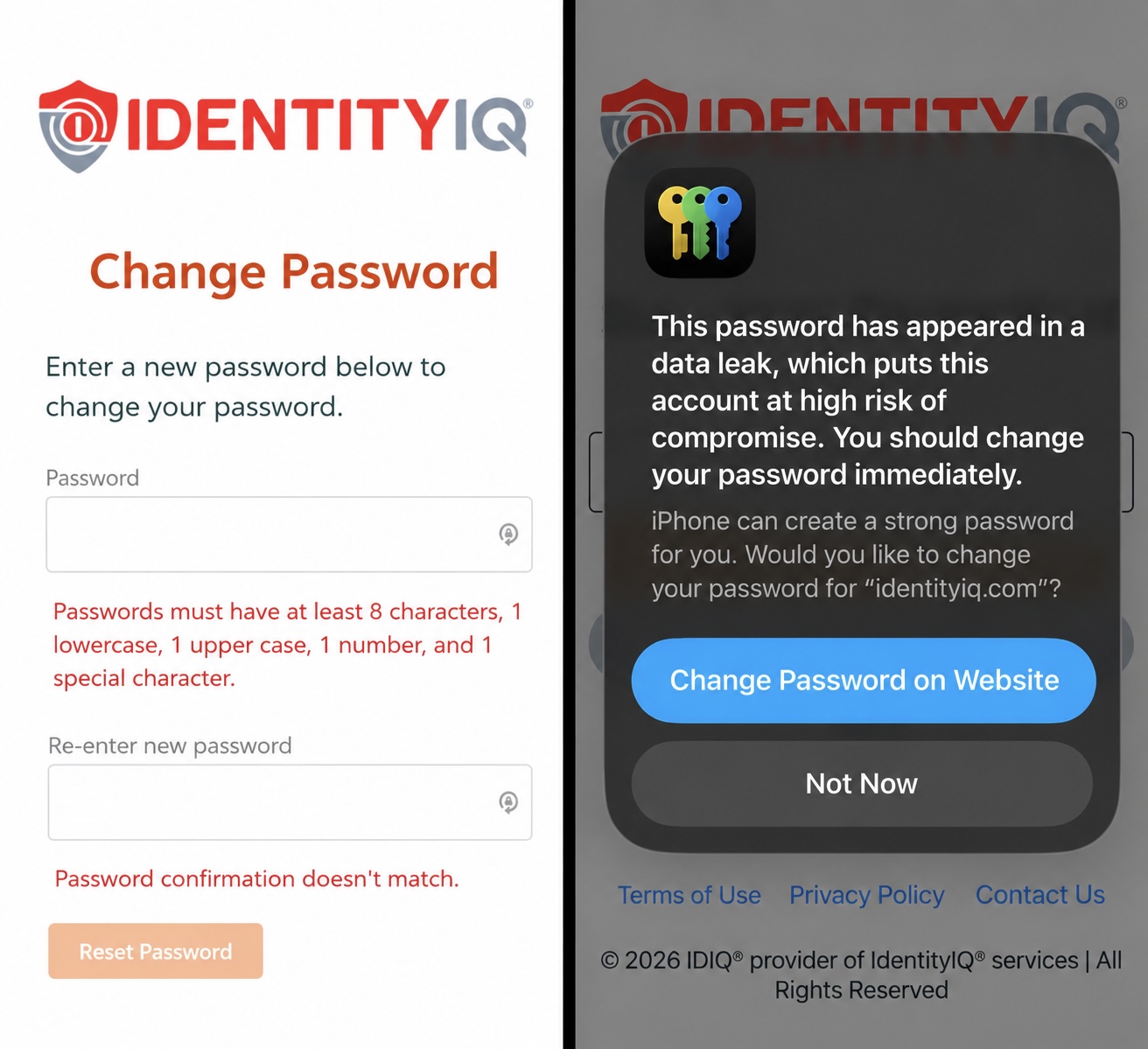
This happens every so often for security purposes. These notifications should never be ignored. If you receive an email or text message regarding any of the items above, it is not sent without cause and is not a system error.
Step 1: Actually log into your account to confirm if the same issue pops up for you. If not send a screenshot to our support team of you being logged into the credit report.
Step 2: If the issue also shows for you, Please Do Not Make Your Own Password. MAKE SURE YOUR PASSWORD IS Credit@2025 with a Captial “C” if that is not your password please change
Just enter your email to receive the reset password link. Once received Enter the same exact password Credit@2025 with a Capital "C" if you can't use the same password add a period at the end so Credit@2025. If That Doesn't Work Please Use Credit@2025! If none of these passwords work out please text our support number to see what password we recommend.
Step 3: After Updating The Password, physically log into your account to make sure the password works.
Step 4: Once completed Please text (312) 584-9969 with your first and last name and the new password to notify us that your account is back active. We will no longer check on this for you until notified.
Monday - Friday
7AM - 6PM CST
Saturdays
8:30AM - 5PM CST
Sunday
Closed
IdentityIQ Customer Service. (877) 875-4347
Before responding with “ I have already completed this” please take a moment to verify first: Log directly into your credit monitoring account to confirm the report is ACTIVE AND UPDATED. If you are correct, we apologize for the mistake and all you have to do is send us a screenshot of the scores on your dashboard. If it doesn’t say REFRESH REPORT. You are good to go.
Adding/ Removing Fraud Alerts 🚨
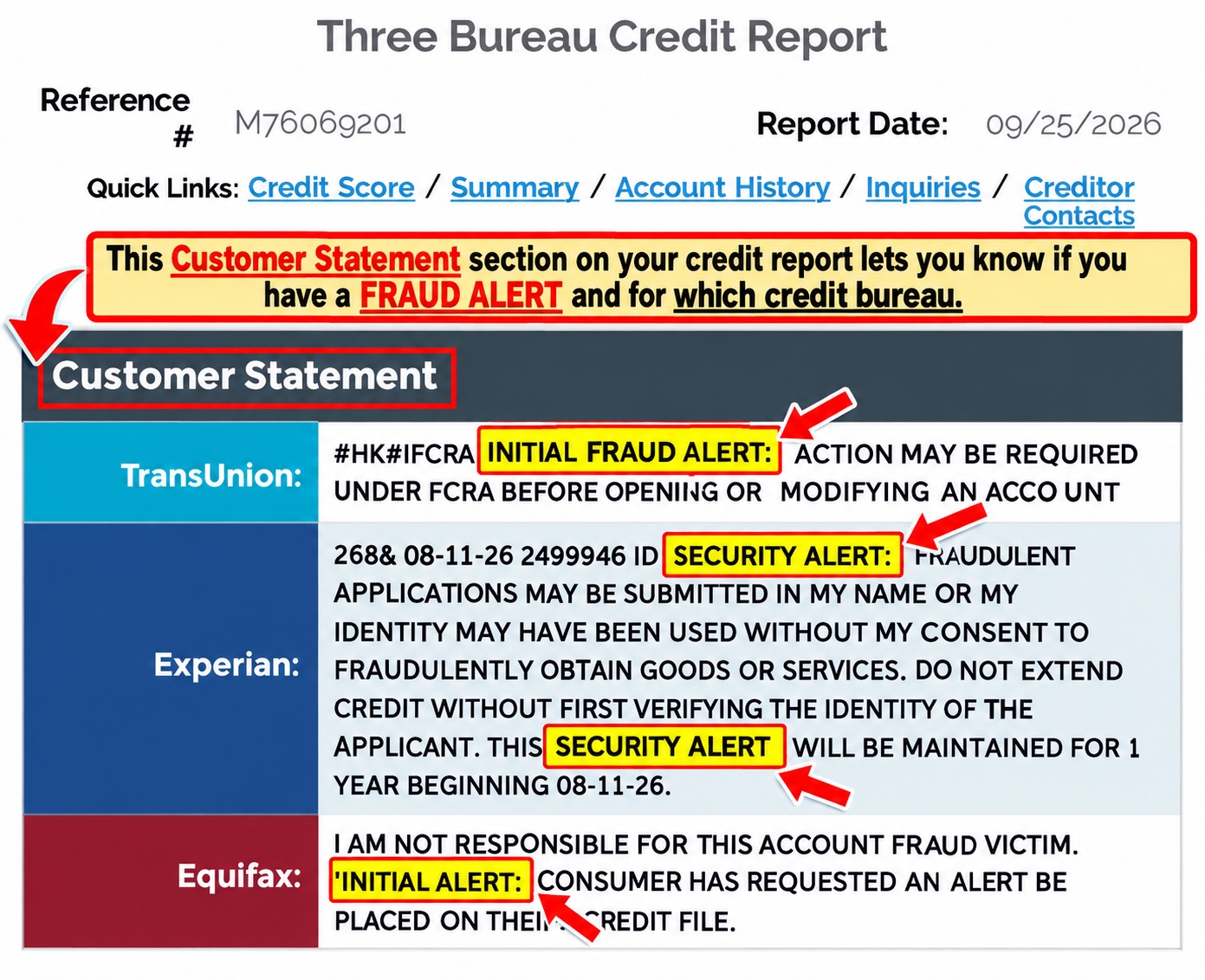
No worries a fraud alert is NOT A BAD THING. It is a free safety tool that helps protect you from identity theft.
A fraud alert is a notice placed on your credit reports that tells lenders and creditors to take extra steps to verify your identity before approving new credit in your name. That extra step is usually to text, call or email you for confirmation before actually running your credit.
Although this is a safe way to protect yourself from identity theft—having an active fraud alert can delay the process because a fraud alert is a strict security feature. The credit bureaus will not process any changes, updates, or actions on your credit report while it remains active and we do not want that.
To resolve this, our team has already sent a request letter to the bureaus on your behalf to remove the fraud alert. However, waiting for the bureaus to process mailed requests can take some time and we do not want to depend on them removing the alerts. To expedite the process, we highly recommend that you call the three credit bureaus directly to request the removal or deactivation of the alert.
Please note that you can do this online. Calling them is completely optional, but doing it over the phone bypasses mail processing times so we can resume work on your credit report much faster.
If you choose to call them, you can reach the fraud divisions at the following numbers:
📞 Equifax: 1-800-525-6285
📞 Experian: 1-888-397-3742
📞 TransUnion: 1-800-680-7289
If you choose to do it online here are the exact links:
Once you have the alerts deactivated, please let us know as soon as it is completed so we can immediately continue working on your file. Once we’re done working on your profile, feel free to add them back if you like.
Thank you for your cooperation!
Canceling Your Credit Monitoring Service
If you choose not to continue your monthly credit monitoring subscription, that is entirely your right. However, please understand that active credit monitoring is required for us to access your credit reports and continue working on your profile.
Once monitoring is canceled, your file is automatically paused. Due to the cancellation we will no longer be able to provide round results or perform any additional work on your account. This does not mean that no results exist — it simply means we no longer have access to your credit reports to review or communicate updates.
After 60 days of inactivity, you will be removed from our active client roster & the credit repair process is terminated. Any work completed up to that point will be considered final. No refunds will be issued, as services were rendered and further progress was prevented by the client. This policy is clearly disclosed in our refund policy, and every client was acknowledged about the $33 monthly fee when they completed the onboarding form.
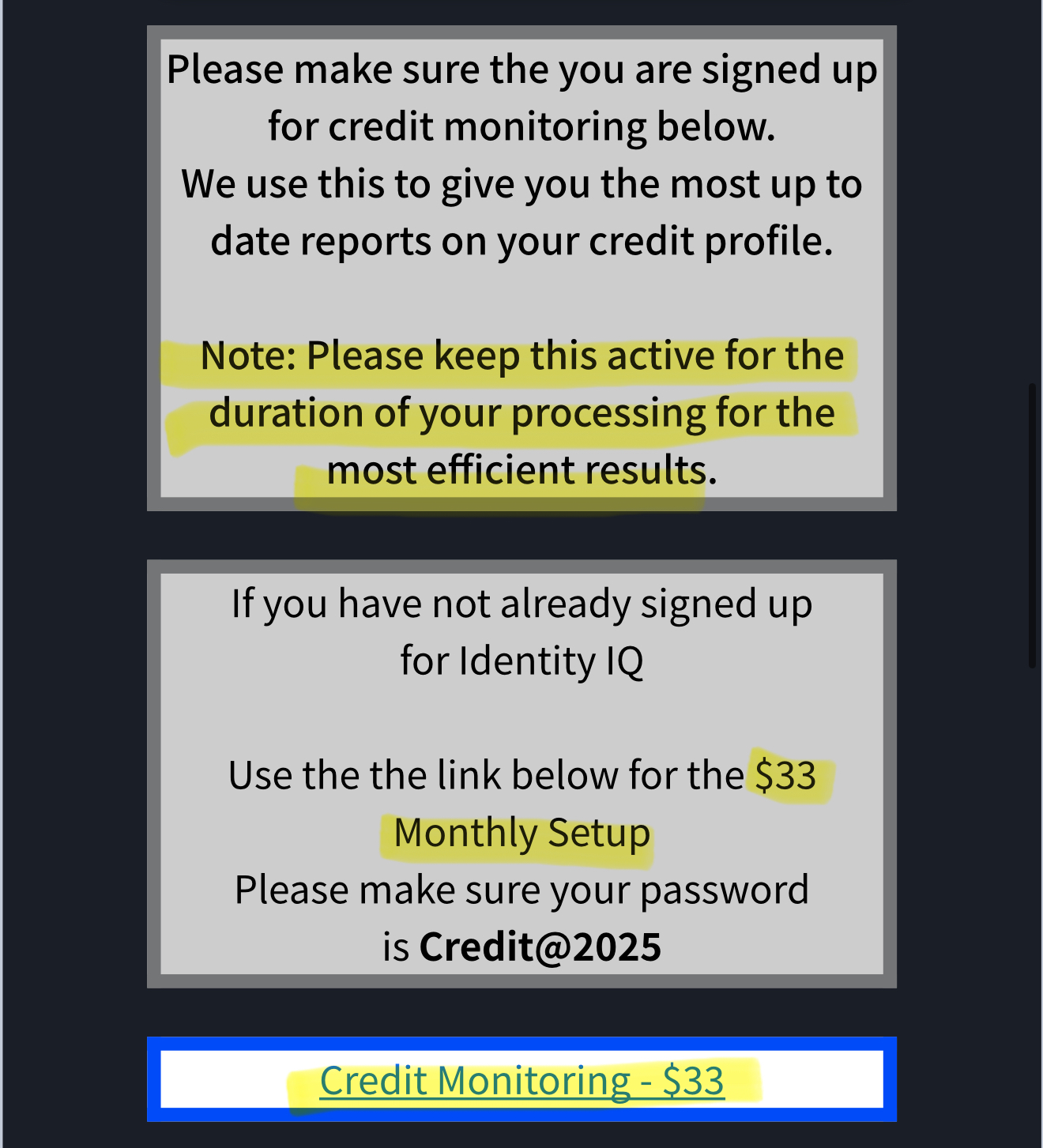
Please do not dispute the charge with your bank, request a chargeback against the credit monitoring company, or have your bank block the credit monitoring company from being able to charge your card.
When this happens it creates financial penalties for the provider. That company already deposited that money into THEIR BANK ACCOUNT. When u DISPUTE it, now that money is being taken away from that company for fees you LEGALLY AGREED TO. BY LAW now that company can come after you. Chargebacks may also expose you to potential collection activity.
If you wish to cancel properly, please follow these steps instead:
Log into your mobile app or contact the credit monitoring company’s customer service directly to cancel your subscription.
Text 312-584-9969 and let us know you no longer want to move forward.
Thank you for your cooperation and understanding.
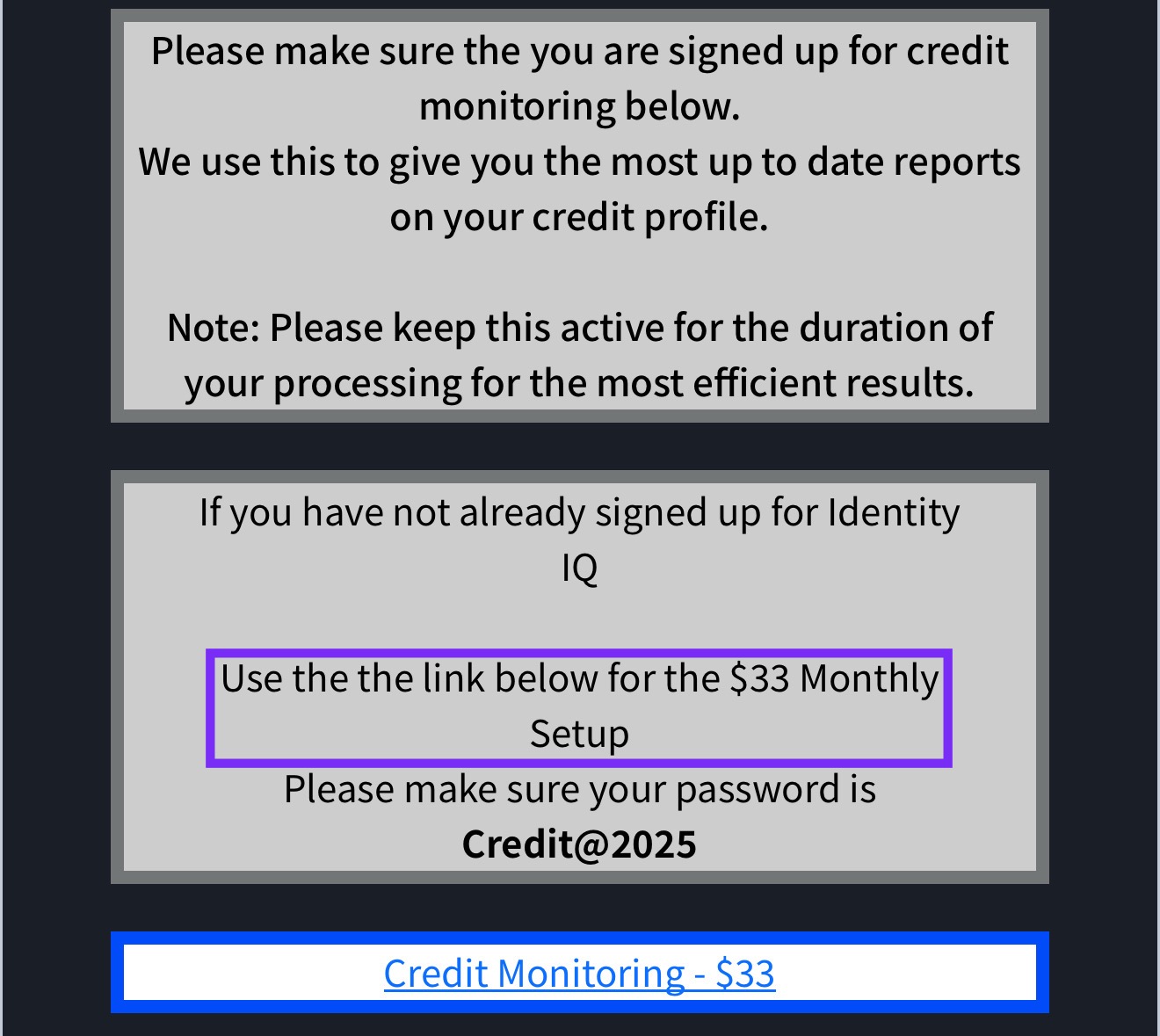
PLEASE READ SCREENSHOT BEFORE CLICKING THIS LINK!
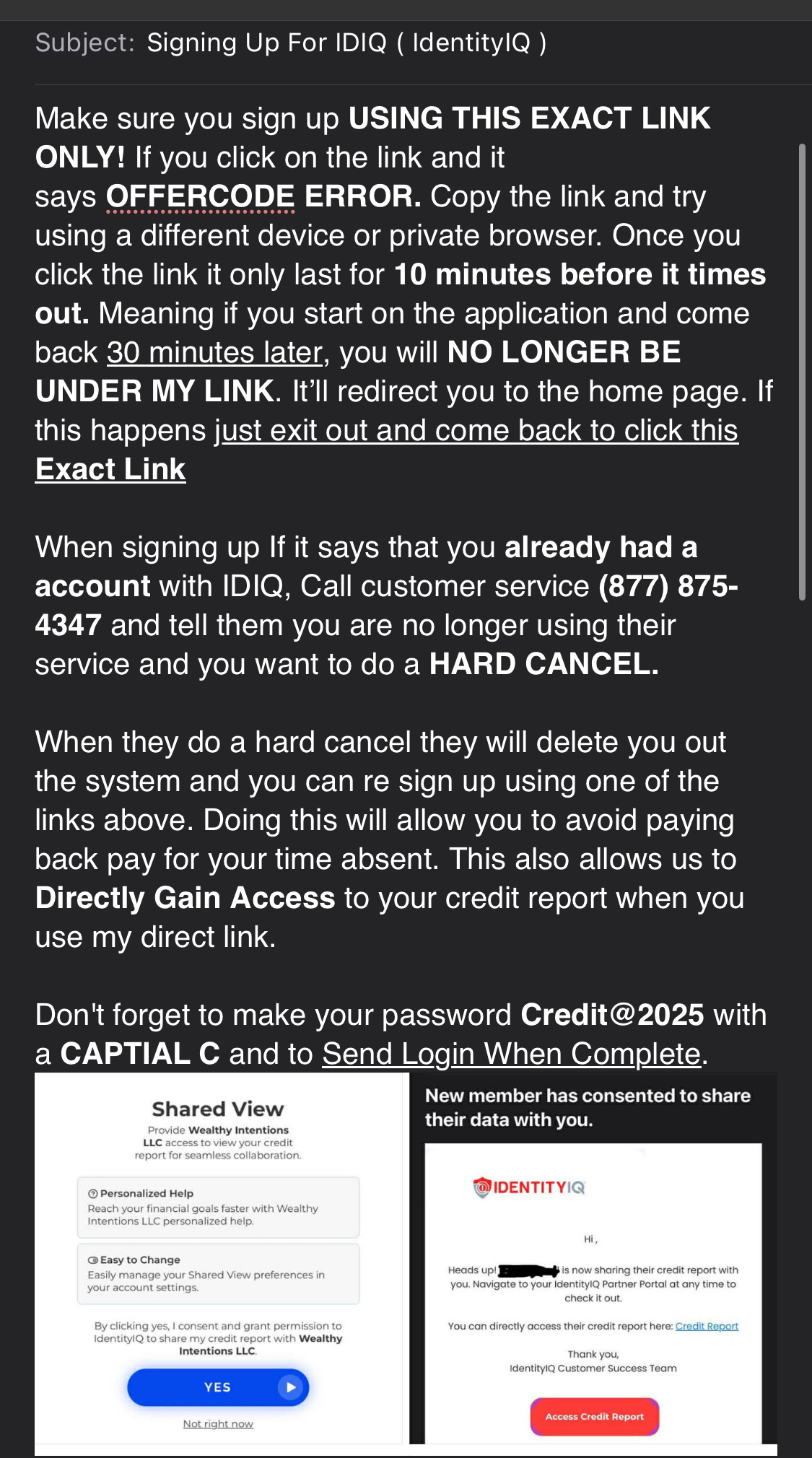
Sign Up Here:
https://member.identityiq.com/creditpreferred.aspx?offercode=431297LA
Please make your Password: Credit@2025 (capital C)
Send Login When Complete
Expired Driver's License Or State ID
This Is Pretty Self Explanatory
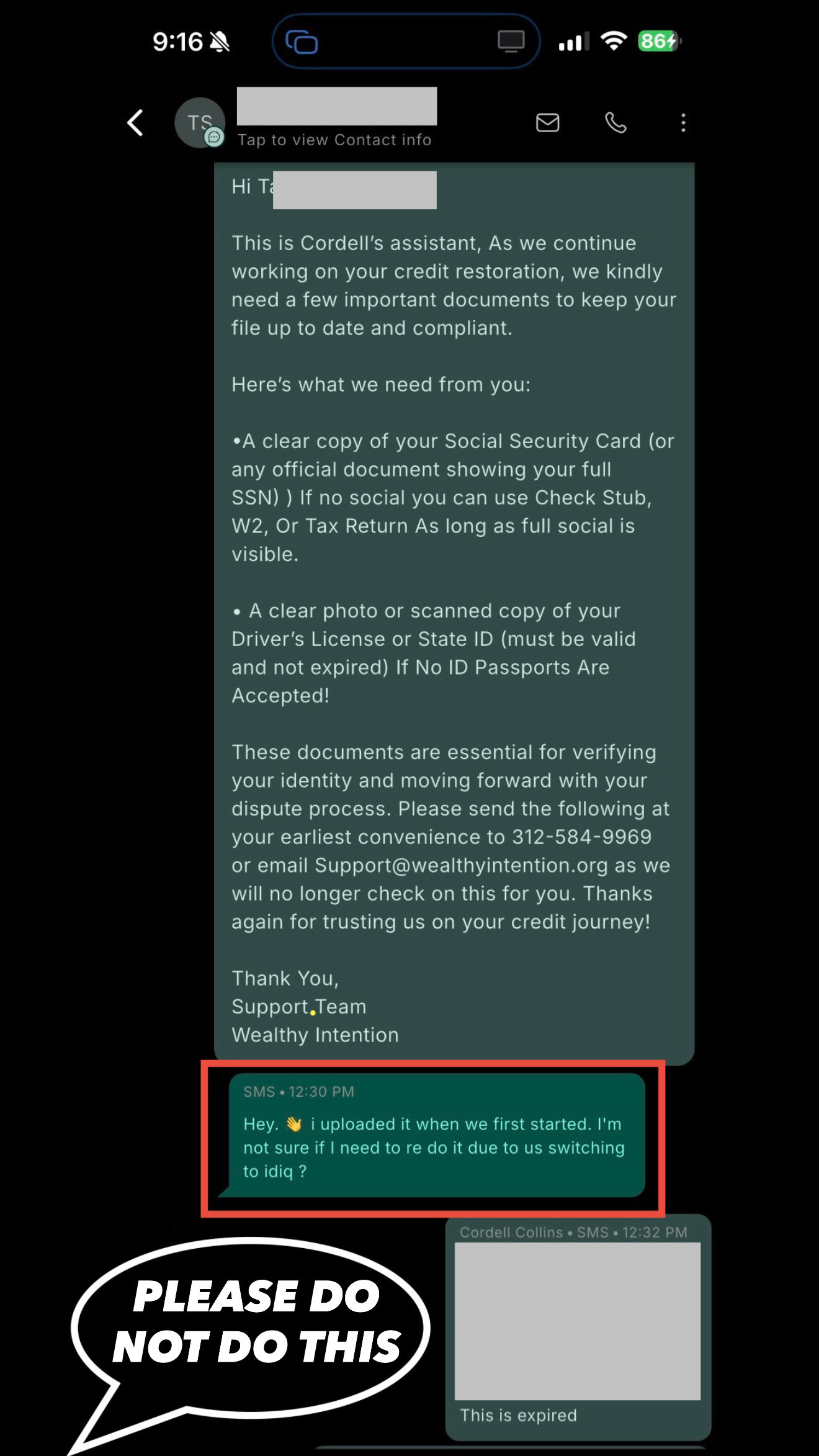
Please understand that every time dispute letters are sent, we must verify your identity. Which means that your Driver's License Or State ID along with your MOST RECENT Proof of Address is required for every round. If your ID or License were to ever expire, my support team will request an updated version and if it is not provided, I cannot proceed with the next round of disputes.
Here's what we need from you:
- A clear photo or scanned copy of your Driver's License or State ID (must be valid and not expired). If No ID, Passports Are Accepted!
- A clear copy of your Social Security Card (or any official document showing your full SSN). If no Social Security card, you can use a Check Stub, W2, Or Tax Return as long as the full Social is visible.
Please upload in your client portal or send the following at your earliest convenience to 312-584-9969 or email Support@wealthyintention.org as we will no longer check on this for you until notified. Thanks again for trusting us on your credit journey!
If you receive an email or text message regarding an issue, it is not sent without cause and is not a system error.
In most cases, either:
- Our team was not notified that the issue has been handled, or
- The issue has resurfaced and requires immediate attention
- The login information provided is invalid
- The submitted documentation is outdated or invalid
That said — these notifications should NEVER be ignored.
Before responding with "I've already completed this," please take a moment to verify first, and provide a screenshot as proof if you believe the issue has already been resolved.
Confirm all documents are clear, dates are accurate, and all submitted documents are up to date.
Thank You,
Support Team — Wealthy Intention
Frequently Asked Questions
Common questions about the credit repair process and what to expect
Different Websites And Logins
Just so There is no confusion about the Websites and logins. Understand that are only 3 websites and logins.
1. Credit Monitoring Platform (Required)
When you first got started with our program you enrolled into a credit monitoring services: ( which is called IdentityIQ ( IDIQ )
If you have not already enrolled SIGN UP HERE:
https://member.identityiq.com/creditpreferred.aspx?offercode=431297LA
Login Here: • IdentityIQ – https://member.identityiq.com/
This platform is used to:
• Monitor your credit
• View your full credit report
• Assist in generating dispute activity
Password Requirement:
Please set your password to: Credit@2025
________________________________________
2. Client Education & Resource Hub
The second platform is TheCreditDaddy.com
This website is used for:
Frequently Asked Questions (FAQs) Education & Training Booking Link With Financial Advisor Rules & Expectations Client To-Do List
24 Hour Support Chat
Booking 1 On 1s With Cordell
Refer A Friend
Suggestion Box
Available Resources
Important Things That Can Hold You Back
All of this information can be found under the “Active Client” tab.
Access Password: Credit123!
_________________________________________
3. Client Portal (Scorexer)
The final platform is your personal client portal: ( also Available on a app called Credit Tracking )
Scorexer – https://ceoacademy.scorexer.com/Portal/login.jsp
This portal is used for two primary purposes:
1. Track Your Progress
• Monitor dispute activity
• View updates on your account
2. Upload Important Documents
Upload Documents we request from you or that you feel like may help us with the process. Such as;
• Proof of Address (POA)
• Driver’s License / State ID / Passport
• Proof of payment for accounts in collections
• Identity theft documentation (e.g., police reports)
• Relevant screenshots, emails, or mailed letters, or correspondence letters
All of these should be uploaded into your Client Portal.
Important Notice:
You must sign the agreement after logging in before everything becomes available. Also If we are unable to access your credit monitoring account, we will not be able to update your progress within your client portal.
Password Setup:
You will receive a temporary password via email but may create your own password for this platform, as it serves as your personal and secure client portal.
Why Was I Charged Twice for Credit Monitoring?
PLEASE DO NOT CANCEL YOUR CREDIT MONITORING SUBSCRIPTION ! 🚨
If you believe you were charged more than once in the same month. In many cases, this happens because a previous monthly payment was missed, and the system is collecting a past-due balance.
EXAMPLE:
Let’s say you successfully paid your subscription for:
✅ May – PAID
✅ June – PAID
✅ July – PAID
✅ August – PAID
❌ September – MISSED PAYMENT
💳 October – PAYMENT MADE
You may assume that because you made a payment in October, your subscription is current.
HOWEVER, THAT MAY NOT BE THE CASE!
Your October payment may have been applied toward your MISSED SEPTEMBER PAYMENT, meaning your OCTOBER BALANCE IS STILL OWED. This is one possible explanation for why some clients may notice TWO CHARGES WITHIN THE SAME MONTH.
If you cancel your subscription, WE WILL NOT BE ABLE TO CONTINUE SERVICES OR PROVIDE YOU WITH UPDATES. This does NOT necessarily mean that no progress has been made on your credit profile. I just can’t tell you what’s going on with your credit if I can’t access your report. And obviously I cannot work on your credit if I can’t access your report.
If you believe you were charged incorrectly, PLEASE CONTACT IDENTITYIQ CUSTOMER SERVICE. They can review your billing history and determine whether a refund is appropriate.
NO WORRIES! WE HAVE ANOTHER OPTION.
If you’ve already canceled your subscription or accumulated multiple missed payments and would prefer to START FRESH INSTEAD OF PAYING THE PAST-DUE BALANCE, please follow the instructions below.
🚨 IMPORTANT: PLEASE READ THE ATTACHED SCREENSHOT BEFORE CLICKING THE LINK!
🔗 NEW IDENTITYIQ REGISTRATION LINK:
https://member.identityiq.com/creditpreferred.aspx?offercode=431297LA
🔐 PASSWORD INSTRUCTIONS:
When creating your account, please use the following password:
Credit@2025
⚠️ The “C” MUST be capitalized.
📲 FINAL STEP:
Once registration is complete, PLEASE SEND YOUR LOGIN INFORMATION to:
Phone: (877) 875-4347
Hours of Operation:
📅 Monday – Friday: 7:00 AM – 6:00 PM CST
📅 Saturday: 8:30 AM – 5:00 PM CST
📅 Sunday: CLOSED
If you fail to reactivate your account., Your Dispute Process Is Paused For Inactivity IMMEDIATELY. After 60 Days of inactivity, You Will Be Placed On Our Inactive Client Roster And YOU WILL HAVE TO PAY A $300 Re-Activation Fee TO GET BACK STARTED. When no action is taken after repeated contact attempts, it creates workflow and scheduling challenges for our team and backend systems.
Why Isn't My Credit Score Showing For All 3 Bureaus?
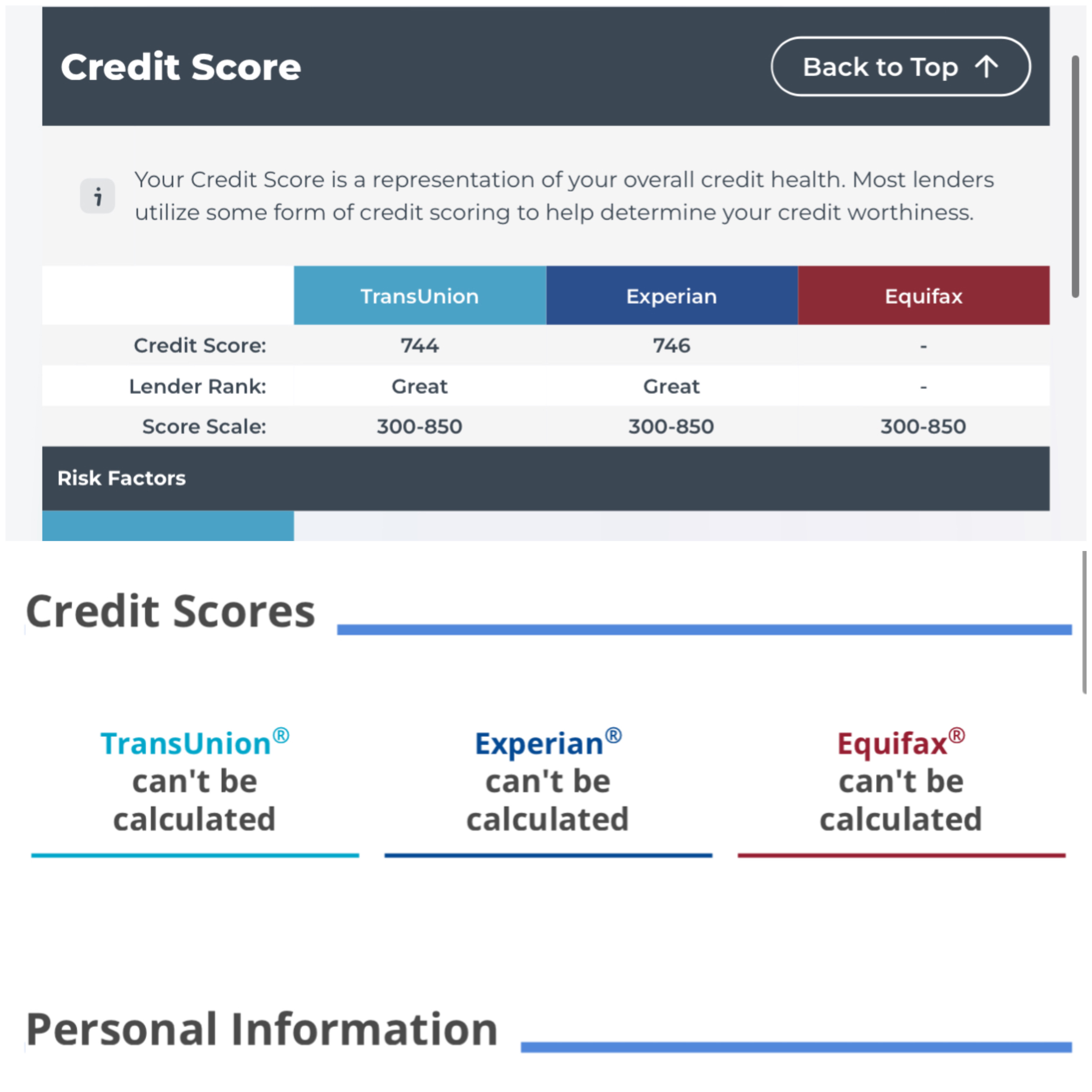
Usually this happens when an old address gets deleted. Your old accounts were attached to that address so now since no old or current accounts are attached to your current address there is nothing to show on your credit report. But no worries this is an easy fix.
Step 1: MFSN USERS ONLY
(888) 548-2008 (Press Option 2)
Call Customer Service to let them know about the issue. They may mention an old address that they had on file. You can let them know that address is incorrect and provide them with your current address. Once you verify your CURRENT ADDRESS they should be able to resolve it. If not, please view step 2.
Step 1: IDIQ USERS ONLY
(877) 875-4347 (Press Option 2)
Call Customer Service to let them know about the issue. They may mention an old address that they had on file. You can let them know that address is incorrect and provide them with your current address. Once you verify your CURRENT ADDRESS they should be able to resolve it. If not, please view step 2.
STEP 2: Call The Bureaus Directly
This step is FOR BOTH IDIQ & MFSN users BUT ONLY if step one didn't work.
You only need to call for whichever bureau is missing. So if your reports and scores aren't showing for both Equifax & Transunion, then you will call both and give them both the same exact rundown.
- Transunion: 800-916-8800
- Equifax: 800-685-1111
- Experian: 888-397-3742
Give them a call (Press 0 To Get To A Live Person):
"I sent some disputes for my credit and I received something that said I couldn't be verified."
Wait for a response and make sure to update all your information.
"I would like to remove any information that I did not mention due to it being inaccurate. My Only Name Is... My Only Address Is... My Only DOB Is..."
"Can we please get this fixed so that they can furnish my credit report because it's holding me back from getting approved from housing which is a violation of my consumer right."
Ask how long it will take before your credit report will show up. They may ask you to send them a "cover letter". Please make sure your State ID or Driver's License is updated with your current address BEFORE sending out this cover letter.
STEP 3: Cover Letter (only if asked to provide)
You only need to send a cover letter for whichever bureau is missing. If missing for two, send two separate letters.
Addresses:
- Equifax: P.O. Box 740256, Atlanta, GA 30374
- Experian: P.O. Box 4500, Allen, TX 75013
- TransUnion: P.O. Box 2000, Chester, PA 19016
Date: __________
To Whom It May Concern,
I am writing to verify my identity so that my [Bureau Name] credit report and score can be released and made available.
My information is as follows:
Full Name: __________________________
Date of Birth: ______________________
Last 4 of SSN: ______________________
Current Address: ___________________
City, State, Zip: ___________________
Phone Number: _____________________
I have enclosed copies of my government-issued photo ID and proof of address for verification. Please process my identity verification as soon as possible so my credit file can be properly displayed.
Sincerely,
________________________ (Signature)
________________________ (Printed Name)
Documents to Include (VERY IMPORTANT):
- ✅ Copy of Driver's license or state ID (cannot be expired)
- ✅ Proof of address (utility bill, bank statement, or lease — dated within 60 days)
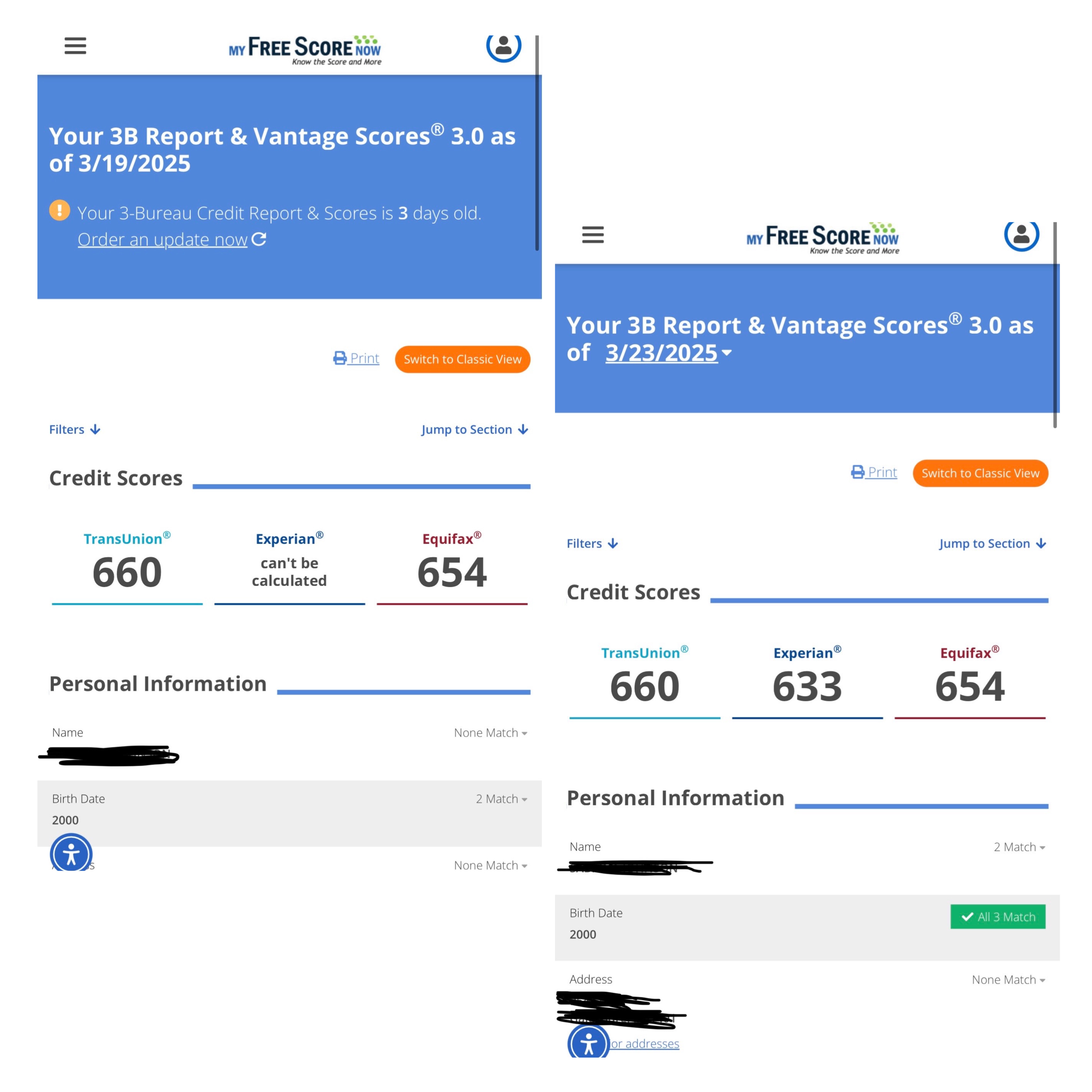
After you make the phone calls to customer service or send the cover letters, your credit reports and scores should reappear by your next credit report at the latest. Sometimes it will appear the next day.
What Is A Tradeline?
A credit tradeline is the industry term for an account included on your credit report. For example, when you have a credit card, auto loan, mortgage, or student loan, the lender generally reports information about that account to the credit bureaus. That reported account is considered a tradeline.
You may also hear about “authorized-user tradelines” or people “buying tradelines.” When people talk about purchasing access to someone else’s established credit-card history as an authorized user (AU).
A purchased tradeline is essentially renting someone else’s positive credit-card history by being temporarily added as an authorized user. Meaning you have ACCESS TO THAT ACCOUNT. But you are not the primary owner. This may help your SCORES, but it doesn’t replace building strong primary accounts in your own name.
Reasons For Buying Tradelines
- Not Enough Credit History
- Credit Limits Too Low
- Utilization Too High
- No Credibility At All
- Credit Scores too low to qualify for loans, credit cards, apartments etc.
Tradelines are entirely legal and often provide an effective tool for improving your credit scores with the credit bureaus. It is essential to exercise caution when considering tradelines, as identity theft protection should always be paramount in any financial decision making.
Tradelines on average will appear on your credit report within 3 weeks, and sometimes even faster, in as little as 7 to 11 days, but 30 Days at the most. This depends on many factors, including the date the AU is added, the reporting period of the tradeline. And when your actual credit report updates.
Remember there is a big difference between your Credit SCORE, Credit REPORT, & Credit PROFILE. A Credit Profile that Only has Tradelines is considered a WEAK PROFILE. The banks aren’t Stupid. They know when you have a Tradeline, it literally says AUTHORIZED USER. Yes It Helps with your SCORES, But NOT YOUR PROFILE. They still want to know what YOU HAVE DONE PERSONALLY.
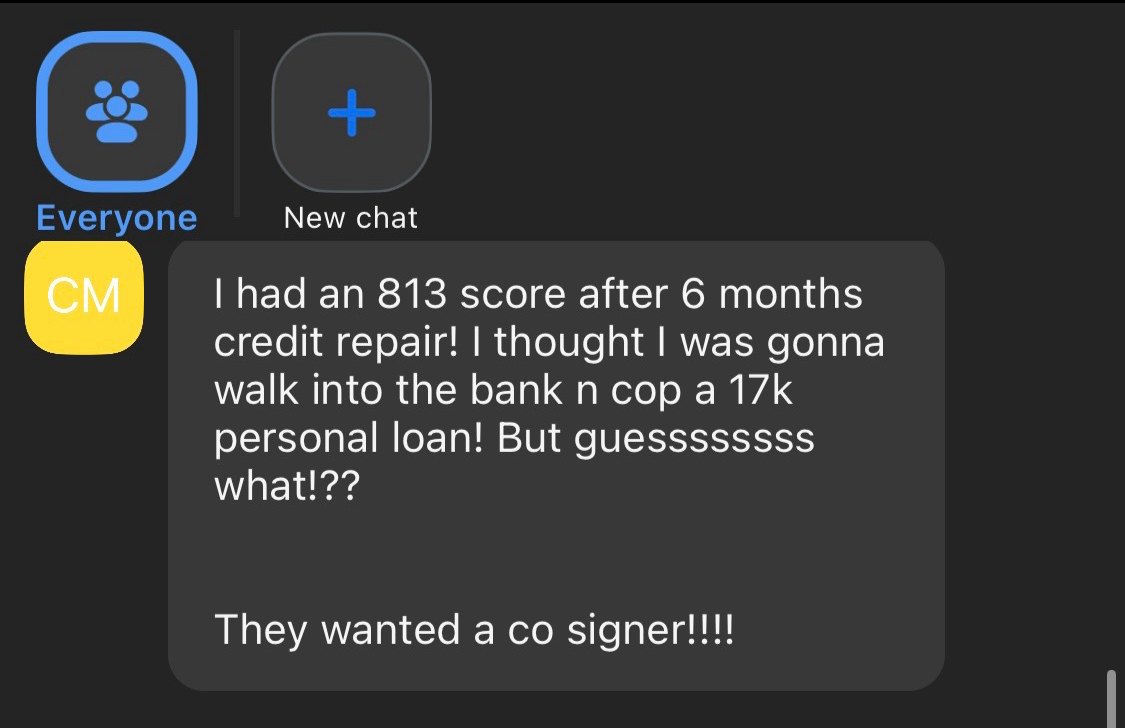
It’s never a bad idea to buy a Tradeline, but it’s not always necessary if you already have great payment history. The Recommended amount is 2 to 4. You don’t need to flood your report with Tradelines.
Understand you are the ONLY person that can boost Your Credit Score Permanently. However buying a Tradeline is the fastest way to do so temporarily. Tradelines can potentially increase your credit scores and you can see results within 2 to 3 Weeks.
Although it is ideal for a Tradeline to post to all three major bureaus (Experian, Equifax, and TransUnion). NOBODY can guarantee that a tradeline will post to all 3 credit bureaus EVERY SINGLE TIME. If they do they’re just saying that to make you feel comfortable enough to pay them. I will only Guarantee that your tradeline will post to at least one bureau of the three.
Tradelines usually last only 2 to 3 Months. So Unless You’re Ready To Apply For A House, Car, Apartment, Credit Card, Or Funding 💰 Within The Next 2 to 3 Months, It Doesn’t Make Sense To Buy A Tradeline. It’s not doing anything for you.
After a tradeline is Closed, it can potentially still have a positive effect on your Credit History and Scores. But it is also possible for your scores to go right back to what they originally were. Most Tradelines will stay on your Credit Reports for a very long time. I cannot guarantee the exact amount of time they will show on your Credit Reports.
Absolutely 👍 Once you have credit cards with 100% Payment History, and either HIGH LIMITS, or GOOD AGE You can now start charging people to add them on to your credit cards for 2 to 3 Months. I actually use this method to pay down my credit cards bills.
By someone adding you as an authorized user on their credit cards it will cause your credit score to go up. Why? Once you are added to a credit card it’s going to show up on your credit report that you have ACCESS to that card.
So for example, if your mom has a $10,000 Chase credit card and she had it for 10 years, the utilization is reporting below 10% to 30%, and she has 100% Payment History on that card. If she was to add you as an AUTHORIZED USER this does multiple things for you:
| What You Gain | Why It Moves Your Score |
|---|---|
| Payment History 35% |
It gives you 10 years worth of PAYMENT HISTORY, which is 35% of your credit score. |
| Credit Card Utilization 30% |
That $10,000 limit gets added to your available credit. If You Have A $1,000 Credit Card And You're Spending $700, Your Utilization Is 70%, Which Is TOO HIGH. Remember you want to keep your utilization UNDER 10%, which would be $100 and below on a $1,000 limit. So When That $10,000 Limit Gets Thrown In, Your Available Credit Goes From $1,000 To $11,000. Now You're Using $700 Out Of $11,000, So Your Utilization Is Roughly 6.4%, Which Is Under 10%. That Is Good, Causing Your Score To Increase 🚀 |
| Credit Mix 10% |
The Credit Card 💳 Itself Is Considered A REVOLVING Account. The Revolving Account Goes Into Your CREDIT MIX, which is 10% of your credit score. |
| Credit Age / History 15% |
Because she had that card for 10 years, that is also 10 years worth of Credit Age / History, which is 15% of your credit score. |
This will cause your score to sky rocket 🚀 and by you having a higher credit score you are able to get approved for more money and have lower interest rates. So it helps you in many ways while not affecting them at all.
1. Make Sure Your Credit Report Is Clean & Accurate
Remember the tradeline will help boost your Credit SCORES, But that will only make you QUALIFIED TO APPLY. Your Credit REPORT Is What Gets You APPROVED OR DENIED! So negative items can still potentially hold you back.
2. Make Sure You’re Actually Ready To Execute
Remember Tradelines only last 2 to 3 Months. So unless you’re ready to apply for something within the next 2 to 3 Months, It doesn’t make sense to buy a Tradeline.
3. Know What Type Of Tradeline You Need Before Just Buying A Random One
It’s never a bad idea to buy a tradeline but it’s not always necessary. Knowing the kind you need based off of your Credit Report & current situation can help you save a lot of money 💵
Reasons For Buying Tradelines
- Not Enough Credit History
- Credit Limits Too Low
- Utilization Too High
- No Credibility At All
- Credit Scores too low to qualify for loans, credit cards, apartments etc.
Different Tradeline Scenarios
| Your Situation | What I'd Recommend |
|---|---|
| You are trying to apply for funding but your credit card debt is holding you back. You already have a high credit score 720+. Your credit age is solid. 5 to 10 years+. Your Credit Card limits are also high. 5K-10k+, But your utilization is TOO HIGH, over 30%. You may not have $8,000 to pay down your balances, but you might have $500-$1,000 for a few tradeline. | By understanding this you can potentially save money. You don't necessarily need a tradeline with 10+ years worth of history. The history can be 6 months, but the limit might be $30,000, helping lower your utilization which can lead to you getting approved for that loan. |
| You have a 720+ credit score, great credit card limits 5 to 10k plus, utilization under 10%, but you've only had the cards for 2 years or under. | You want a tradeline that has maybe a 1K limit but 20 years worth of history. But if you can find a deal that has good history and a nice limit, you take that 10 out of 10. |
| You don't have good history or high limits. | Obviously you need a tradeline that has nice limits, preferably 10K+, and good history. Then I would recommend buying two tradelines: one with history and one with a nice limit. |
| Everything is decent but your credit score just isn't meeting the requirements. | For example you have a 620 credit score but the house, credit, or bank lender says you need a 680 or 700+. I would recommend buying one Tradeline: Maybe one with a nice limit should do the trick. |
Once Again, Even Though It’s Not Always Necessary, It’s Never A Bad Idea. Banks Like To Match Energy, So When It Comes To Your Credit, The More You Put In The More You Get In Return.
The cost of tradelines can range from several hundred dollars to several thousand dollars. Pricing may vary depending on how long the account has been opened and the size of the credit limit, as well as how many you purchase.
When Buying A Tradeline Or Two You Can Expect To Either Get Approved For More Money Than You Would Have Gotten Without The Tradeline, Or Get A Lower Interest Rate Than You Would Have Originally Gotten, Saving You Thousands. MOST OF THE TIME YOU GET BOTH.
So At The End Of The Day, Even If You Spent $3,000, It’s Worth Every Dime Because You Get And Save More Money Than It Costed, Instantly Getting Your Money’s Worth 🤑 If You Apply For A Chase Credit Card 💳 And Get Approved For $5,000, It Could Have Easily Been $10,000 Had You Bought A Tradeline First.
Yes I offer Tradelines. For now you can text me your budget and I’ll help find you the best option available.
Why Hasn't My Credit Score Went Up?
Please Understand That Credit Repair DOES NOT Boost Your Score. ‼️ The Only Person That Can Increase Your Credit Score Is YOU.
I Cannot Make Your Scores Go Up Or Down. So If You Want A Higher Credit Score You First Need To Know What Makes Up Your Credit Score? These Are Called #The5Factors ‼️
| Factor | Points It's Worth | Explanation | Expectations |
|---|---|---|---|
| Payment History 35% |
192.5 Points | Nobody pays your bills BUT YOU. So if you get a late payment you can expect your scores to drop 40-60 points & the only person should be to blame IS YOU. I Do Not Pay Any Of My Clients Bills. Even if you haven't recently received a late payment, old accounts & previous late payments DO MATTER. So if you do not have a 100% payment history your scores will be affected. | It answers the question: How Often Do You Pay Your Bills On Time when you owe? Is it 20%, 50%, 80% Or 100% Of The Time? Meaning You Pay Your Bills On Time Every Month? Payment History is the most important factor in your credit score. |
| Credit Card Utilization 30% |
165 Points | Nobody should be using any of your credit cards BUT YOU so if your credit card balances are over 30% or maxed out and your score drops. Once again that is not my fault. I have 0 access to any of my clients credit cards | Banks & Lenders like to see utilization under 10%. |
| Credit Age/History 15% |
82.5 Points | This is the one that gets everyone including myself. Unfortunately people don't care about their credit until it stops them from getting approved for things. So if you waited last minute to prioritize your credit and you have no credit history or short history…. THAT IS NOT MY FAULT. | It answers the question: How Long Have You Been Establishing Credit? Has It Been For 3 Months, 6 Months, 1 Year, 3 Years, Or 5 YEARS OR MORE? • Calculated based on the average age of all your accounts • Older = better for your score |
| Inquiries 10% |
55 Points | Every time you apply for something that is a HARD PULL… You WILL RECEIVE A INQUIRY. And every time you receive an inquiry whether you are Approved Or Denied YOUR SCORE WILL DROP. I don't apply for anything in anyone's name So if you have too many inquiries or receive new inquiries once again… NOT MY FAULT | In reality you want to have was than 2 inquiries per Bureau (Equifax, Experian, Transunion) and whenever you have inquiries you want them to be at least 6 months apart. |
| Credit Mix 10% |
55 Points | So incase you didn't know there are different types of credit. If you have no positive accounts on your profile then you have no credit mix. And since I have not and will not apply for anything in anyone's name if my client's names. Once again… NOT MY FAULT. | Banks & Lenders love profiles with good Credit Mixes. Revolving Accounts (Credit Cards) Recommended: 3–5 accounts. Major credit cards (Visa, Mastercard, Amex) Installment Accounts (Loans) 1–2 or more Active short term loan (Self lender, credit builder loan, secured loan) — Recommended: 2–3 or more Active long term loan (Car, mortgage, personal loan etc) Open Credit / "Other" Accounts (Credit Builders) Rent reporting, phone bill, utility bills — Recommended: 1–3 accounts |
| Reality | 550 points controlled BY YOU. 300 points at setup automatically. You can easily achieve 100+ points by controlling payment history and utilization. | Credit score changes are based on account activity and lender reporting. I do not make payments, use your credit cards, or apply for credit on your behalf. | This Is Why I Can Never Be The Reason Your Score Increases Or Decreases. The Most I Can Do Is Give You Suggestions On How To Build Your Scores |
Hard Truth:
Remember your Credit Is Your CREDIBILITY AKA YOUR REPUTATION WITH BANKS & LENDERS. There's absolutely NO WAY to have good credit without having positive reporting accounts. You can get everything deleted off of your credit report and STILL have bad credit (no credibility) due to failure of REBUILDING your credit profile. Rebuilding means you have positive reporting accounts that report to the credit bureaus monthly.
Take a look at the chart above where it says "EXPECTATIONS" — This section represents what the banks & lenders like and expect to see whenever viewing your credit report. If you cannot go through your report and find any of the following, you should be making it your business to visit my ACTIVE CLIENT TAB & CLICK ON THE "TO DO LIST."
Credit repair works only when WE work.
I'm not a miracle worker, I'm a strategist. You have to do your part as well. Please take your credit seriously — it represents your financial credibility.
How To Read Your Credit Report
A credit report is a detailed record of your credit history and financial behavior. It shows lenders, banks, and creditors how you have managed borrowed money over time.
In the United States, credit reports are maintained by the three major credit bureaus:
Equifax Experian Transunion
These companies collect information from lenders, credit card companies, and collection agencies to build your report.
What Information Is On a Credit Report
1. Personal Information
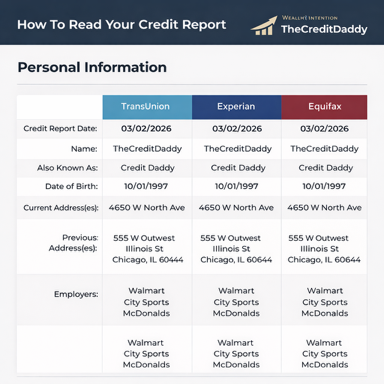
This section identifies you. It may include:
• Full name and any previous names used
• Current and previous addresses
• Social Security number (partially masked)
• Date of birth
• Employers (past and present)
What you want to see
When reviewing the Personal Information section of your credit report, the goal is to maintain a clean and consistent profile. Ideally, your report should display:
• One name
• One current address
• One date of birth
• One current employer
Having multiple variations of names, addresses, or employers can sometimes create inconsistencies within your credit file. These inconsistencies may allow negative accounts or collections to remain linked to your profile.
While our team can submit dispute letters to request corrections, clients can often help speed up the process by contacting the credit bureaus directly:
• Equifax - 800-685-1111
• Experian - 888-397-3742
• TransUnion - 800-916-8800
If you notice incorrect or outdated personal information, you may contact the bureaus to request an update or removal.
It is also important to ensure that your government-issued ID or driver’s license reflects your current address. If your identification still shows an old address, the credit bureaus may consider those addresses accurate, which can make them more difficult to remove.
Keeping your identification updated can significantly help the process of removing outdated or incorrect personal information from your credit report.
2. Credit Scores
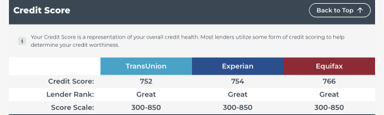
It’s your credit grade—a number that tells lenders how risky or reliable you are.
3. Risk Factors
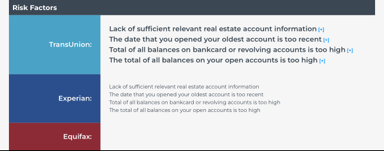
Risk Factors are the key reasons why your credit score is not higher.
👉 In simple terms:
They tell you what’s hurting your credit the most right now.
They show exactly what to fix
• Help you prioritize what’s hurting you most
• Give insight into how lenders view your profile
4. Summary
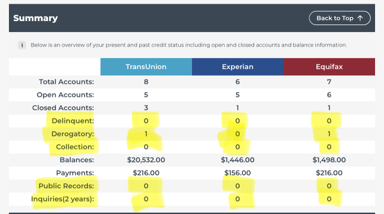
The Summary is a quick overview of your entire credit profile.
👉 In simple terms:
It’s a snapshot that breaks down everything on your credit report at a glance. ( Soft Pulls & Pre-Approvals )
5. Account History
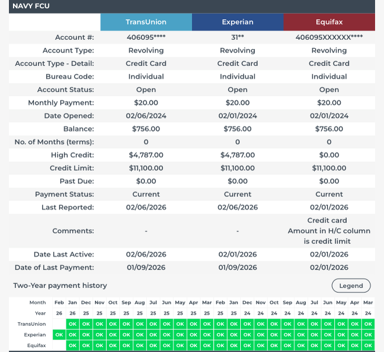
Account History is a detailed record of how an account has been managed over time—especially your payment behavior month by month.
👉 In simple terms:
It shows your track record for all account both open and closed.
| Company’s Name | Navy Federal Credit Union | Example | ACTUAL |
|---|---|---|---|
| Account #: | Account Number is a unique identifier assigned by the creditor to a specific account. | Full: 1234567890 • Report may show: XXXXXX7890 | 31** |
| Account Type: | Account Type tells you the general category of the account—how the credit is structured and how it’s meant to be repaid. | Revolving, Installment, Open Credit | Revolving |
| Account Type - Detail: | Account Type – Detail gives a more specific description of the type of account you have. | 🔍 Examples of Account Type – Detail 💳 Credit Cards (Revolving Accounts) • Bank Credit Card • Retail / Store Card (ex: store financing) • Secured Credit Card ⸻ 🚗 Loans (Installment Accounts) • Auto Loan • Personal Loan • Student Loan • Mortgage Loan | Credit Card |
| Bureau Code: | Bureau Code identifies how you are connected to an account on your credit report. | It tells you your role or responsibility for that account. Individual, Authorized User, Joint, Co-Signer/ Co-Borrower | Individual |
| Account Status: | This lets banks & lenders know whether this account is open or closed, & negative or positive | Open, | Open |
| Monthly Payment: | Monthly Payment is the amount you are required to pay each month on an account to keep it in good standing. | Credit Card Balance: $2,000 • Monthly Payment: $60 ➡️ You must pay at least $60 to avoid being late | $20.00 |
| Date Opened: | Date Opened is the exact date when an account was originally created or started. | Credit Card opened: February 1st, 2024 ➡️ That account has been active for 2+ years | 02/01/2024 |
| Balance: | the total amount you currently owe on an account. | $756.00 | $756.00 |
| No. of Months (terms): | refers to the total length of time you agreed to repay a loan. | 0 | 0 |
| High Credit: | The displays the most money you ever spent on a credit card. Or what the installment was originally worth before you started making payments. | • Credit Limit: $5,000 • Most you ever used: $3,200 ➡️ High Credit = $3,200 | $4,787.00 |
| Credit Limit: | Credit Limit is the maximum amount a lender allows you to borrow on a revolving account (like a credit card). | Credit Limit: $5,000 • Current Balance: $1,500 ➡️ You still have $3,500 available to use | $11,100.00 |
| Past Due: | Past Due is the amount of money you owe that should have already been paid—but wasn’t paid on time. | Monthly Payment: $150 • You missed 2 months ➡️ Your Past Due = $300 | $0.00 |
| Payment Status: | Payment Status tells you the current condition of an account and how it’s being paid (or not being paid). | Current, Collection/Charge-Off | Current |
| Last Reported: | Last Reported is the most recent date that the creditor updated information about your account to the credit bureaus. | Last Reported: 02/15/2026 ➡️ This means the creditor last sent an update about this account on February 15, 2026 | 02/06/2026 |
| Comments: | Comments are notes or remarks added by the creditor or credit bureau that give extra details about an account. | In collections” 🚨 → Sent to a collection agency • “Settled for less than full balance” ⚠️ → You paid less than what was owed | - |
| Date Last Active: | It shows the last time the account was used or had any movement. | You used your credit card on January 10, 2026 • Or made a payment on that date ➡️ Date Last Active = 01/10/2026 | 02/01/2026 |
| Date of Last Payment | It shows the last time you actually paid toward that account. | You made a payment on February 5, 2026 ➡️ Date of Last Payment = 02/05/2026 | 02/01/2026 |
6. Payment History
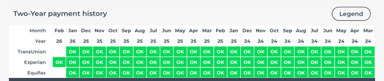
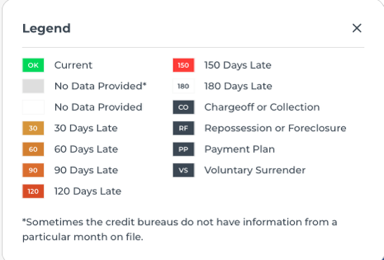
This is one of the most important parts of the report. It shows:
• On-time payments
• Late payments (30, 60, 90, 120 days late)
• Collections, Charge-offs or repossessions
Your payment history heavily influences your credit score.
7. Credit Inquiries
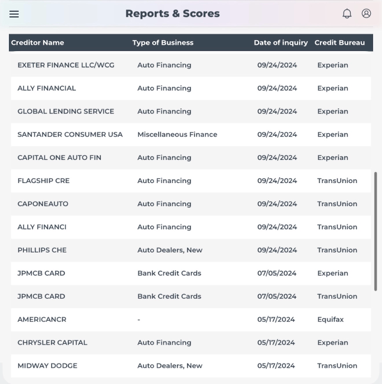
Account Inquiries are records of who has accessed your credit report and when.
👉 In simple terms:
They show who checked your credit and why.
Two types:
• Hard inquiries – when you apply for credit (can affect score)
• Soft inquiries – background checks or when you check your own credit (no impact)
8. Public Records
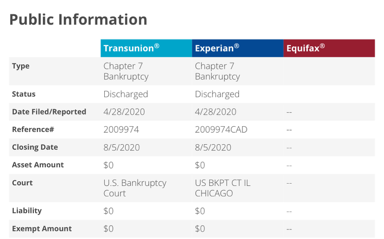
Some serious financial events may appear here, such as:
• Bankruptcies
• Tax liens
• Civil judgments (less common now)
9. Creditors Contact
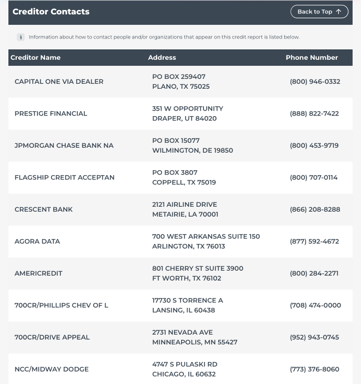
Creditor’s Contact Information provides the details of the company that owns or reports the account.
👉 In simple terms:
It tells you who to contact about that account.
How Does The Process Work / What's Included?
- We send out customized letters to the credit bureaus to challenge for removal of negative items off your file and clean up your report. Things like charge-offs, collections, late payments, inquiries, derogatory, evictions and even repossessions.
- You will Be required to pay $33/month To monitor your Credit until we're done with your profile. It's like a credit karma but it's more accurate and shows everything we need to see.
- Each round takes 45 days for updates and results! (approximately one and a half months) You will have access to your own personal portal to track the progress as we go! 24/7 access!
Step 1: Credit Repair
My primary responsibility is to dispute inaccurate, unverifiable, and negative items on your credit report. That is the service you are paying for.
Step 2: Credit Growth
In addition, I provide all clients with guidance on how to properly build and maintain their credit scores by giving them a TO DO LIST.
Step 3: Profile Building
I also coach clients on how to develop a strong credit profile and assist with applying for credit cards when the timing is appropriate. THIS IS ALSO INCORPORATED WITHIN THE TO DO LIST.
Step 4 : Execution
This is when I assist clients who are ready to pursue business funding or apply for major financing such as a home or vehicle. While this level of involvement is not required of me, I choose to provide it because I genuinely care about my clients' long-term success.
It's important to understand that a 750 credit score alone does not automatically mean you have GOOD CREDIT. True credit strength consists of:
- A good score (typically 720+),
- A clean credit report, and
- A strong overall credit profile.
Step 5: LLC Setup/ Business Funding ( BONUS )
Regarding business credit, I educate clients on how to properly set up an LLC, establish relationships with banks, and position themselves to qualify for business funding. My goal is to teach clients how to apply independently. However, if you choose to have me assist directly with applications, I charge a 10% success fee for based on the approved amount.
I also work with relationship managers at major institutions, including Chase, U.S. Bank, PNC Bank, Truist, Citizens Bank, the SBA, and American Express. These relationship managers are the individuals who actually review and approve applications, and I refer my clients directly to them. Additionally, I offer tradelines & shelf corporations, which function similarly to tradelines but for an LLC.
Step 6: FREE FINANCIAL REVIEW 👀🔎
Our Wealth Management team is providing a FREE Financial Review with a financial advisor as a client benefit!
Services include:
- 🏦 Trust & Estate Planning
- 📄 Wills
- ❤️ Life Insurance & Cash-Value Options
- 🩺 Health Insurance
- 💰 Financial Planning & Wealth-Building Strategies
All Of steps 1-6 are included but understand what you are paying for is Step 1: CREDIT REPAIR—the process of cleaning and correcting your CREDIT REPORT. When it comes to creditworthiness, your credit report is what gets you approved—not your credit score.
When Will I Start Seeing Deletions & How Long Does Credit Repair Take?
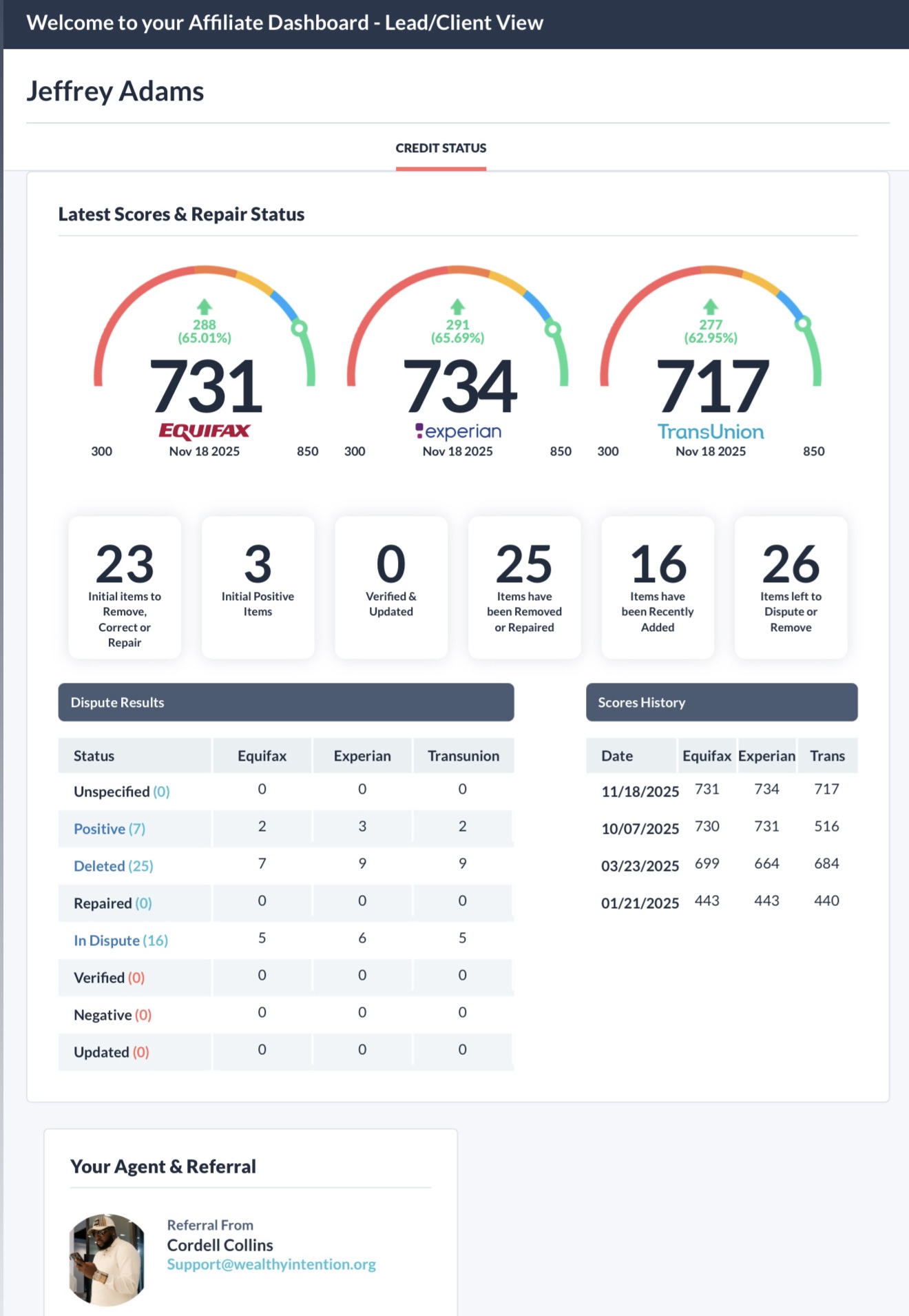
I can't give a specific timeframe for a few reasons:
- Often times clients hold themselves back with the process by not keeping their credit monitoring up to date.
- They don't check their emails for instructions and they don't send in their most recent proof of address every month — and we need that in order to dispute on your behalf.
If you look at the screenshot above, you'll see that this client started with 23 negative items and we actually got 25 negative items deleted. Which means 2 additional negative items appeared after he started, and we got those removed as well — resulting in a completely clean credit report.
If you pay attention to the dates on the right-hand side, you'll see this client started Round 1 on 1-21-25 and Round 2 on 3-23-25. However, the next round did not begin until 10-7-25. From the outside looking in, it may appear that no work was done for 8 months, but that is not the case.
In most situations, delays like this happen because the client either did not maintain their credit monitoring subscription (which prevents me from accessing your credit report), or the client failed to submit an updated Proof of Address (POA) every single month.
Please understand, every time dispute letters are sent, we must verify your identity. Your Proof of Address is required for every round, and if it is not provided, I cannot proceed with the next round of disputes.
These two things alone can prolong a client's results for months or even up to a year — which would not be my fault as long as I send out emails and texts notifying them. So his total timeframe took a total of 10 months. 10 months, although it could have potentially been significantly shorter without delays.
On top of that, the credit repair timeline varies from person to person, depending on the number and type of negative items on the credit report.
Success Stories:
• Fastest deletion: Eviction removed in just 14 days
• Quickest full clean-up: 88 total negative items cleared within 45 days
That said, results like these are possible but not typical and cannot be guaranteed for every client — no one in this industry can honestly make such a promise. If they do, they're telling you what you want to hear so you feel comfortable enough to give them your money because they know you're in a rush & most likely desperate.
Realistic Expectations:
On average, credit repair takes 6 to 9 months, and in more severe cases, it can take up to a year.
I believe in full transparency: credit repair should take as long as it needs to take. Anyone guaranteeing complete results in 30–60 days is not being realistic. The average client goes through 4–7 rounds of disputes. If it were that simple, multiple rounds of disputes wouldn't even exist.
Unfortunately, many companies lie for sales, which gives credit specialists a bad reputation. My approach is different — I prefer honesty over hype. MY NAME IS MORE IMPORTANT THAN YOUR MONEY! I will let anyone walk before I tell them what they want to hear. It's not about what you want — it's about how the process actually works. Results take time, but they do come. Will it take the full 6–9 months, or even a year? Not necessarily, but you should be prepared for that timeframe.
Each dispute round lasts approximately 45 days, and after every round, you will receive a detailed PDF update outlining any deletions or changes that occurred.
See Real Results:
If you click this link you can look at the credit scores and deletions for some of my clients and kind of do the math on how long it took — do with that what you will. Also, a lot of the shares are from some of my real clients.
www.TheCreditDaddy.com/results

Why Haven't I Received Any Updates?
I would like to take a moment to clarify how updates are provided throughout the credit improvement process.
First, it is important to understand that not receiving a formal update from us does not necessarily mean there has been no progress. Many clients receive updates directly through creditor notifications, emails, mailed correspondence, or alerts from their credit monitoring service indicating deletions or changes. In addition, you also have access to your client portal, where updates may be reflected. All of these notifications are considered valid updates.
That said, we intentionally provide formal PDF updates because they are more professional, easier to review, and help clients feel confident and informed about their progress.
Misconceptions
Please understand that an update is strictly just an update. It does not guarantee a score increase every round or that something will be deleted every round. You can expect certain rounds—and sometimes back-to-back rounds—with no change, and that is completely normal and part of the process.
Believe it or not, this actually helps increase your chances of deletions, as it Helps Us Catch The Credit Reporting Agencies & Debt Collectors Up In Violation Even More Than They Already Were.
Update Timeline
Each dispute round operates on a 45-day cycle (approximately one and a half months). Updates are scheduled according to this timeline and are dependent on all required documentation and access being current and accurate.
Phase One: Proof Of Identity
The first step before any update can be issued is confirming that we have two forms of Identification on file for you. One being documentation that displays your FULL SSN, and the other being either a valid State ID or Driver's License.
Here's what we need from you:
- A clear photo or scanned copy of your Driver's License or State ID (must be valid and not expired). If no ID, passports are accepted.
- A clear copy of your Social Security Card (or any official document showing your FULL SSN). If no Social Security card, you may use a check stub, W-2, or tax return, as long as the full SSN is visible.
Please understand that every time dispute letters are sent, your identity must be verified. This means your Driver's License or State ID is required for every round. If your ID or License expires, my support team will request an updated version, and if it is not provided, we cannot proceed with the next round of disputes.
Phase Two: Proof of Address (POA)
The 2nd step before any update can be issued is confirming that we have a current Proof of Address (POA) on file. Whenever we request your most recent Proof of Address (POA), we are not asking whether you have moved from your current residence. We understand that your address may remain the same.
What we are specifically requesting is updated documentation that verifies you are currently residing at that address.
There are ONLY Four (4) Acceptable Documents, and we only need ONE out of the four (please DO NOT send anything other than one of these).
- A rental or lease agreement
- A utility bill
- A bank statement
- A mortgage statement
If you don't have your own apartment, obviously you won't have a utility bill or rental agreement. THAT IS COMPLETELY FINE. In your case, you will use your bank statement for the proof of address.
Regarding bank statements, all financial institutions are accepted. This includes, but is not limited to, Chime, Cash App, Apple Pay, Varo, credit card statements, and any major traditional bank.
To be valid, the document must:
- Display your full first and last name (not a business name or nickname)
- Show your complete residential address
- Be dated within the last 60 days
Whenever sending or uploading documents into your portal PLEASE MAKE SURE ALL DOCUMENTS ARE CLEAR:
- Not Too Light Or Too Dark
- No Blurry Photos Or Screenshots
- No shadows or light flashes blocking words in the documents
- Pictures MUST BE FULL PAGE (Meaning take it out of the mail and unfold it)
- Screenshots Must Also Be FULL PAGE (meaning MAKE SURE ALL 4 CORNERS ARE IN THE PIC)
These things can cause your docs to come back as NON VERIFIABLE—which can prolong you getting fast and efficient results.
If the document is older than 60 days, it is considered outdated and cannot be used. For example, if it is currently December and the document on file is from September or October, it is no longer valid. For this reason, we strongly recommend submitting a new POA every month as soon as it becomes available. Utility bills and bank statements are often delayed, and by the time the next update cycle arrives, a previously submitted document may already be expired. This can cause unnecessary delays for both you and our team.
If you have a rental or lease agreement, that is ideal, as it typically remains valid for an extended period and eliminates the need for monthly submissions.
If your POA is missing or outdated at the time an update is scheduled, we will contact you via email and text message and send up to three reminders. If the issue is not resolved, the process CANNOT move forward.
Phase Three: Credit Monitoring Access
Once the POA is confirmed, the next requirement is accurate and up-to-date credit monitoring access.
Common issues at this stage include:
- Incorrect login credentials
- An outdated credit report
- Required password changes initiated by the monitoring service for security reasons
If we are unable to access your credit report, we cannot provide an update.
It is important to understand the difference between active and updated credit monitoring:
- Paying the monthly fee keeps the account active
- Logging in and refreshing the report ensures it is updated
When you log into your credit monitoring account, the report will display a "last updated" date. That date must reflect the current month. For Example: Let's say the current month is December. If the report is showing a prior month (for example, September, October, Or November), it will be considered outdated & cannot be used to provide a current update. I can't tell you what's going on in June if I'm looking at a report from March.
While we can request an update on your behalf if your monitoring is active, we cannot initiate updates that would result in unauthorized charges. If your monitoring payment has lapsed, updating the report would trigger a charge, and we will not proceed without your authorization.
Once a client is scheduled to receive a PDF update, my team will then begin Phases 1 & 2. If my team has any issues such as mentioned before, step 1 would be to contact you via email or text. From there we will wait for your confirmation and we will no longer check on that issue for you — it will be 100% YOUR DUTY to notify us once the issue has been handled so that we can resume the process.
Best Practices to Avoid Delays:
To ensure consistent progress, we recommend the following:
- Submit your most recent Proof of Address every month
- Log into your credit monitoring account monthly to confirm:
- The report is updated
- Your login credentials work
- No password reset is required
If these 3 are consistently maintained, everything else falls on us. Don't let it be your fault we couldn't successfully do our job.
⚠️ Hard Truth:
You can't pay for credit repair then:
- Ignore or skim through instructions
- Stop responding
- Ignore emails and text messages
- Keep adding new inquiries, or late payments
- Skip credit building
Then come back 3 months later saying you haven't heard anything, seen any changes, requesting a refund, & proceed to blame my company or the process.
Credit repair works only when WE work.
I'm not a miracle worker, I'm a strategist. You have to do your part as well. Please take your credit seriously—it represents your financial credibility.
☎ Customer Service Number: 312-584-9969
📧 Customer Service Email: Support@wealthyintention.org
Receiving The Same Email & Text From My Support Team
Primary Issues That Delay Results
- • Outdated credit monitoring reports
- • Inaccessible or incorrect credit monitoring login credentials
- • Missing or invalid Proof of Address (POA) documentation
- • Full or inaccessible email inbox (clean up space or buy more storage if needed)
- • Phone settings that block or silence unknown numbers. Please save 312-584-9969 in your contacts to ensure uninterrupted communication.
These are the primary issues that delay results for most clients. By proactively managing the items listed above, you set yourself up for a smooth and successful experience.
Whenever an issue arises—such as a (POA) matter or a login-issue concern—you are tagged within our system. Once tagged, automated messages with clear instructions are sent to you via email & text every 10 business days. You will no longer receive these notifications after a maximum of three reminders are issued, or until the issue is resolved—whichever occurs first.
These reminders are simply a courtesy to ensure you don't forget or nothing is overlooked, as we understand that schedules can be busy.
If you receive an email or text message regarding any of the items above, it is not sent without cause and is not a system error.
In most cases, either:
- • Our team was not updated that the issue has been handled, or
- • The issue has resurfaced and requires immediate attention.
- • The login information provided were invalid.
- • The submitted documentation is invalid
These notifications should NEVER be ignored.
Before responding with "I've already completed this," please take a moment to verify first:
- Log directly into your credit monitoring account to confirm the report is current
- Confirm all dates on submitted documents are accurate and up to date
Verification ensures accuracy, prevents delays, and keeps your account active and progressing as intended. Notify 312-584-9969 whenever you have taken care of an issue.
Where Can I Find My Client Portal
Within 4 Business Days After Getting Started my support team should have sent you a email for you to access your portal. The sole purpose of your client portal is to track your own progress and upload documents when necessary. Search for TRACK YOUR RESULTS or CLIENT PORTAL LOGIN in your email and spam. If you do not see the email with the username and password for your online client portal please text my team to make sure it gets resent out. (312) 584-9969
Important Notice: Anytime you upload any documents inside your portal you must notify us to check it at 312-584-9969 or Support@wealthyintention.org
Log into your portal directly on the website: https://secure.scorexer.com/Portal/login.jsp
As your credit journey continues you can expect phone calls, emails or mail from: the original creditors of whoever you have done business with, Various Debt collectors, Credit reporting agencies such as Transunion Equifax And Experian. YOU DO NOT have to answer any calls or respond to any emails or mail. We will notify you via text or email if there is anything you need to do on your end. Any mail or emails you receive you can upload them inside of your portal. Also if you feel like you may have something that may help us with the process. Such as; proof you or your insurance company paid off certain accounts that are in collections, proof that you were a victim of identity theft like a police report. Screenshots of messages, emails, or letters that you may have gotten in the mail that is important to your situation; FEEL FREE TO UPLOAD THEM INTO YOUR PORTAL. When It Comes To The Password For Your Client Portal. You Are Allowed To Change Your Password To Whatever You Want. Also You Can Upload Documents Here.
I Received This Letter In The Mail?
⚠️ Important Notice: Anytime you upload any documents inside your portal you must notify us to check it at 312-584-9969 or Support@wealthyintention.org. We only check the client portal when notified!!
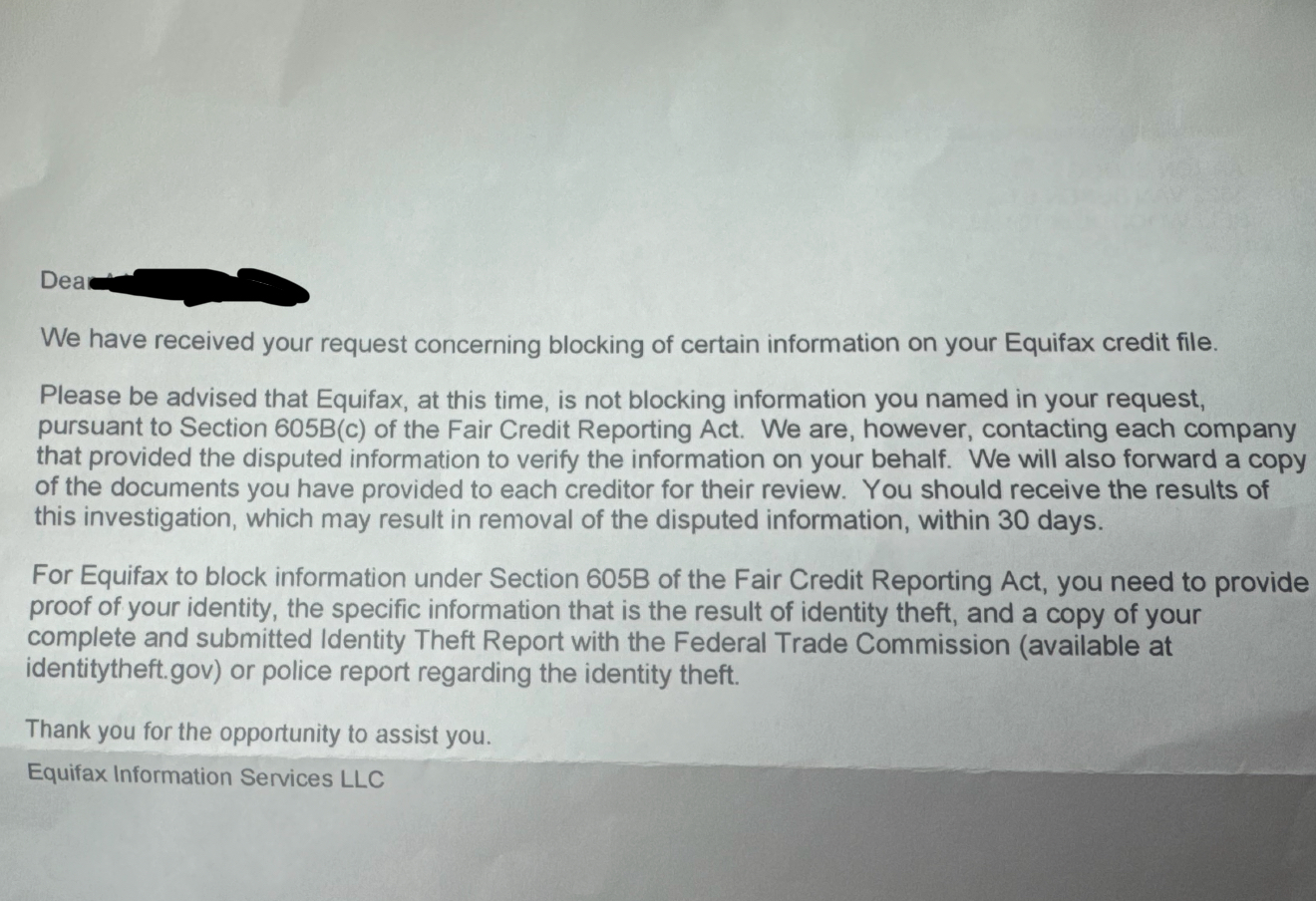
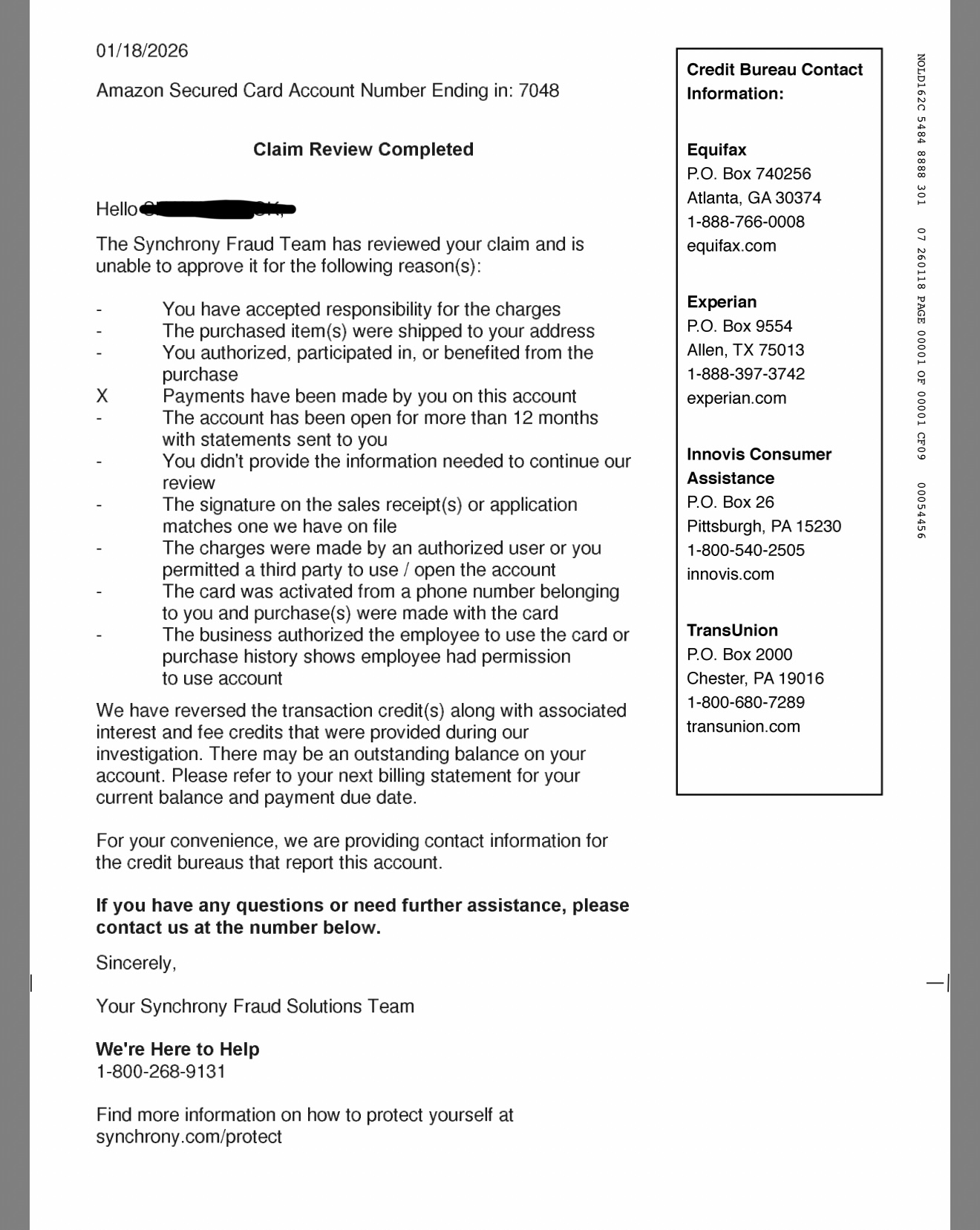
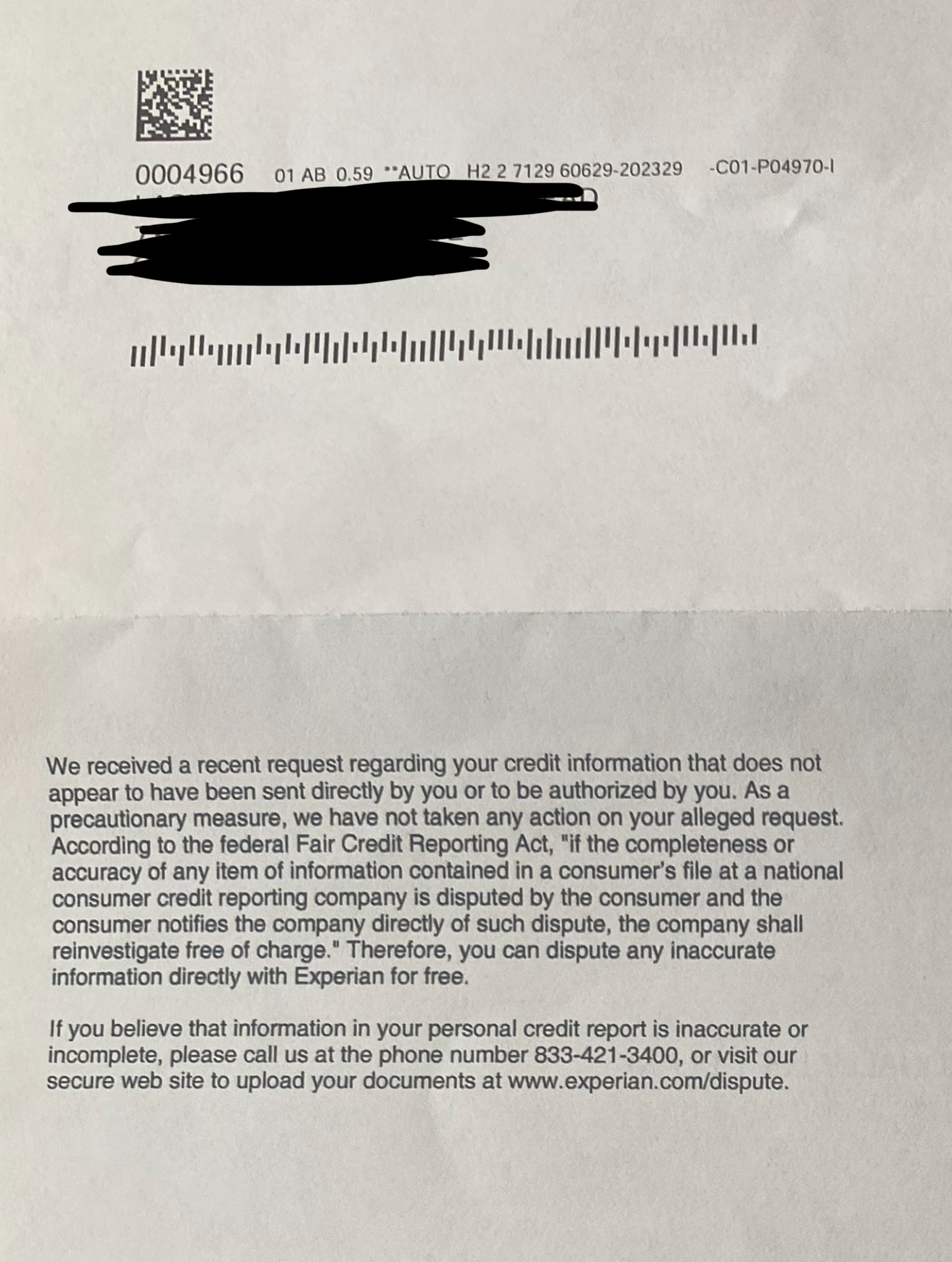
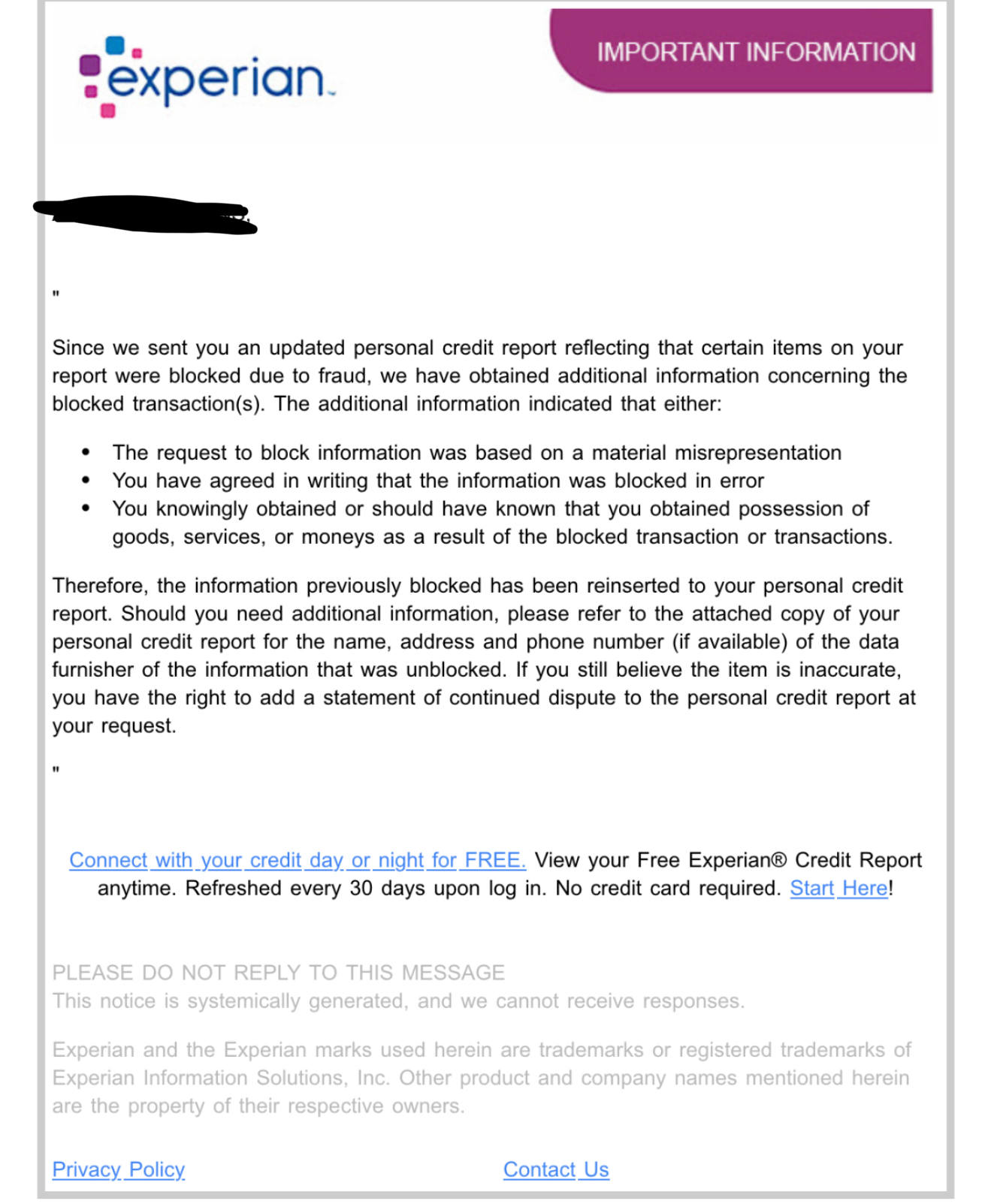
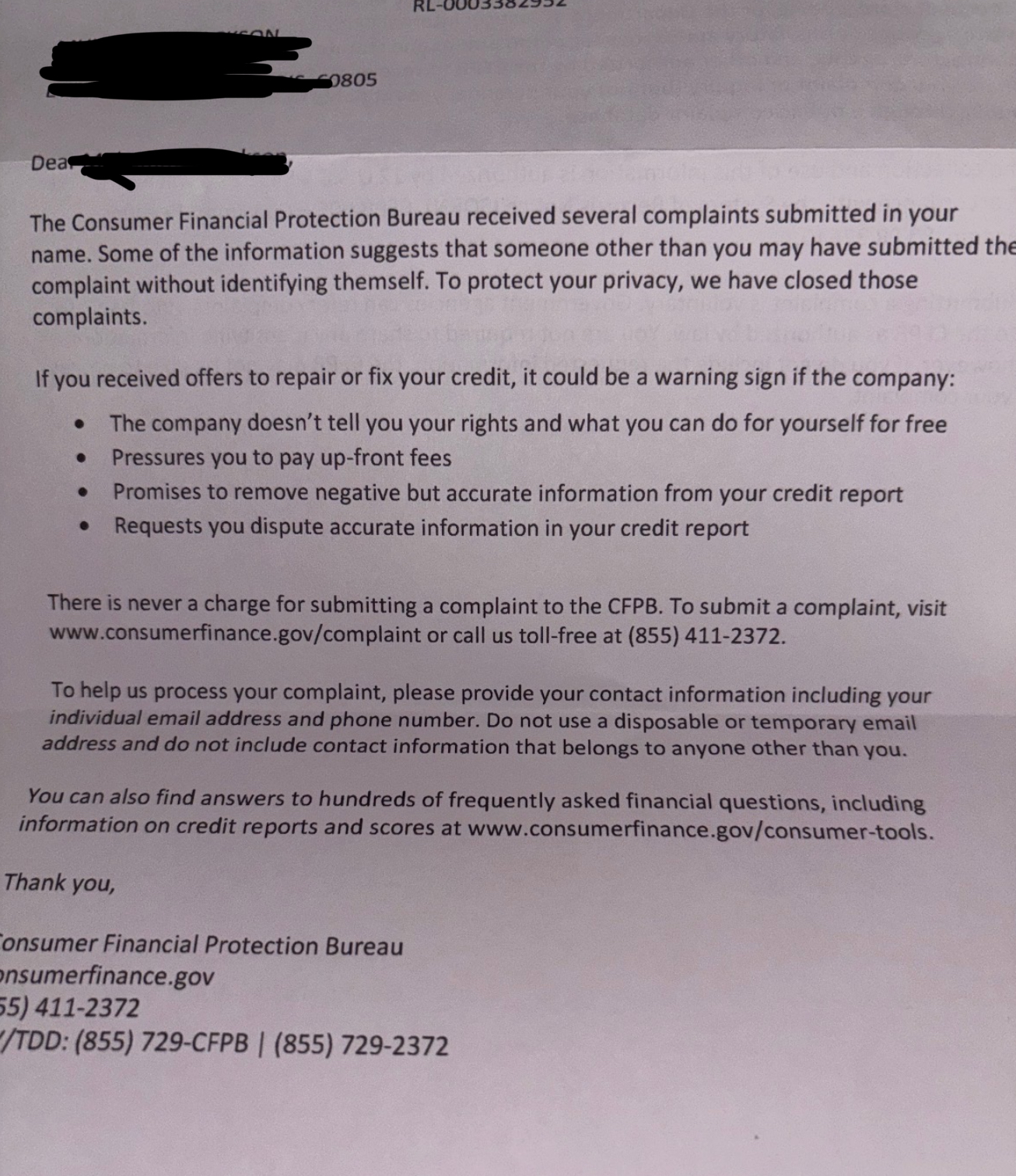
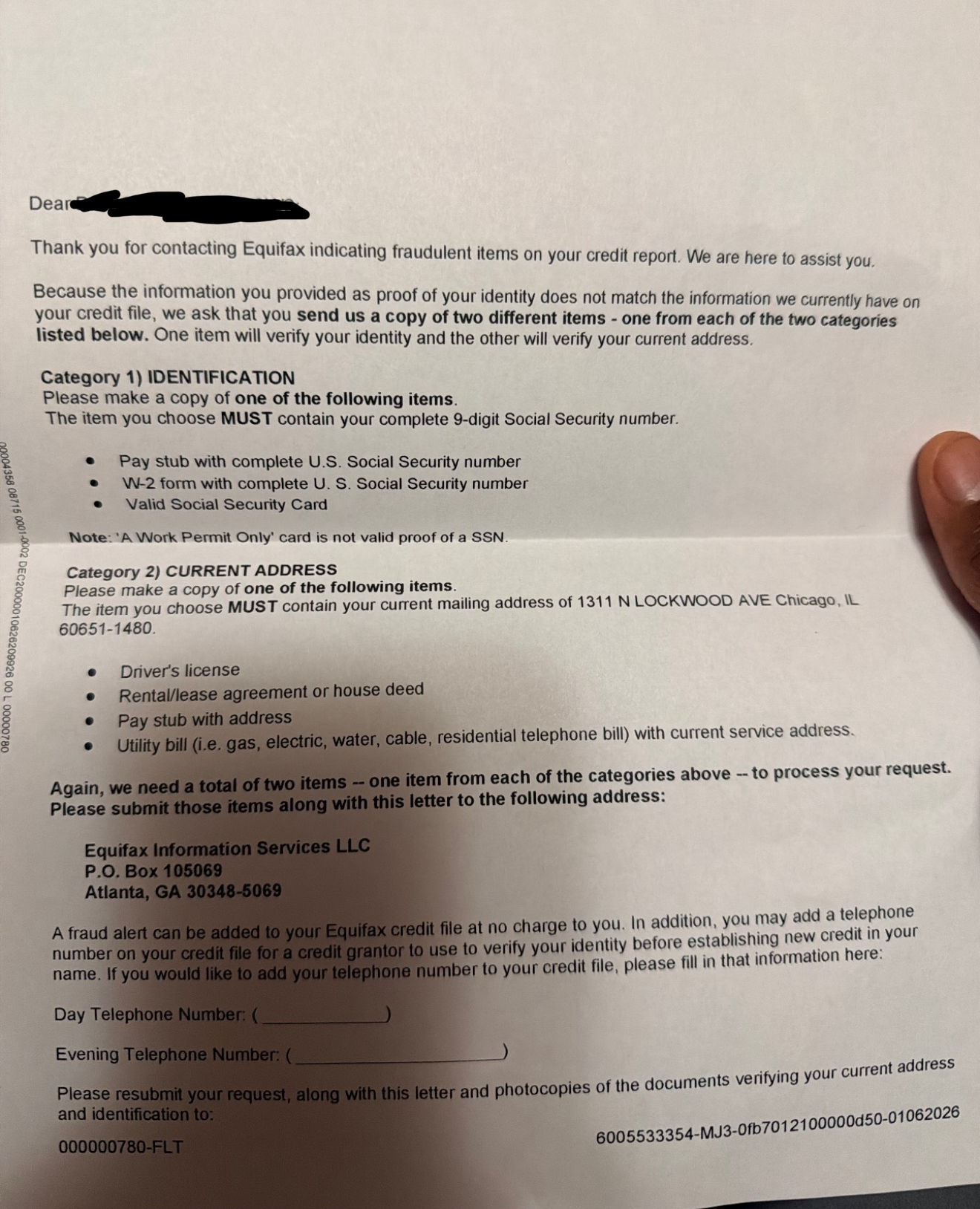
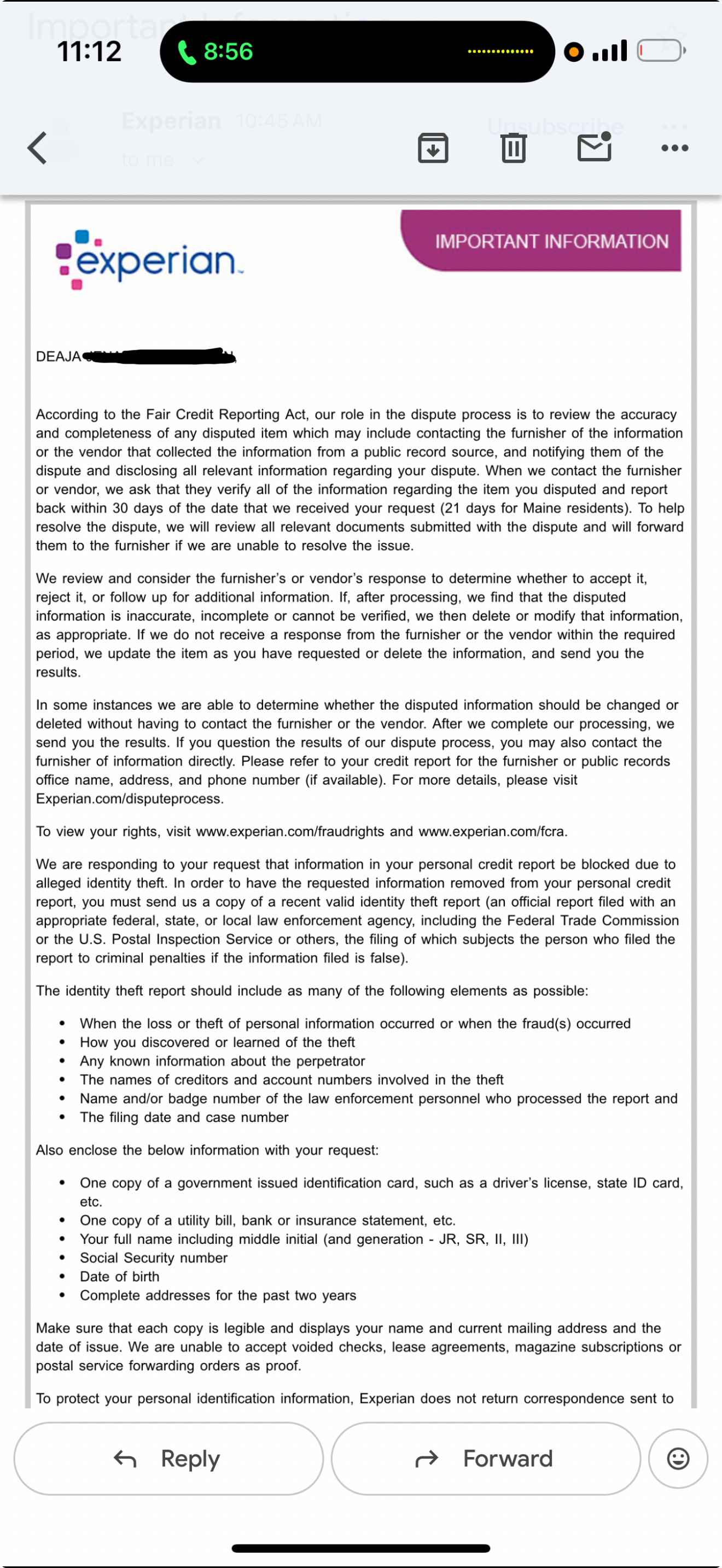
What Does This Mean?
While restoring your credit, you will receive many updates from the credit bureaus. Bureaus send these out hoping that you will stop your dispute efforts because they are compensated for reporting negative accounts and benefit from keeping them on file longer. No need to be worried about this. You are not required to respond to any letters you receive. Simply take a photo of the correspondence and upload it to your client portal.
These responses are typically stalling tactics. Credit bureaus are required to respond within 30 days, or the item must be removed from your credit report. As a result, they often issue a response stating that the account is "under investigation" to stall the process. In many cases, this delays deletion.
It is also common for them to claim they cannot verify your identity, that an account has been verified, or that a request was denied. These responses are often intended to stall the deletion & discourage consumers who are unsure of the next steps, hoping that you stop the credit repair process. We know how to respond to these type of updates.
We will send a violation letter as any delay in the processing of a consumer's letters is a violation of 15 U.S. Code § 1681i, which sets forth the procedures in which a Consumer Reporting Agency must investigate a consumer's reasonable dispute. Any such delay will be considered willful disregard of our rights as a consumer and will be forwarded to an attorney for litigation purposes.
There is no such exception that would legally allow any bureaus to delay the processing of a consumer's letter based on an unfounded assumption that assistance from a third party may exist.
Here are some examples of these letters:
☎ Customer Service Number: 312-584-9969
📧 Customer Service Email: Support@wealthyintention.org
Where To Upload Documents
⚠️ Important Notice: Anytime you upload any documents inside your portal you must notify us to check it at 312-584-9969 or Support@wealthyintention.org. We only check the client portal when notified!!
Step 1: Log into your client portal.
Step 2: Click On UPLOAD DOCUMENTS.
As your credit journey continues you can expect phone calls, emails or mail from:
- The original creditors of whoever you have done business with
- Various Debt collectors
- Credit reporting agencies such as Transunion, Equifax, And Experian
YOU DO NOT have to answer any calls or respond to any emails or mail. We will notify you via text or email if there is anything you need to do on your end. Any mail or emails you receive you can upload them inside of your portal.
Also if you feel like you may have something that may help us with the process. Such as; proof you or your insurance company paid off certain accounts that are in collections, proof that you were a victim of identity theft like a police report. Screenshots of messages, emails, or letters that you may have gotten in the mail that is important to your situation; FEEL FREE TO UPLOAD THEM INTO YOUR PORTAL.
When It Comes To The Password For Your Client Portal. You Are Allowed To Change Your Password To Whatever You Want. Also You Can Upload Documents Here.
Step 3: Whenever uploading something into your portal PLEASE MAKE SURE ALL DOCUMENTS ARE CLEAR:
- Not Too Light Or Too Dark
- No Blurry Photos Or Screenshots
- No shadows or light flashes blocking words in the documents
- Pictures MUST BE FULL PAGE (Meaning Take it out of the mail and unfold it)
- Screenshots Must Also Be FULL PAGE (meaning MAKE SURE ALL 4 CORNERS ARE IN THE PIC)
These things can cause your docs to come back as NON VERIFIABLE which can prolong you getting fast and efficient results.
Step 4: Important Notice: Anytime you upload any documents inside your portal you must notify us to check it at 312-584-9969 as submissions are only reviewed once we are notified to check.
Any mail you receive - letters from creditors, debt validation notices, credit bureau results - can be uploaded directly inside your portal.
Upload it and notify us at (312) 584-9969.
🚨 IMPORTANT: When Can I Start Applying For Things?
YOU SHOULD NOT BE APPLYING FOR ANYTHING WHILE YOU STILL HAVE NEGATIVE ITEMS ON YOUR REPORT.
Not until the highlighted subjects reach the number 0, and you have 2 or less inquiries for Equifax, Experian, & Transunion. (If you have more than 2 inquiries across 3 bureaus, it's fine as long as they are attached to OPEN ACCOUNTS and are older than 6 months.)
But realistically, your credit report summary should look like this:
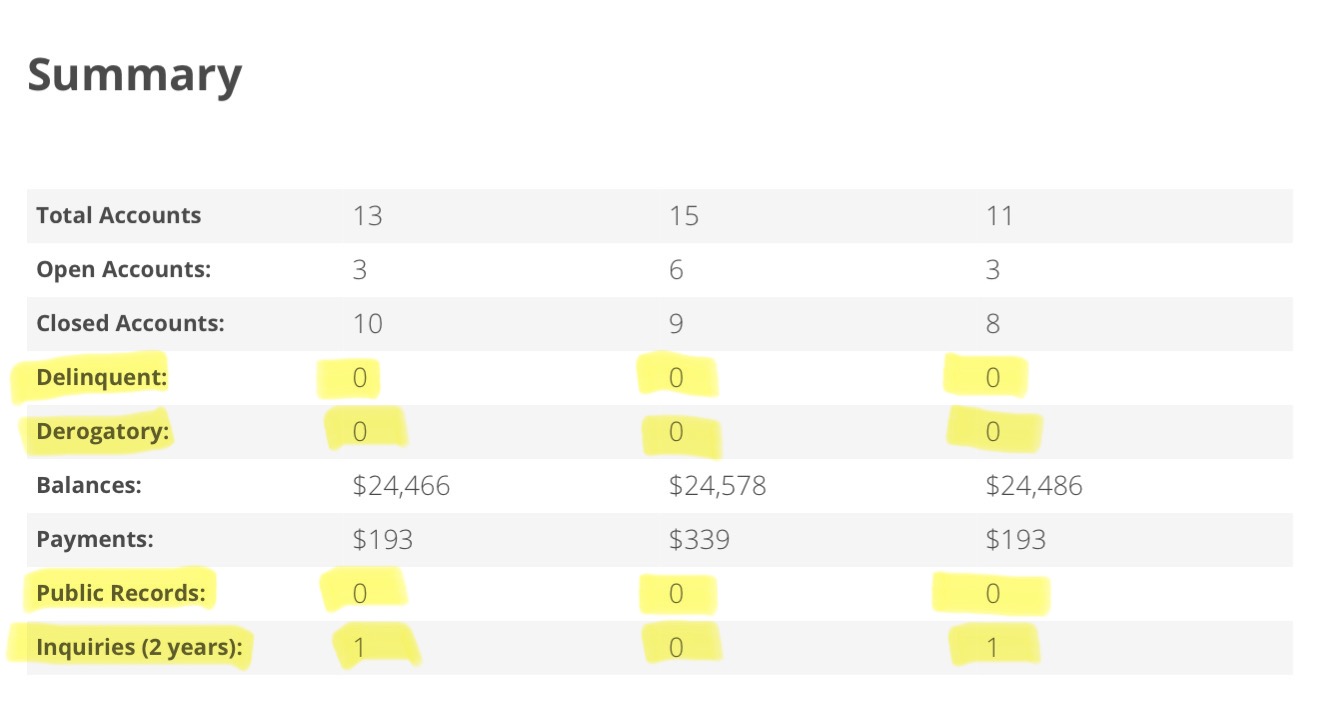
I understand a lot of you may have goals & trust me, it's in my best interest that you hit those goals. But if I have to be honest, the timeframe most of you give yourself to hit those goals are unrealistic to begin with.
Let's Be Real:
- Your credit score is SHOT
- You don't have good payment history
- You're in crazy debt
- You have multiple negative items on your credit report
- You have no positive accounts showing proof that you can pay anything consistently
- But yet you want years worth of damage cleaned up in a short period of time
Does This Mean I Won't Try To Help You Hit The Goal? Absolutely Not. But If You're Not Able To Get Approved For Something In A Short Timeframe I Don't Need You Being Mad Or Discouraged Because You Didn't Give Yourself The Proper Time To Begin With. Please understand it's not about WHAT YOU WANT, it's About HOW IT WORKS. At The End Of The Day 10%, 30%, 50%, Is Better Than 0% — WE'LL GET THERE IN DUE TIME 🤝🏾
While getting credit repair I don't recommend applying for anything as new inquiries can affect your score negatively and can hold you back. I am also not required to delete any new inquiries. You will be able to apply for whatever it is you want once everything is deleted from your report — as long as you did your TO DO LIST it's your time to shine!
In Conclusion — Meet These Qualifications BEFORE You Apply For Anything:
- ✓ Credit Score MUST BE a minimum 680, but preferably 720+
- ✓ Credit Card Utilization Under 10%
- ✓ 0 Negative Derogatory Accounts
- ✓ 0 Delinquent Accounts (Late Payments)
- ✓ 2 Or Less Inquiries
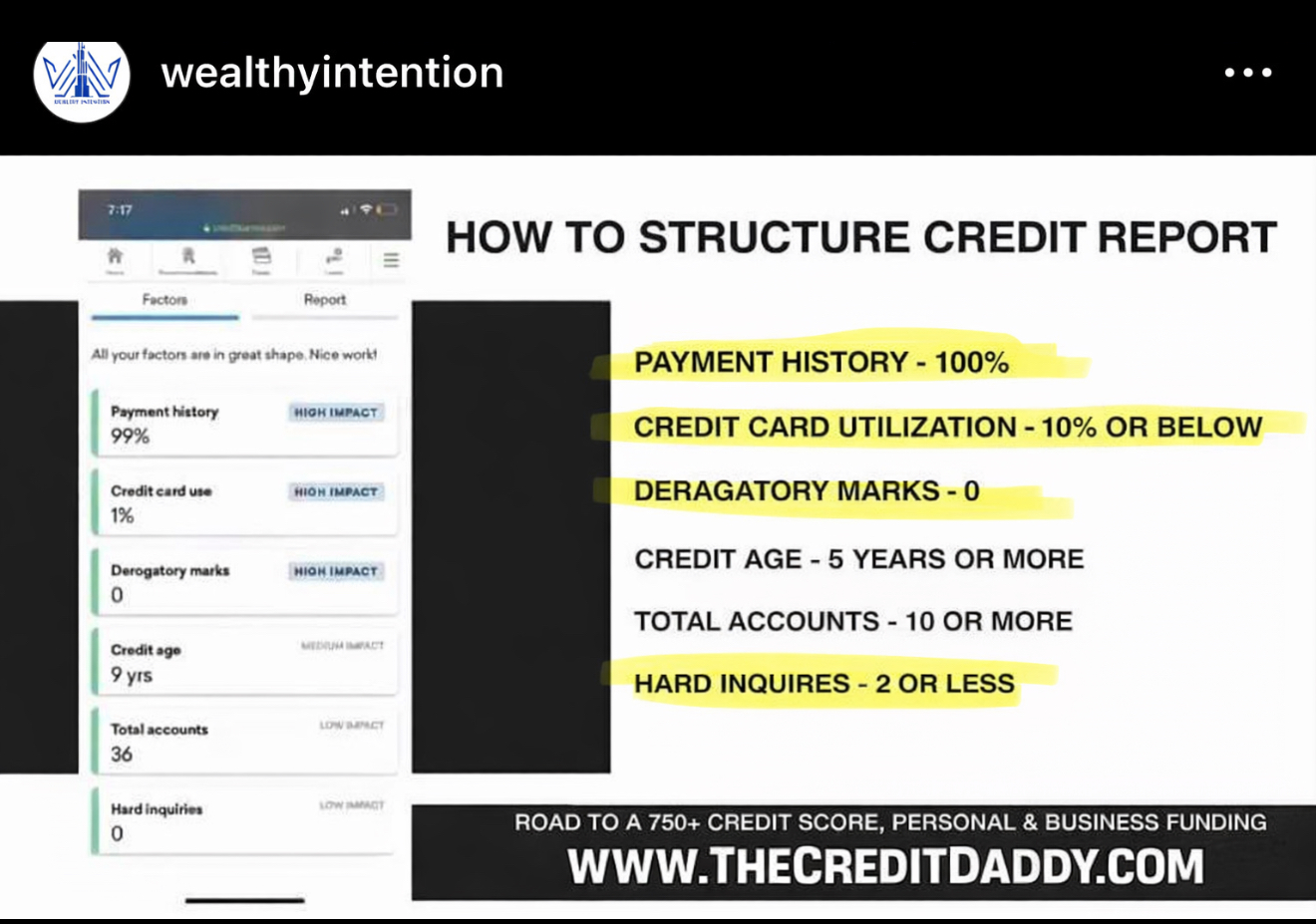
💡 Quick Tip: How To Avoid Unnecessary Inquiries
Whenever you want to apply for something do these 5 steps
Step 1 - find out what is the Minimum Credit Score Required.
If it’s a car being financed, I’ll tell you now the real score recommend score is 720+ but a MINIMUM 680 if you want a decent interest rate. Anything other than a car you can call and find out
After calling, once you come to the conclusion that you do not have that minimum score required, unfortunately you don’t even qualify to apply just yet. But A tradeline could help with raising the score faster. ( yes I have them just reach out to me. )
Step 2 - Find Out WHO THEY PULL FROM.
This is so clutch ! Always BEFORE APPLYING FOR ANYTHING, be sure to find this out. Let’s say when you got started you had a repo on your credit report and it was showing for all 3 bureaus. As time went by it was deleted from Transunion but it’s still on Experian & Equifax being disputed. If you’re in need to apply an auto loan. If you know that repo is no longer on Transunion you can focus on getting an auto loan from a bank who pulls from Transunion like Navy Federal. This same concept goes for Credit cards, loans, apartments doesn’t really matter.
Step 3 - Find Out What Do They REALLY CARE ABOUT
So let’s say you do have that minimum credit score or you bought a tradeline to get there. The Next step is to call and find out what do they really care about. So for example. If you want to get a House, any negatives items can get you denied instantly. But if you wanted an apartment maybe the company only cares about rental history ( meaning no evictions or broken leases ) and is willing to let you slide with a few collections. If you have any of the red flags 🚩 they mention, then you know to avoid even applying adding an unnecessary inquiry.
Step 4 - Make sure you have the verifiable income ( tax returns, check stubs, bank statements, W2, 1099 ) Some loans or applications may require you to make a certain amount of money. It’s a lot easier to get approved for things when you can prove you can afford it.
Step 5 - If you are applying for a house, apartment, or car… GO CHECK IT OUT FIRST. Applying for something you haven’t seen up close in person is insane. If a company tells you that you Must apply first before viewing 9/10 it’s a scam or they are hiding something. That’s why you make sure you qualify first & you let them know you are more than qualified.
- I have a 750+ credit score
- I make well over than 3X the rent
- I have no late payments or collections.
- And I refuse to pay any application fees or let anyone run my credit unless I am 1000% sure this is what I truly want.
BONUS QUESTIONS
- Do they check for background and how far back they go?
- What background records are automatic rejections?
- Can you get approved with evictions and / or do they accept receipts showing the judgment was paid off !
Why Are These 5 Steps Nonnegotiable?
Everything looks good on pictures & videos. You can’t hear if a car is making weird sounds from a picture. You can’t see that your charger port isn’t working from a screenshot. Same can be said about an apartment or house. Obviously there won’t be anything striking online but what if you view the crib and see roaches everywhere or rat traps you can avoid wasting your time, energy and money. What if there’s a shootout right outside the apartment ( speaking from experience) these things will save you from making a terrible decision.
I am very Strict about these 5 rules. Whenever I want to apply for something I check off all 5 steps before hand and I advise you to do the same.
⚠️ While in active credit repair, do NOT apply for anything. New inquiries can negatively affect your score and hold you back. We are also not required to delete any new inquiries added during your service.
I Want To Finance A Car / Refinance My Car
AFTER completing Steps 5 & 6 from the To Do List, and ONLY AFTER EVERYTHING IS DELETED FROM YOUR REPORT — if you want to finance or refinance a car:
Search around for the car you like, test drive it, and ask questions about the vehicle. Specifically ask questions about your personal preferences. Remember, dealerships often buy cars from other dealerships and lots — so even if they don’t have the specific one or color you want, if you know a location who does, they’re usually willing to buy it from them and you can still finance through them. I got my car shipped from Massachusetts.

Once you have the car you want picked out, go to the dealership or car lot and ask for a Purchase Order / Buyer’s Order (sometimes called a Purchase Agreement).
Do Not Skip This
If they ask why, let them know: “I’m obtaining outside financing through my current bank.” DO NOT LET THEM RUN YOUR CREDIT and DO NOT GIVE THEM YOUR SOCIAL!
Then go directly to Navy Federal, or whichever credit union or bank you did your secured loan with. You should be able to do this online as well, but I personally went inside.
Give them the Purchase Order and ask them directly for an auto loan. They will give you the PAPER CHECK 🧾 for the car. (Make sure you have the VIN number.)
There is no need for the dealership to run your credit and give you a million inquiries, because you don’t need to qualify for a loan through them. YOU HAVE THE CHECK! Your auto loan will be financed through your bank.
This same concept applies for refinancing a car. Just call or go to your bank and tell them you want to refinance.
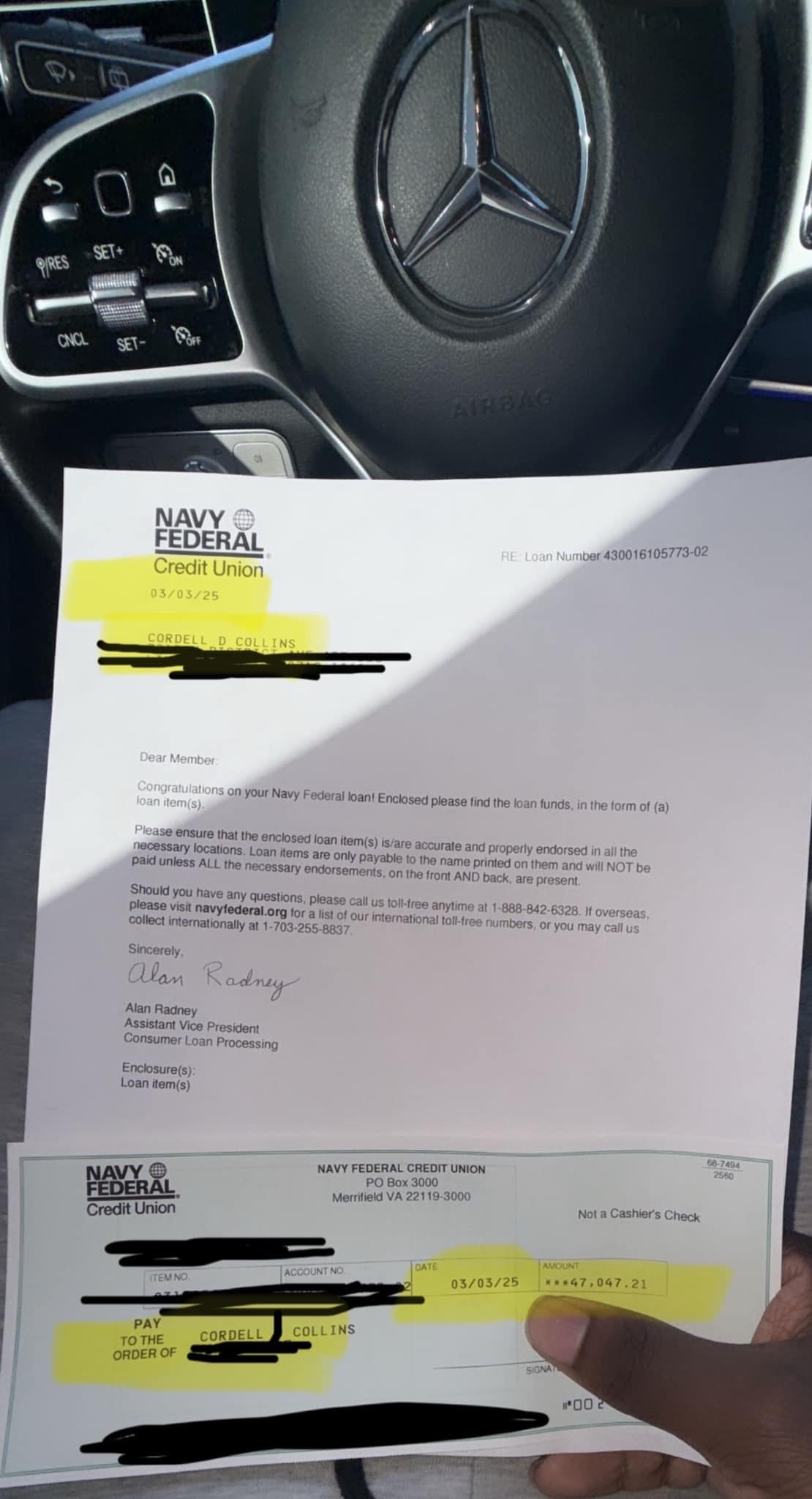
Take the check to the dealership. Sign your papers 📑 and drive off blasting your favorite song 🎵 DON’T FORGET TO TAKE PICTURES AND GIVE ME A SHOUTOUT — tagging me on Facebook & Instagram. If you prefer to remain anonymous, just take pictures and videos and I’ll post them without tagging you.


Should I Close Credit Card Accounts I Don't Use?
Short Answer: Usually NO — Don't Close Them
❌ Why You Usually Should NOT Close Unused Credit Cards
Closing a credit card can hurt your credit, even if you never use it.
1️⃣ It Can Increase Your Utilization (30% of your score)
Credit utilization = balances ÷ total available credit.
Example:
- You have $10,000 total credit
- You're using $1,000 → 10% utilization (GOOD)
- You close a $5,000 card → now you have $5,000 total credit
- Same $1,000 balance → 20% utilization (WORSE)
👉 Score can drop without you doing anything wrong.
2️⃣ It Can Lower Your Average Credit Age (15% of your score)
Older accounts help your profile.
- Closing an old card can shorten your credit history
- Especially harmful if it's one of your first cards
3️⃣ Banks & Lenders Like to See Available Credit
Banks prefer:
- Low usage
- High limits
- Accounts in good standing
Unused cards = strength, not weakness.
✅ When It DOES Make Sense to Close a Card
You might consider closing a card if:
- It has a high annual fee and no real benefit
- It tempts you to overspend
- You've already paid it off and replaced it with better cards
- It's a predatory card with terrible terms (low limit, high fees)
💡 Pro Tip: Before closing, ask the bank to:
- Waive the annual fee, or
- Product-change the card to a no-fee version (essentially upgrading to a better card but keeping your history)
🧠 Best Practice — What I Recommend to Clients
- Keep unused cards open
- Use them once every 3–6 months
- Put a small charge on it (Netflix, phone bill, gas, coffee)
- Pay it off before the statement date
This keeps the account active without increasing utilization.
In Conclusion: Avoid Closing Accounts.
- A credit card you don't use is not hurting you.
- A credit card you close can potentially hurt you.
Would It Be Better To Just Pay My Collections Off?
Short Answer: Only if the creditor offers a Pay-For-Delete. If so, yes. If not, then NO — not until the collection is deleted.
Here's Why
1. 9/10 if you have a collection, your information has been passed on to a 3rd party debt collector that you NEVER did business with — so therefore you DO NOT OWE THEM ‼️
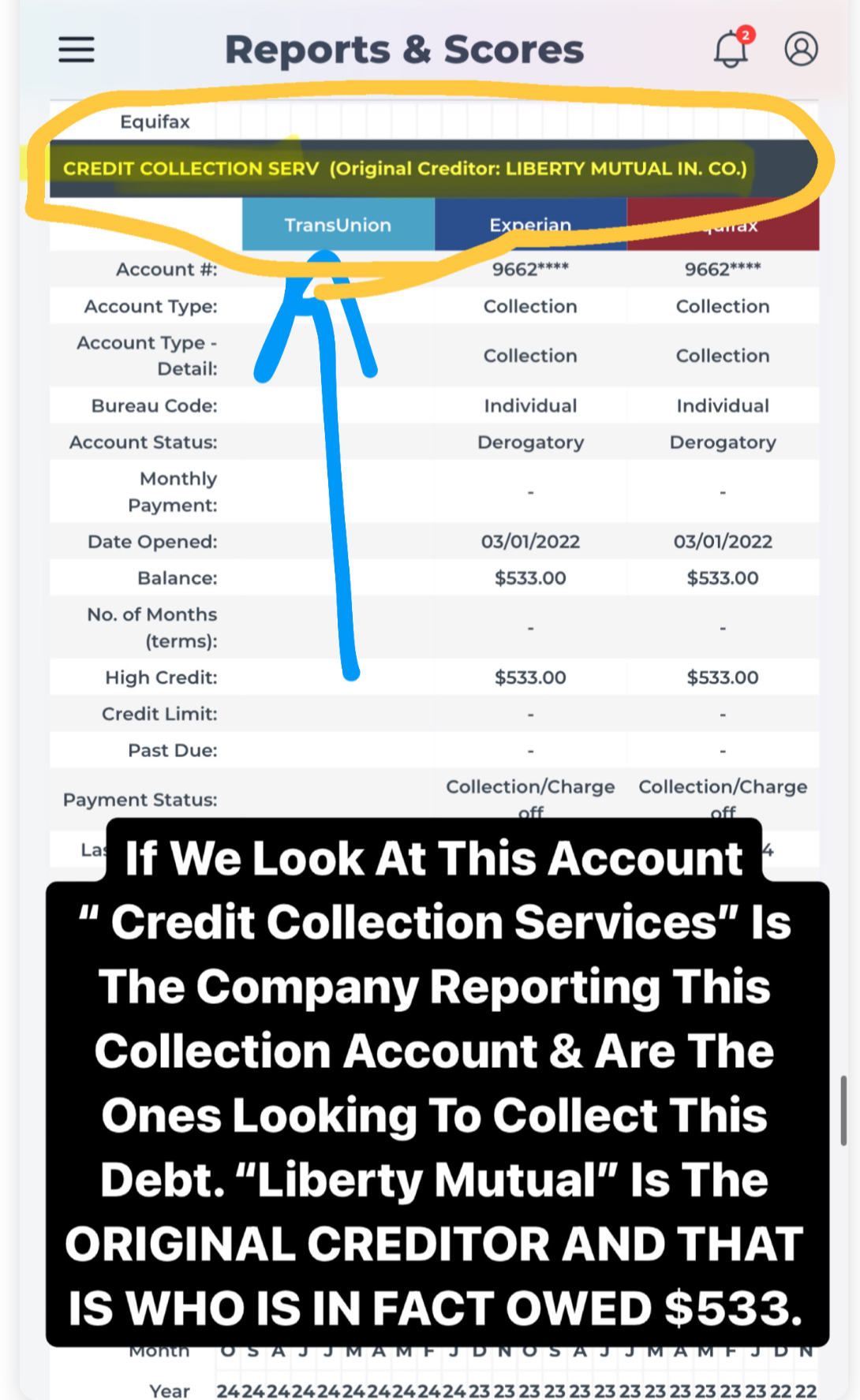
Why pay a company you don't owe?
2. Even if it were the original creditor, paying them DOES NOT REMOVE IT FROM YOUR CREDIT REPORT.
3. If you fall for that letter saying "Pay 30-40% off and we will SETTLE this for you," it will still be on your credit report as a Paid Collection / SETTLED FOR LESS THAN FULL BALANCE — which is still a negative account and DOES NOT help you.
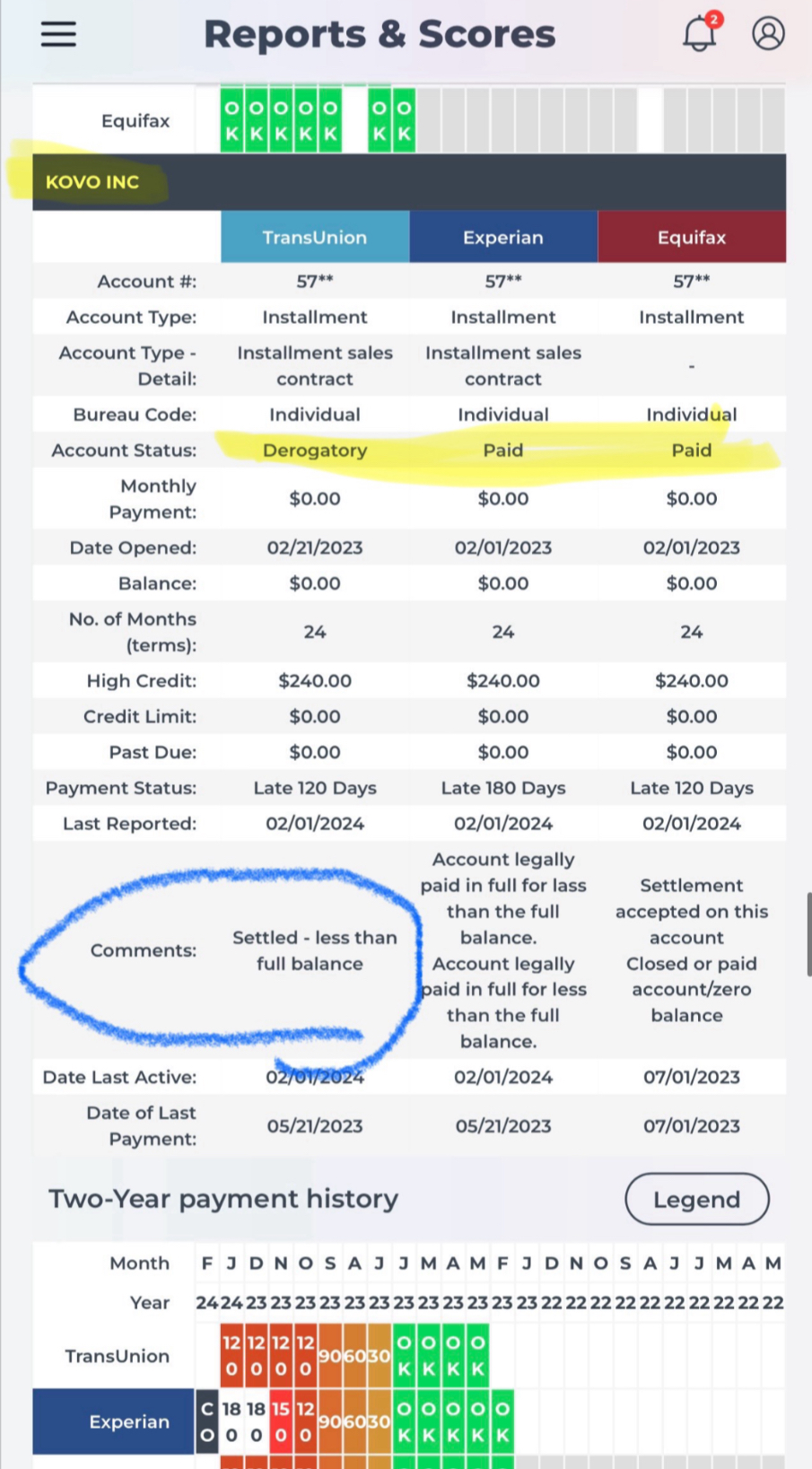
Not only were you already behind 120-180 days, but when you finally decided to pay them, they didn't even get all of their money? It doesn't look good.
4. If you pay them IN FULL, it will still show up as a PAID COLLECTION — which is still a negative account and DOES NOT help you.
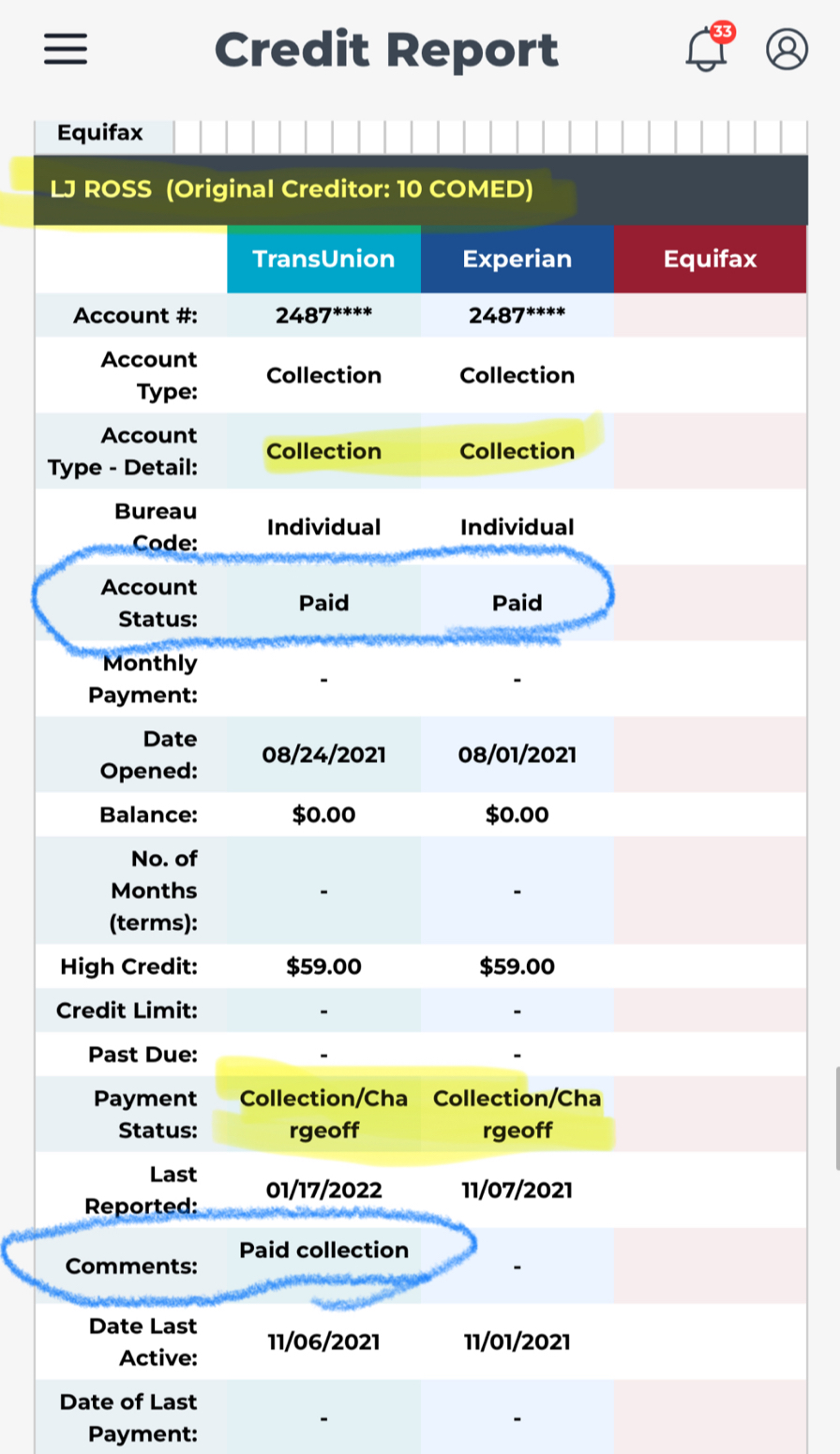
But What's The Problem If I Paid It?
Short Answer: Paying a collection DOES NOT HELP YOUR CREDIBILITY.
Example: I go to jail for stealing money out of Walmart's register. I do my time for it. When I get out of jail, I apply to work for Chase Bank. Do you think they'll hire me? I can't say "But I went to jail for it" because something like that should never have happened to begin with.
No different here. How the banks look at you: if you defaulted on your agreement several times already, what makes this time different? Would you continuously lend money to someone who never pays back on time?
The Smart Approach
Nothing wrong with settling a debt. It's just WHEN you settle it. Please allow me to explain.
- If you're ever behind on an OPEN ACCOUNT — yes, it is safe to get on a payment plan to pay it down.
- But if that account has already been closed & sent to collections, it's better to get it removed FIRST & then settle the debt.
- Even if you have to send them $20/month, I doubt they respond saying they no longer want the money. Especially since most companies require payment or settlement if you want to do business with them again.
- But if you pay them first, you'll find out the hard way that YOU STILL NEED TO GET IT DELETED — and you will be mad.
The ONLY TIME paying a collection makes sense before getting it removed from your credit report is if the company offers what's called a PAY FOR DELETE.
A negotiated agreement where you offer to pay a collection account (in full or for a settlement) in exchange for the creditor or collection agency completely removing the negative account from your credit report — not just marking it "paid."
Important Things To Know About Pay-For-Delete
1. It's not automatic. Creditors & collection agencies are not required by law to do Pay-For-Delete — it's voluntary.
2. Always get it in writing FIRST. If a company isn't willing to send you something in writing before receiving payment, TRUST ME, IT'S A BLUFF. They're telling you what you want to hear so you'll feel comfortable enough to pay, and they have no intention of actually deleting the account. Never send payment until you receive written confirmation that they will delete the account indefinitely.
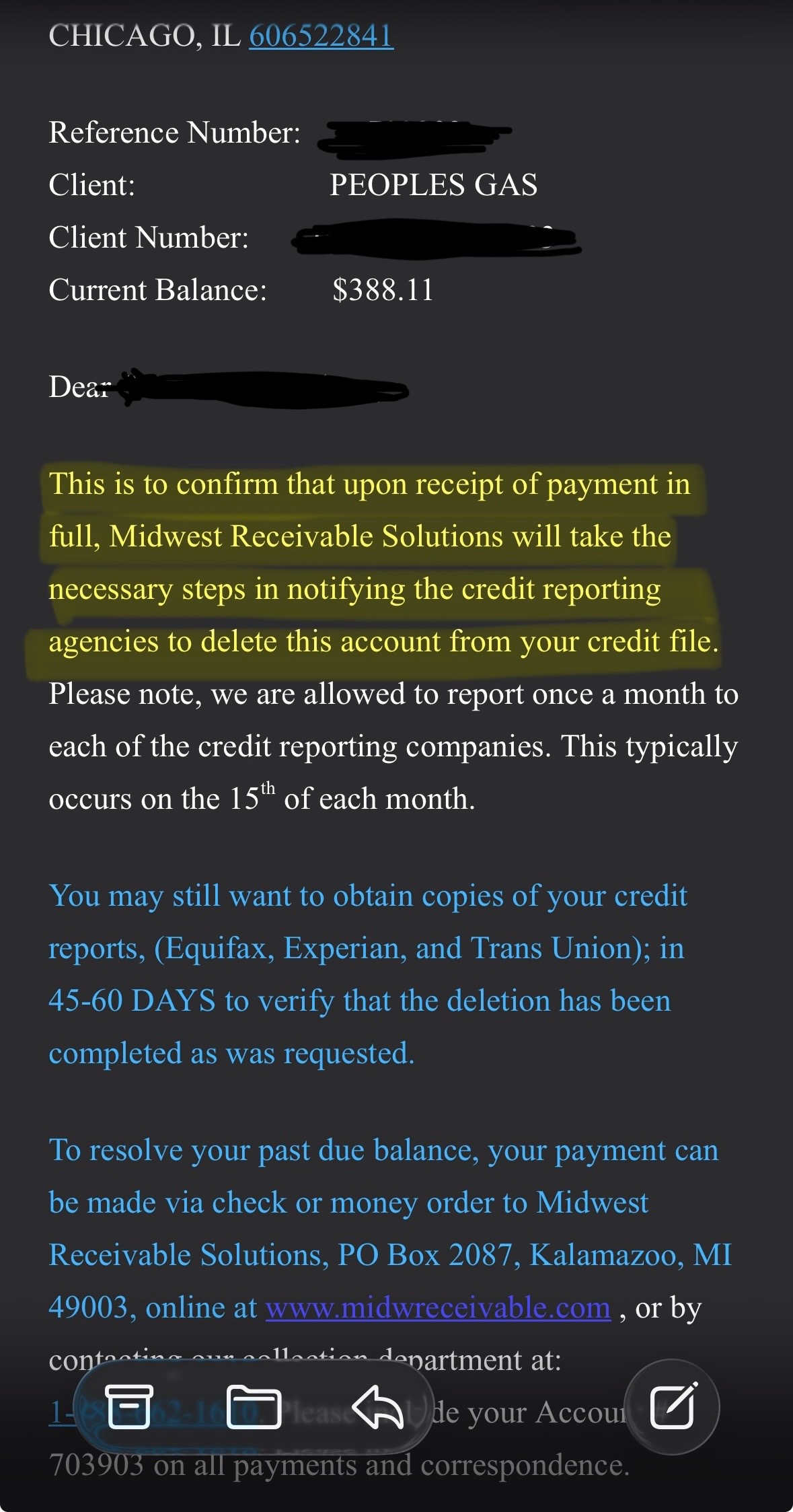
3. It works best with collection agencies. Original creditors (Capital One, Chase, etc.) rarely agree — but third-party collectors often will.
4. You can usually settle for less. Many accept 30%–60% of the balance for a PFD.
Simple Pay-For-Delete Script
"Hello, I'm calling regarding account #____. I'm willing to settle this balance today if you agree to delete the tradeline indefinitely from all credit bureaus upon payment. If you agree, please send written confirmation by email or mail before I submit payment."
Fun Fact: Every State Has A Statute Of Limitations On Debt Collection
Each state sets different time limits for different categories of debt. The clock doesn't run the same for everything.
Common Debt Categories That Matter (Illinois Example)
| Debt Type | Why It Matters | Statute Of Limitations |
|---|---|---|
| Written contracts | Credit cards, personal loans, auto loans | 10 years |
| Oral (verbal) contracts | Handshake agreements | 5 years |
| Open-ended accounts | Credit cards, lines of credit | 5 years (commonly argued) |
| Promissory notes | Student loans, auto loans, personal loans, installment loans | 10 years |
| Judgments | Court-ordered debts (completely different rules) | 7 years (renewable) |
How Statutes Of Limitations Actually Work
Each category can have a different statute — even within the same state.
What Starts The Clock? The statute of limitations clock usually starts at:
- Date of first delinquency (DOFD)
- OR date of last payment (varies by state & debt type)
⚠️ Any of the following can RESET the clock:
- Making a small payment
- Acknowledging the debt in writing
- Entering a payment agreement
If the statute of limitations has already surpassed, the only thing you really need to do is get the negative item deleted from your credit report so other lenders won't see the debt.
A lot of times consumers don't realize they're almost scot-free of paying a debt. When creditors & debt collectors convince you to get on a payment plan and you make that first small payment, THE CLOCK STARTS OVER.
This is why clients should NEVER casually agree to pay old debt without advice. If you pay them, it will be harder to get removed because now you look guilty. Why would anyone pay a debt that doesn't belong to them?
You may receive letters & emails threatening to garnish your check or sue. It's all a bluff to scare you into paying.
Can Something Come Back After Being Deleted?
Important Understanding
CREDIT REPAIR DOES NOT DELETE THE DEBT! — it only removes inaccurate, unverifiable, or outdated negative items from your credit report. You DO NOT Owe The DEBT COLLECTOR. But You DO OWE The Original Creditor.
But Credit Repair Is Still Important. The Purpose Of Credit Repair Is To Hide The Negative Items From Your Report So That They No Longer Hold You Back. Look at it as if you just got your RECORD EXPUNGED. Just because you get your record expunged doesn't mean you didn't do the crime and do the time. But when you apply for jobs THEY DON'T SEE THE FELONIES you have on your background.
In this case just because you get something removed from your report doesn't mean you don't have collections or negative accounts, but when you're applying for things. Other Banks & Lenders WON'T SEE THEM… This allows you to qualify for approvals you may have been denied before. Without having to wait 7-10 years. You May Just Have To Do Business With Another Company.
Example: Let's Say I Owe Capital One For An Auto Loan & I Want To Apply For Another Car. Almost Everyone Will Deny Me. But Once I Get That Auto Loan Deleted, It's A Million Companies That'll Allow Me To Finance A Car. But If I Want To Finance Another Car Through CAPITAL ONE — 9/10 I Will Still Have To Settle The Debt I Owe Them Because THEY PROBABLY HAVEN'T FORGOTTEN ABOUT ME. But Other Banks & Lenders Will Be Willing To Work With Me Because They Won't Be Able To See That I Owe Capital One.
Important to Understand:
If the statute of limitations to collect the debt hasn't yet passed, then you may still owe the original creditor, and it would be smart to settle with them AFTER THE DELETION — Even if you have to send them $20/month. I doubt they respond saying they no longer want the money. Especially since most companies would require payment or settlement if you want to do business with them again.
Can Items Be Reinserted?
Once an item has been deleted from your credit report, the credit bureaus are not supposed to reinsert it. However, in some cases, if the debt remains unsettled, a creditor or collection agency may attempt to re-report the account — often assuming that consumers are unaware of their rights under the Fair Credit Reporting Act (FCRA).
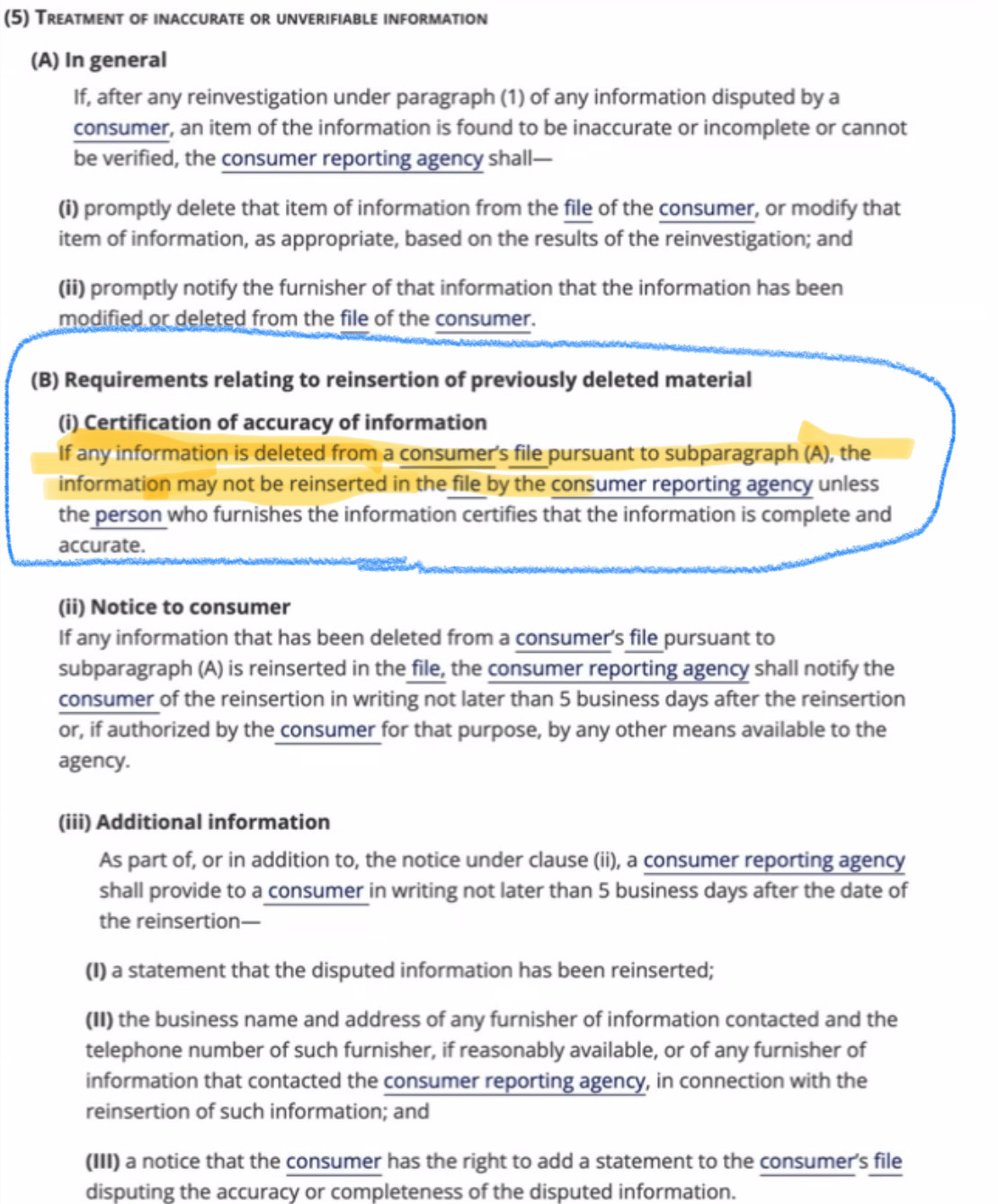
Active Client Protection
If you are an active client, as part of my service process, if a new collection account appears or a previously deleted collection reappears while you are actively enrolled in the credit repair program, it will automatically be included in the next dispute round at NO ADDITIONAL COST. While this is not a required part of the service, I handle it this way in good faith to help keep all clients on track and maintain the progress of their credit profile.
After Program Completion
Once all negative items have been removed and your file has been successfully completed and closed, the service is considered finished. If a collection account later appears or reappears after the completion of the program, there will be a $300 reactivation fee to reinitiate credit repair services — especially since you are being informed upfront about the possibility of re-reporting if you don't settle after the deletion.
How To Properly Set Up Your LLC
Regarding business credit, I educate clients on how to properly set up an LLC, establish relationships with banks, and position themselves to qualify for business funding. My goal is to teach clients how to apply independently. However, if you choose to have me assist directly with applications, I charge a 10% success fee based on the approved amount.
I also work with relationship managers at major institutions, including Chase, U.S. Bank, PNC Bank, Truist, Citizens Bank, the SBA, and American Express. These relationship managers are the individuals who actually review and approve applications, and I refer my clients directly to them. Additionally, I offer tradelines & shelf corporations, which function similarly to tradelines but for an LLC.
Setting Up Your LLC PROPERLY
Do These In This EXACT ORDER. Because When You Do Step 6, You Will Need To Put Steps 1–5 On The Application.
| Step 1 | Business Name | Not In A Restricted Industry |
| Step 2 | Business Address | Brick & Mortar |
| Step 3 | Business Phone | 800 Number |
| Step 4 | Business Email | Not A Gmail |
| Step 5 | Website | Nothing Related To Anything Restricted (Social Media Not Enough) |
| Step 6 | Apply For Business Entity | LLC |
| Step 7 | E.I.N | Your business social |
| Step 8 | Open Business Checking & Savings Bank Account | No Personal Bank Account. (MUST NOT BE IN CHEXSYSTEMS) Put $100 In Checking & Savings |
| Step 9 | Duns & Bradstreet Number | Making Sure Your Company Is Verified |
| Step 10 | Ask For Money | You have 30 days to remove the inquiries before they hit your credit report |
Picture A $50,000 Line Of Credit Waiting On You. For Every Red Flag 🚩 You Lose $5,000
| Find Out If Your Business Is In A High Risk Industry | $50,000 | https://fairfigure.com/blog/low-risk-naics-codes |
| Wrong Business Name? -$5,000 | $45,000 | Search For The Business Name Here — https://apps.ilsos.gov/businessentitysearch/ |
| No Business Email? -$5,000 | $40,000 | Google Workspace — $7–$14/Month https://workspace.google.com/business/signup/welcome |
| No Business Address? -$5,000 | $35,000 | Google Registered Agent For Your State ( Ex: Registered Agent Illinois ) |
| No Business Number -$5,000 | $30,000 | Google Voice, Grasshopper, RingCentral, SideLine, TextNow |
| No Business Website -$5,000 | $25,000 | Contact Harry — He's The One Who Created My Website. harry-castaner.vercel.app |
| No Duns & Bradstreet -$5,000 | $20,000 | Get Your D&B Number https://www.dnb.com/en-us/smb/duns/get-a-duns.html |
| No Business Bank Account | $0.00 | Must Have An ACTUAL BUSINESS BANK ACCOUNT To Receive A Business Loan |
☎ Customer Service Number: 312-584-9969
📧 Customer Service Email: Support@wealthyintention.org
What's Going On With My Credit?
Whenever you ask yourself "what's going on with my credit" please note that your Client Portal is also where you will come to track your own progress. Keep in mind each round will be 45 days — which is essentially one and a half months. Please be patient with our team while we work on each client's results. By law we have to give the credit bureaus that time frame to view a client's file and validate the debt/inaccuracies. So results won't show overnight, but here's how you can stay in the loop:
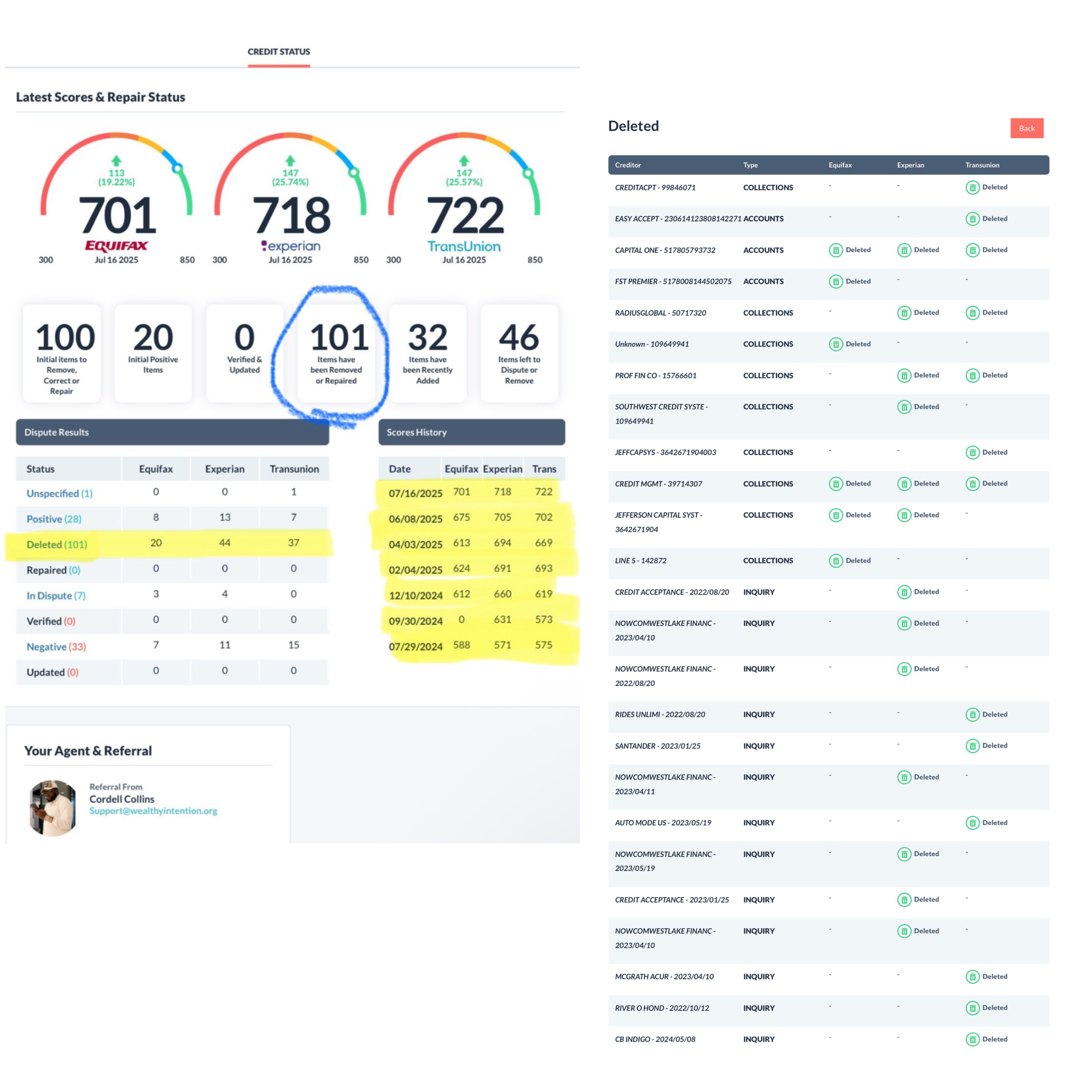
- Check your portal — see what's actually being disputed and what's been deleted so far. (You DO NOT Have To Check Your Portal Every 2 Weeks. It Will Only Update After Each Round.)
- Actually log into your credit monitoring account with IDIQ or MFSN — compare before & after. Look for deleted accounts, updated balances, or status changes.
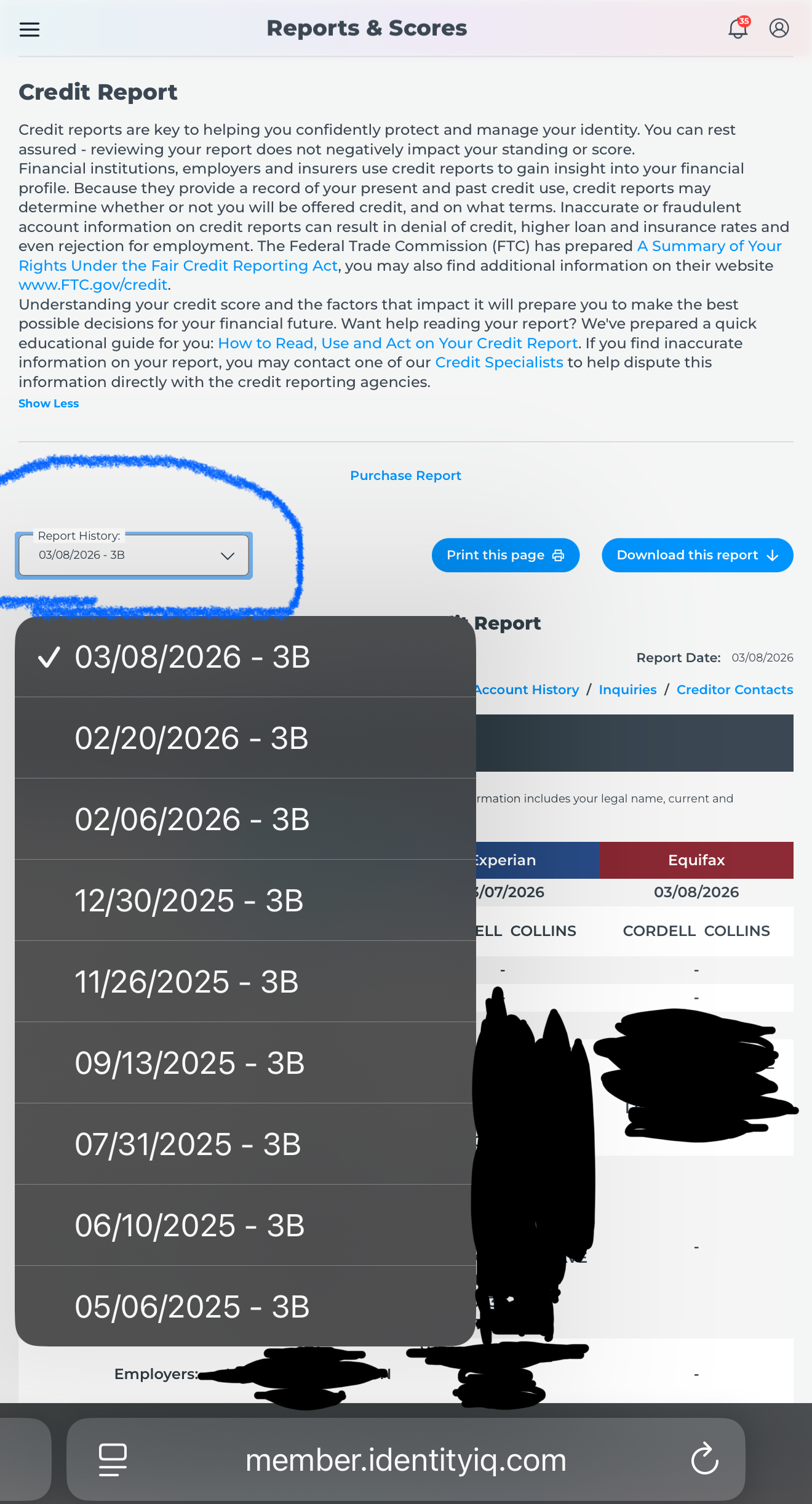
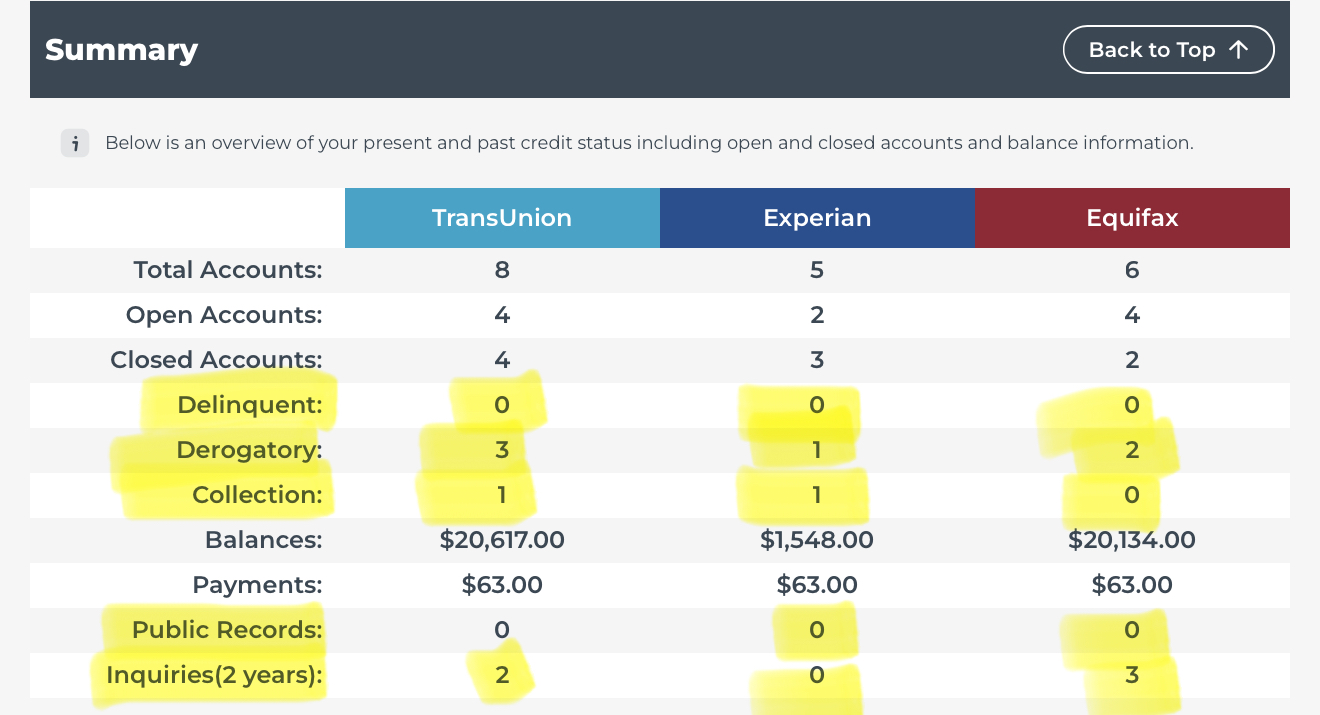
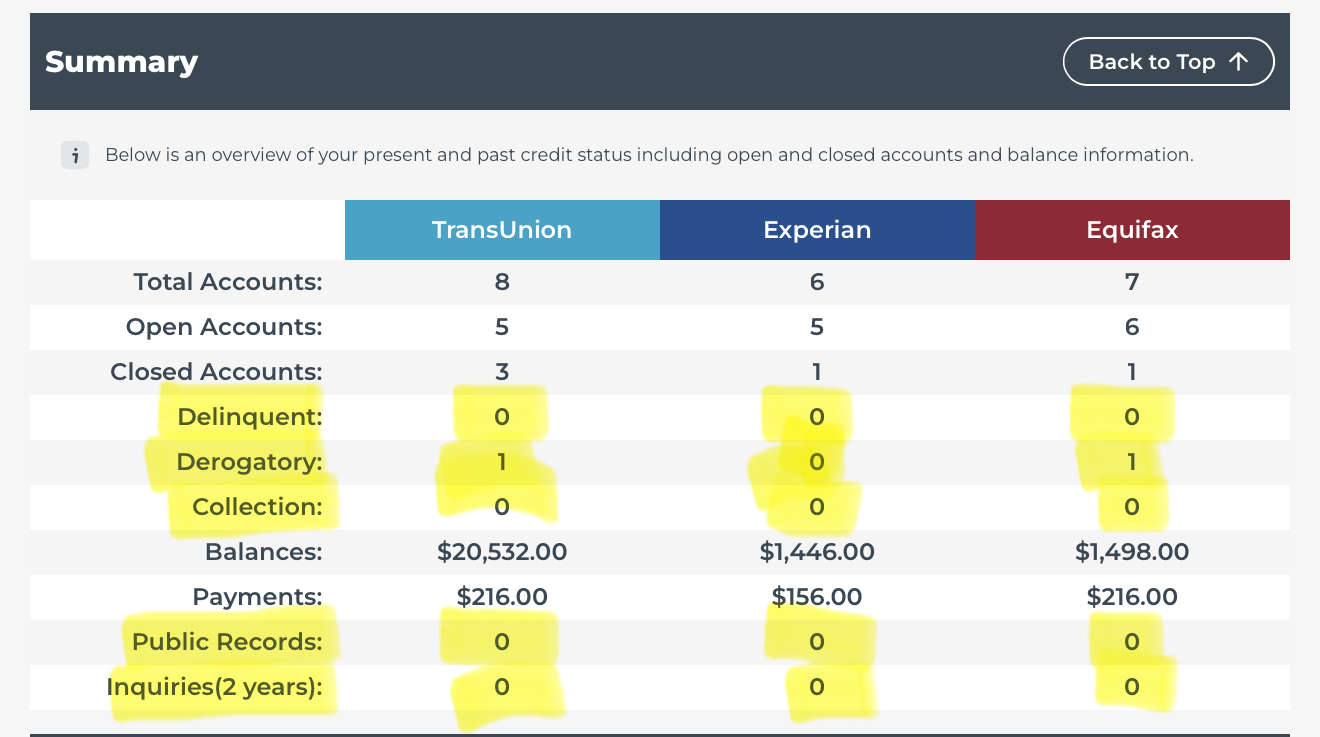
- Watch your scores (but don't obsess) — they will fluctuate, but overall trends matter most. Remember your Report & Profile are far more important than your scores.
- Ask me questions — if something looks off or confusing, Book a free consultation.
Please allow up to 4 business days in between rounds. Your Client Portal WILL NOT UPDATE UNTIL AFTER your dispute letters are sent out for the next round. Then you’ll be able to see the difference in the amount of deletions & score changes. After each round, any remaining negative items automatically go into your next round of disputes.
Please Understand That A Update Is Strictly Just A Update. It Doesn't Mean You Will Have A Score Increase Every Round Or Something Will Be Deleted Every Round.
You Can Expect Certain Rounds With No Change. That's Completely Normal as It is Apart Of The Process. Believe It Or Not It Actually Helps With You Getting Deletions Because It Helps Us Catch The Credit Reporting Agencies Up In Violation Even More Than They Already Were.
How To Avoid Late Payments
Contact the Creditor Immediately — DO NOT WAIT until you miss a payment.
Call your lender or credit card company and say: "I'm experiencing a temporary financial hardship and want to avoid falling behind. What options do you have to help me stay current?"
Most lenders have hardship programs that can:
- Reduce your monthly payment
- Lower your interest rate
- Pause payments temporarily
- Change your due date
👉 This is your #1 best move to protect your credit.
- Ask for a "Payment Deferral" or "Skip-A-Payment" — especially common with auto loans. You may skip 1–3 payments added to the end of the loan while staying current. ⚠️ Some lenders charge a small fee or still accrue interest.
- Minimum Payment Strategy (Credit Cards) — Always pay at least the minimum (put it on autopay). Even $30–$50 prevents a late payment from reporting. A late payment is only reported after 30 days past due.
- Use the Grace Window — Bureaus do NOT report late payments until 30 days late. You still have time to fix it before it hits your report.
- Ask To Change Your Due Date — Most lenders allow this. Move it to align with your paycheck to prevent future misses.
🧠 Simple Game Plan:
- Call lender TODAY
- Ask for hardship or deferral
- Pay at least the minimum if possible
- Mark your calendar before 30 days hits
👉 Communication is what protects your credit — not silence. Lenders are WAY more flexible before you fall behind than after.
⚠️ If nothing is done: Car → risk of repossession | Loans & Credit Cards → charge-off after 120–180 days | Severe credit damage + collections.
What Is A Debt To Income Ratio (DTI)?
Debt-to-Income Ratio (DTI) is a simple but very important number lenders use to decide whether to approve you, how much to approve, and what terms you get.
Your DTI is the percentage of your gross monthly income that goes toward monthly debt payments. In short: It tells lenders how much of your income is already spoken for.
DTI = (Total Monthly Debt ÷ Gross Monthly Income) × 100
Why DTI Matters
• Determines loan approval
• Affects credit limits
• Impacts interest rates
• Can stop you from getting a mortgage even with a 750+ credit score
🔑 You can have a great credit score and still get denied because of high DTI.
DTI Guidelines Lenders Use
• 0-36% → ✅ Excellent - Most lenders love this
• 37-43% → ✅ Acceptable for most loans
• 44-50% → ⚠️ High - harder to get approved
• 50%+ → ❌ Most lenders will deny
DTI Calculator
Calculate your Debt-to-Income Ratio
Your Debt-To-Income Ratio
My Credit Is Already Good. I Just Need Business Funding
If your credit is already good, realistically you don’t need me or anyone else to obtain business funding. You should be able to just apply and get approved, and the process should be a very smooth transaction. On the flip side If are not in a position to confidently request six-figure funding from a financial institution, your credit profile may not be as strong as you believe. Having "good credit" means more than a high score.
For the statement "I have good credit" to be accurate, four key elements must be in place:
Good Credit Score ( 720+ )
Clean & Accurate Credit Report
Strong Credit Profile
LLC SET UP PROPERLY
Why Do You Need All Four? Because All 4 Combined Is WHAT MAKES YOU CREDIBLE. And Remember YOUR CREDIT IS YOUR CREDIBILITY.
A good CREDIT SCORE doesn’t mean you’re approved. But without a good credit score, you most likely won’t QUALIFY TO APPLY for most things you actually want.
You can have a good credit score and still fail the application by either putting the wrong information on an application or by not having clean and accurate credit report. Ultimately leading to being denied.
You can have a good credit score, clean & accurate credit report, but still be denied due to having a WEAK PROFILE.
Even if you had a good credit score, clean/accurate credit report, and a strong profile. You can still be denied business funding if the LLC is not set up PROPERLY. Entity structure, compliance, and financial alignment play a critical role in lender approval. Your LLC/Business is WHAT GIVES YOU ACCESS to over 150K or more. Not to mention all of the tax benefits associated with being a business owner.
This is a separate—but equally important—conversation. If you would like to determine whether your LLC is properly established or need assistance with setup and compliance, you are encouraged to schedule a consultation.
Short Answer: Yes,
but it’s not as simple as these Youtube & TikTok gurus make it seem.
May I remind you that your CREDIT is your CREDIBILITY. Meaning your financial reputation with banks, credit unions, and lenders. It tells financial institutions how you’ve handled the ability to borrow money and repay it responsibly.
I understand that many people have adopted the mindset that “business credit is completely separate from personal credit.” While there may be some truth to that when it comes to receiving an hard inquiry or reporting utilization on business credit cards to your personal credit report. What people fail to realize is that you establish BUSINESS CREDIT the same way you establish PERSONAL CREDIT. By getting approved for credit and PROVING THAT YOU CAN PAY IT BACK ON TIME.
Whether we’re talking about personal credit or business credit, lenders ultimately want to see the same thing:
Can we trust you with our money?
That’s why I always say: CREDIT = CREDIBILITY. Think about it: You cannot build a credit history without first establishing a history of borrowing and making on time payments.
The stronger your track record, the more confidence banks and lenders can have in doing business with you. I say that to say this….
Major Lenders Vs Private Lenders
Two Popular Ways Of Receiving Funding.
Who Is This For?
This opportunity is available to business owners who meet the revenue requirements, but it can be especially valuable for individuals who need access to business capital now and do not want to wait until the credit repair process is complete.
No Minimum Credit Score Required
Minimum Revenue: $10,000 PER MONTH
Business Bank Account Required
Tax Returns Preferred, But Not Always Required.
Funding Amount Based Primarily on Business Revenue & Cash Flow
Potential Opportunity to Refinance & Access Additional Capital Every Halfway Mark Of Loan Term
Finish the online application process and receive your funds in as little as 24 hours-72 Hours.
I can assist business owners with obtaining business funding based primarily on their monthly revenue & cash flow, If they can provide verifiable business bank statements and tax returns.
To qualify, the business should consistently generate a minimum of $10,000 per month. ALL REVENUE must be deposited into an established BUSINESS BANK ACCOUNT. This means you CANNOT combine personal bank statements with business bank statements to meet that 10K mark.
Having business tax returns can strengthen the application, but they are not necessarily a deal breaker if you do not have them.
How the Funding Works
This is revenue and cash flow-based funding, meaning the amount you may qualify for is primarily determined by how much revenue your business generates each month and how much money you’re keeping in the bank account at all times.
For example, if your business consistently generates $50,000 per month, you could potentially qualify for funding in the range of approximately $40,000–$50,000+, depending on the lender’s underwriting and other qualifying factors. If your business only generates $10,000 per month then you may only qualify for about $7,000-$15,000.
Another major benefit is that every halfway mark of the loan term, you may have the opportunity to refinance and apply for additional funding, subject to continued qualification. This means if you take out a 10K loan for example and have 12 months to pay it off. The halfway mark for 12 months would be 6 months. So at the 6 month mark if you have made all payments on time up to that point, you could potentially qualify to refinance the loan for more capital.
Secure an instant pre-approval. Our application process is straightforward and can be completed in seconds.
Apply Here:
Business Financing
If you do not already have an established business that’s generating a minimum 10K Per Month, then unfortunately this option does not work for you. A major lender would be a much better fit as business revenue is not a deal breaker.
💳
Some major banks and credit unions include Chase, Navy Federal, Bank of America, Wells Fargo, PNC and many others as the list goes on.
Who Is This For?
This option is available to newly established business owners and small businesses. It can be especially valuable for individuals with a strong personal credit profile who want access to traditional bank financing. If your goal is to qualify for traditional bank loans, lines of credit, or higher-limit credit products with potentially more favorable rates and terms, building a strong credit profile is extremely important.
When it comes to traditional loans from major lenders there is something very important that every future or current business owner needs to understand:
A BUSINESS LOAN doesn’t automatically mean your personal credit is irrelevant. Simply having a “BUSINESS ” does NOT guarantee that your business WILL MAKE MONEY.
Think about it this way:
If you take out a $50,000 business loan, but your business isn’t generating enough revenue to comfortably repay that loan, who does the business ultimately have to fall back on?
THE ANSWER IS YOU. 🫵🏾
This is exactly why personal credit plays a major role in business funding. At the end of the day banks & lenders still want to know, WHAT HAVE YOU DONE?
Lenders will review YOUR FINANCIAL HISTORY to judge your ability to repay when deciding whether they are willing to extend financing. Especially for NEWER businesses or businesses that lack substantial revenue to stand on its own. The lender then expects YOU—the owner to stand behind it.
Getting approved is only the beginning. Consistently making your payments on time and properly managing the credit extended to you is what builds credibility.
In conclusion
If your business isn’t consistently generating at least $10,000 per month, or if you can’t show that you’re capable of MANAGING $10,000+ on the PERSONAL SIDE—such as credit cards, auto loans, personal loans, student loans, or mortgage loans—or if you still have maxed out credit cards & collection accounts showing that YOU OWE MULTIPLE COMPANIES, ask yourself:
Why should a lender trust you with a $50,000+ business loan?
If this sounds like you, then you may need to rely heavily on your personal credit and a personal guarantee to qualify for certain types of business financing.
That said Step 1 would be to position yourself to actually QUALIFY FOR A BUSINESS LOAN through a major financial institution. You would do this by focusing on removing any negative items & unnecessary inquiries from your credit report. While improving your credit scores to a 720+ and strengthening your personal credit profile to better position yourself for business financing.
This is where I come in. I’d be happy to help you through that process, and we can begin by scheduling a consultation to review your current credit situation and determine the best path forward.
Can You Help With ChexSystems & Early Warnings Removals?
If you are in ChexSystems or Early Warning then that means that you have been violated. Read 15 USC 6802 - 15 USC 6805. If you read your terms and conditions and privacy agreements of your credit card accounts and banking information, it tells you that they do not share your personal information with any 3rd party non-affiliate…
Third Party Non-Affiliates Include:
• Lexis Nexis
• Experian
• Equifax
• Transunion
• Early Warning System
• ChexSystems
What we don't realize is when we open up these accounts, we have the option to opt out so they don't share our information — but they don't outright tell us that in plain English either. In their privacy agreements and terms and conditions, it states that they don't share your info, but yet they do anyway, which is a violation.
Request your consumer report from both websites & send me over the PDFs once you receive them.
ChexSystems:
https://www.chexsystems.com/request-reports/consumer-disclosure
Early Warnings:
https://www.earlywarning.com/faqs-requesting-your-file-disclosure
ChexSystems Customer Service: 800-428-9623
Early Warnings Customer Service: 800-745-1560
Representatives are available to assist during normal business hours 8AM to 7PM Central Time, Monday - Friday excluding federal holidays.
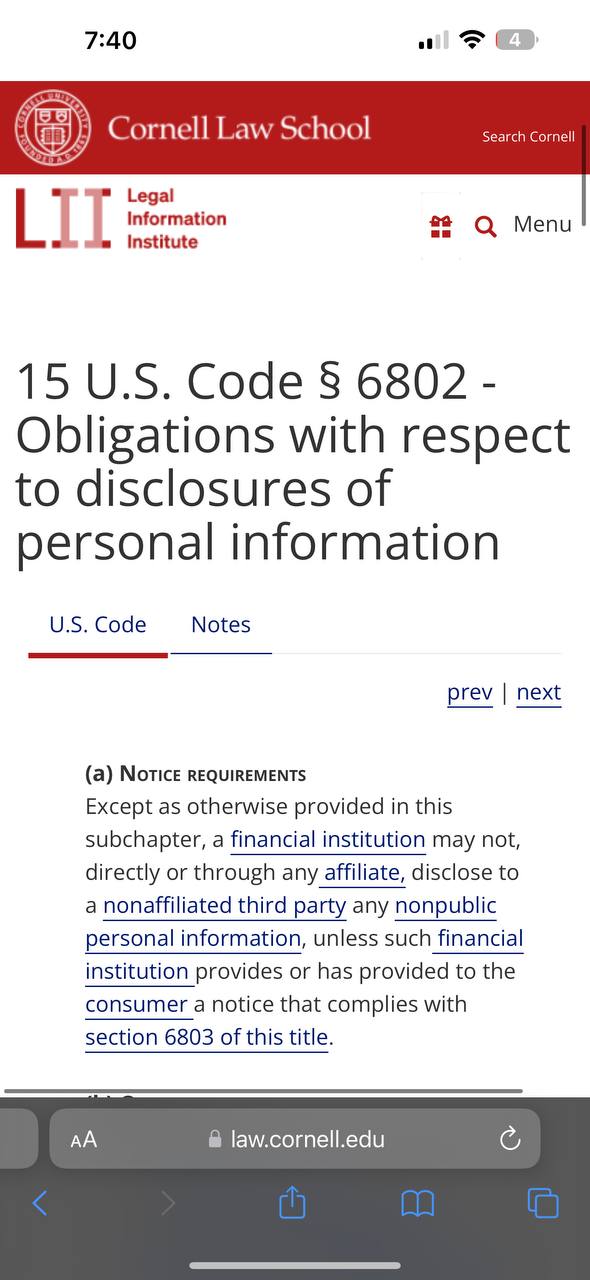
Payment Requirements:
• Payments must be paid IN FULL before we begin the process
• Afterpay, Klarna, and Zip are acceptable
After that, we will mark up any information you do not recognize or whatever is negative and start the disputing process. This process can take up to 3 months.
What Are Some Good Credit Cards To Apply For?
Credit Card Ladder 🪜
Side Note: YOU DO NOT NEED EVERY LAST CREDIT CARD LISTED…. These Are Just EXAMPLES ‼️
Important Reminder
While there's nothing wrong with applying for maybe 2–3 credit cards in the same day, realistically speaking you generally want to wait at least 6 months before every new inquiry.
New credit can lower your CREDIT HISTORY, and too many inquiries back-to-back make you look desperate for money.
So please don't go too crazy just because you have a good credit score and a clean credit report.
Starter Cards 💳
These are the cards we will use to get our credit going 🪜 — considered ENTRY LEVEL CREDIT CARDS. These are specifically for people with bad credit, decent credit OR NO CREDIT.
⭐ Wealthy Intention — Credit Builder Card (Cordell's pick)
- Built by Wealthy Intention LLC — designed specifically for clients in the credit-repair journey
- Reports to all 3 bureaus — great for building a fresh positive trade line
- Graduates after consistent on-time payments (deposit returned, account converts to unsecured)
- Pairs with the rest of the program — no need to bank elsewhere first
💳 Capital One Platinum
- No annual fee — designed for fair / rebuilding credit
- Automatic credit limit increase after on-time payments
- Pre-approval with no hard inquiry first
- Reports to all 3 bureaus (great for building profile)
🏦 Navy Federal Platinum Card
- VERY LOW APR (one of the lowest in the industry)
- No annual fee — great for balance transfers / debt payoff
- Strong limits $2,000–$10,000 with Navy Federal relationship
⚠️ Must be eligible for Navy Federal (military, family, etc.)
Apply Now →✨ Capital One Quicksilver
- Unlimited 1.5% cash back on EVERYTHING
- $200 welcome bonus | 0% intro APR ~15 months | No annual fee
- Good upgrade path from Platinum — daily spender card
🏃 Chase Freedom Rise
- Designed for new credit / low credit history
- Helps build relationship with Chase (VERY important bank)
- Cashback rewards | No annual fee | Higher approval odds if you bank with Chase
🔒 Discover it® Secured Card
- 💳 Builds credit from scratch | Still earns cash back
- 🔁 Can upgrade to unsecured + get deposit back | No annual fee
- Requires deposit ($200+) — Best for clients starting over or rebuilding
👎 Bad Starter Cards (crazy interest rates, low limits) — AVOID: Open Sky, Credit One, First Premier, Store Cards
Beginner Cards 💳 (700+ Credit Score, 2–5 Cards MAX)
By the time you get to this point you should be at a 700+ credit score from 2–5 cards MAX. These cards are the next step up — better rewards, higher limits, and stronger long-term relationships with the major banks.
🍽️ Capital One Savor
- High cash back on dining, entertainment, streaming, groceries
- 💰 Unlimited cash back (no caps) | Strong welcome bonus | No foreign transaction fees
🔵 Discover It
- 5% rotating categories | Cashback Match (DOUBLE all cash back first year)
- Known for credit limit increases over time | No annual fee
- 👉 One of the STRONGEST beginner cards for rewards + growth
💰 Navy Federal Cash Rewards (Up To $25,000)
- Up to 2% cash back | $250 bonus | HIGH LIMITS (10K–25K+)
- Rewards don't expire | No annual fee | Best for funding plays + BIG limits early
⚠️ Must qualify for Navy Federal (military / family)
Apply Now →✈️ Chase Sapphire (Min $5,000 Limit)
- Top-tier travel rewards | 3X dining, 2X travel | Huge welcome bonus (60K–75K+ points)
- Travel protections | $5,000 minimum limit (Visa Signature)
- 👉 Best for travel + building a premium credit profile
Amateur Credit Cards 💳 (Higher Limits $10,000+ | 3–6 Months)
After 3–6 months of consistent payments and clean profiles you can step up to these. Expect higher limits ($10,000+), stronger rewards, and bigger sign-up bonuses. These are the cards that start unlocking real funding power.
💵 American Express Blue Cash Everyday®
- 💰 3% Cash Back on groceries, gas, online shopping | $0 Annual Fee
- 0% Intro APR (12–15 months) | Welcome bonus $150–$250+
- 👉 Good for: beginners, everyday spenders, clean profiles
🍎 Apple Card (Up To $30,000)
- 2% Cash Back on Apple Pay | 3% at Apple + select partners
- 📲 Instant approval (soft pull first) | Daily Cash paid out daily
- Can get limit increases fast | Great for Apple product financing (0% plans)
🔄 Chase Freedom Flex
- 💰 5% rotating categories | 3% dining + drugstores | 5% travel (Chase portal)
- 0% APR ~15 months | $0 Annual Fee | $200+ bonus
♾️ Chase Freedom Unlimited
- 💰 1.5% unlimited cash back on EVERYTHING | 3% dining + drugstores
- 0% APR ~15 months | $0 Annual Fee | $200–$250 bonus
- 👉 This is your "daily swipe" card — no thinking, just earn on everything
Free Travel Cards 💳 (Annual Fees, MAX REWARDS, Best Benefits)
The Goal Is To Travel FOR FREE. Only if you travel at least 1–3X per year.
🥇 American Express Gold Card ($325/yr)
- 🍽️ 4X Points on Dining Worldwide | 🛒 4X Points on Groceries
- 🎁 Monthly credits (Uber, dining, etc.) — total $500+ yearly value
- Can out-earn the annual fee with credits | Builds strong Amex relationship
- 👉 Perfect for stacking points FAST — daily spender card
👑 American Express Platinum Card ($895/yr)
- ✈️ 5X Points on Flights & Hotels | 🛫 1,400+ Airport Lounges Worldwide
- 💼 NO preset spending limit | Airline, Uber, Hotel, Streaming credits
- 👉 Best for business owners, travelers, and high spenders
⚓ Navy Federal Flagship Card (Up To $50,000)
- 💳 HIGH LIMIT approvals | ✈️ 3X Points on Travel | 💰 2X Points on Everything
- FREE Amazon Prime (~$139) | TSA PreCheck / Global Entry credit (up to $120)
- Low annual fee (~$49) | No rewards cap or expiration
- 👉 Hidden gem for funding + travel combo
Business Credit Cards 💳
Max Travel, Crazy Rewards, High Limits, And 0% Offers 8–18 Months
| Card | Best For | Key Perk |
|---|---|---|
| Capital One Venture X Business | Best overall travel | 2X–10X miles, $300 travel credit, lounge access |
| Amex Business Platinum | Status + big funding | 5X on flights/hotels, 1,500+ lounges, no preset limit |
| Chase Ink Business Preferred | Chase ecosystem | 3X travel/shipping/ads, $1K+ signup bonus |
| Chase Ink Business Cash | Easy approval + 0% | 0% APR 12 months, 5% cash back, $0 annual fee |
| Chase Ink Business Unlimited | Simple stacking | 0% APR 12 months, 1.5% unlimited, $750 bonus |
| Amex Blue Business Cash | Clean profiles + Amex | 0% APR 12 months, 2% cash back, no annual fee |
| Amex Blue Business Plus | Low-key travel points | 0% APR 12 months, 2X points everything, no annual fee |
| U.S. Bank Triple Cash Business | Longest 0% offer | 0% APR 12–18 months, 3% categories, $500 bonus |
| BofA Business Advantage Travel | Travel + 0% combo | 0% intro APR, travel rewards, no annual fee |
| Wells Fargo Signify Business | High spend + simple | 0% APR 12 months, 2% flat cash back, no annual fee |
I Am Being Sued Or Threatened To Have My Check/Wages Garnished
Need A On Hand Lawyer? Click Here:
Legal | LegalShield Associate
Wealthy Intention is partnered with a Law Firm to help you better protect yourself and your family. Click that exact link for a discount. I personally have the PERSONAL PLAN & the BUSINESS PLAN and wouldn’t recommend something I didn’t feel was legit. You can click on the Preferred Package or the Premium Package. It shows a list of everything that’s included in each package. Please note that regardless of what package you may choose but they do cover EVERYTHING and anything not on the list you will receive a 15%-25% discount depending on which package you choose.
Disclaimers:
I am not a financial advisor or attorney. I simply provide information and guidance that has helped many individuals improve their credit profiles.
If you are currently being sued or experiencing wage garnishment, It Is Not My Responsibility To Fix That. That matter falls outside of my services and must be addressed directly with your local county clerk or the court handling your case.
You may be able to request an Earner Wage Plan or explore payment arrangement options through the court, especially if your monthly expenses exceed your income they may not legally be allowed to garnish your wages.
That said, court action is often used as a pressure tactic to encourage payment — however, it is important that you do not ignore any legal notices. Make sure you respond appropriately and on time. Once Again I Am Not A Financial Advisor, but I hope this helps provide clarity & assistance.
Step 1, Part 1:
If you are being summoned to court AKA being sued by a debt collector or a collection agency the first thing to do is to check to see if the debt collector, credit card company, finance company etc has an arbitration agreement.
When you applied to those loans and credit cards the agreements were there ( of course they don’t tell you though. ) You can google the company’s name and type arbitration agreement and it will show.
If they have an arbitration agreement that means they were supposed to try to settle with you outside of court. Even if it’s a debt collector suing you they are bound by that original contract and Arbitration agreement. If your car has been repossessed this is a strategy you can use to get it back as well.
Step 1, Part 2:
You can FILE A MOTION TO REMOVE THE LAWSUIT DUE TO MANDATORY ARBITRATION AGREEMENT or FILE A MOTION TO COMPEL ARBITRATION.
You will file this in the county clerks office where you reside. ( Address should be at the top right of the letter you received ) This applies to collection agencies as well who have bought the debt from the original creditor. The arbitration agreement still applies when they purchase that debt.
Step 1, Part 3:
Once you file that motion the judge will decide whether to dismiss the case due to Arbitration Clause and the debt collectior or collection agency may reach out to you to negotiate.. If you already have a judgement against you then you will file a "STAY OF JUDGEMENT" due to mandatory ARBITRATION CLAUSE.
This will temporaily put a pause on the judgement and also stop wage garnishments pending the outcome of Arbitration. When you submit your motion make sure you submit it with the arbitration agreement.
This Is The Law that can help you. It says 9 U.S. Code 4 Failure to arbitrate under agreement; petition to U.S. court having Jurisdiction for order to compel arbitration; notice and service thereof; hearing and determination
__________________________________________
The 2nd Thing You Should Do Is See If The STATUTE OF LIMITATION HAS ALREADY PASSED FOR THAT DEBT.
Please Understand they cannot legally garnish your wages without a court judgment — and they usually cannot win a lawsuit once the statute of limitations (SOL) has expired. Yes, a creditor can still file a lawsuit — even if the SOL has passed.
However:
• The debt becomes “time-barred”
• If you raise the statute of limitations as a defense in court, the case should be dismissed
• If you do not respond to the lawsuit, they can still get a default judgment
This is where people get caught. Even expired debt can turn into a judgment, but ONLY if you ignore the summons.
Can they garnish your check after the SOL ( statute of limitations ) expires?
🔹 If there is NO judgment:
No. They cannot garnish wages without first suing you and winning.
🔹 If they somehow get a judgment:
Yes. Wage garnishment is possible because judgments have their own statute of limitations, which is different from the original debt SOL.
For example:
• In Illinois, judgments are generally enforceable for 7 years and can be revived.
• Other states range from 5–20+ years.
Very Important: You can accidentally restart the SOL
In many states, the statute of limitations can restart if you:
• Make a payment
• Agree to a payment plan
• Acknowledge the debt in writing
• Sometimes even verbally admit it (depends on state law)
That’s why you NEVER want to casually say:
“Yeah I owe it but I’ll pay later.”
___________________________________________
Educational
Learn about credit, understand the process, and master financial literacy
How To Read Your Credit Report
A credit report is a detailed record of your credit history and financial behavior. It shows lenders, banks, and creditors how you have managed borrowed money over time.
In the United States, credit reports are maintained by the three major credit bureaus:
Equifax Experian Transunion
These companies collect information from lenders, credit card companies, and collection agencies to build your report.
What Information Is On a Credit Report
1. Personal Information
This section identifies you. It may include:
• Full name and any previous names used
• Current and previous addresses
• Social Security number (partially masked)
• Date of birth
• Employers (past and present)
What you want to see
When reviewing the Personal Information section of your credit report, the goal is to maintain a clean and consistent profile. Ideally, your report should display:
• One name
• One current address
• One date of birth
• One current employer
Having multiple variations of names, addresses, or employers can sometimes create inconsistencies within your credit file. These inconsistencies may allow negative accounts or collections to remain linked to your profile.
While our team can submit dispute letters to request corrections, clients can often help speed up the process by contacting the credit bureaus directly:
• Equifax - 800-685-1111
• Experian - 888-397-3742
• TransUnion - 800-916-8800
If you notice incorrect or outdated personal information, you may contact the bureaus to request an update or removal.
It is also important to ensure that your government-issued ID or driver’s license reflects your current address. If your identification still shows an old address, the credit bureaus may consider those addresses accurate, which can make them more difficult to remove.
Keeping your identification updated can significantly help the process of removing outdated or incorrect personal information from your credit report.
2. Credit Scores
It’s your credit grade—a number that tells lenders how risky or reliable you are.
3. Risk Factors
Risk Factors are the key reasons why your credit score is not higher.
👉 In simple terms:
They tell you what’s hurting your credit the most right now.
They show exactly what to fix
• Help you prioritize what’s hurting you most
• Give insight into how lenders view your profile
4. Summary
The Summary is a quick overview of your entire credit profile.
👉 In simple terms:
It’s a snapshot that breaks down everything on your credit report at a glance. ( Soft Pulls & Pre-Approvals )
5. Account History
Account History is a detailed record of how an account has been managed over time—especially your payment behavior month by month.
👉 In simple terms:
It shows your track record for all account both open and closed.
| Company’s Name | Navy Federal Credit Union | Example | ACTUAL |
|---|---|---|---|
| Account #: | Account Number is a unique identifier assigned by the creditor to a specific account. | Full: 1234567890 • Report may show: XXXXXX7890 | 31** |
| Account Type: | Account Type tells you the general category of the account—how the credit is structured and how it’s meant to be repaid. | Revolving, Installment, Open Credit | Revolving |
| Account Type - Detail: | Account Type – Detail gives a more specific description of the type of account you have. | 🔍 Examples of Account Type – Detail 💳 Credit Cards (Revolving Accounts) • Bank Credit Card • Retail / Store Card (ex: store financing) • Secured Credit Card ⸻ 🚗 Loans (Installment Accounts) • Auto Loan • Personal Loan • Student Loan • Mortgage Loan | Credit Card |
| Bureau Code: | Bureau Code identifies how you are connected to an account on your credit report. | It tells you your role or responsibility for that account. Individual, Authorized User, Joint, Co-Signer/ Co-Borrower | Individual |
| Account Status: | This lets banks & lenders know whether this account is open or closed, & negative or positive | Open, | Open |
| Monthly Payment: | Monthly Payment is the amount you are required to pay each month on an account to keep it in good standing. | Credit Card Balance: $2,000 • Monthly Payment: $60 ➡️ You must pay at least $60 to avoid being late | $20.00 |
| Date Opened: | Date Opened is the exact date when an account was originally created or started. | Credit Card opened: February 1st, 2024 ➡️ That account has been active for 2+ years | 02/01/2024 |
| Balance: | the total amount you currently owe on an account. | $756.00 | $756.00 |
| No. of Months (terms): | refers to the total length of time you agreed to repay a loan. | 0 | 0 |
| High Credit: | The displays the most money you ever spent on a credit card. Or what the installment was originally worth before you started making payments. | • Credit Limit: $5,000 • Most you ever used: $3,200 ➡️ High Credit = $3,200 | $4,787.00 |
| Credit Limit: | Credit Limit is the maximum amount a lender allows you to borrow on a revolving account (like a credit card). | Credit Limit: $5,000 • Current Balance: $1,500 ➡️ You still have $3,500 available to use | $11,100.00 |
| Past Due: | Past Due is the amount of money you owe that should have already been paid—but wasn’t paid on time. | Monthly Payment: $150 • You missed 2 months ➡️ Your Past Due = $300 | $0.00 |
| Payment Status: | Payment Status tells you the current condition of an account and how it’s being paid (or not being paid). | Current, Collection/Charge-Off | Current |
| Last Reported: | Last Reported is the most recent date that the creditor updated information about your account to the credit bureaus. | Last Reported: 02/15/2026 ➡️ This means the creditor last sent an update about this account on February 15, 2026 | 02/06/2026 |
| Comments: | Comments are notes or remarks added by the creditor or credit bureau that give extra details about an account. | In collections” 🚨 → Sent to a collection agency • “Settled for less than full balance” ⚠️ → You paid less than what was owed | - |
| Date Last Active: | It shows the last time the account was used or had any movement. | You used your credit card on January 10, 2026 • Or made a payment on that date ➡️ Date Last Active = 01/10/2026 | 02/01/2026 |
| Date of Last Payment | It shows the last time you actually paid toward that account. | You made a payment on February 5, 2026 ➡️ Date of Last Payment = 02/05/2026 | 02/01/2026 |
6. Payment History
This is one of the most important parts of the report. It shows:
• On-time payments
• Late payments (30, 60, 90, 120 days late)
• Collections, Charge-offs or repossessions
Your payment history heavily influences your credit score.
7. Credit Inquiries
Account Inquiries are records of who has accessed your credit report and when.
👉 In simple terms:
They show who checked your credit and why.
Two types:
• Hard inquiries – when you apply for credit (can affect score)
• Soft inquiries – background checks or when you check your own credit (no impact)
8. Public Records
Some serious financial events may appear here, such as:
• Bankruptcies
• Tax liens
• Civil judgments (less common now)
9. Creditors Contact
Creditor’s Contact Information provides the details of the company that owns or reports the account.
👉 In simple terms:
It tells you who to contact about that account.
How To Avoid Late Payments
Contact the Creditor Immediately — DO NOT WAIT until you miss a payment.
Call your lender or credit card company and say: "I'm experiencing a temporary financial hardship and want to avoid falling behind. What options do you have to help me stay current?"
Most lenders have hardship programs that can:
- Reduce your monthly payment
- Lower your interest rate
- Pause payments temporarily
- Change your due date
👉 This is your #1 best move to protect your credit.
- Ask for a "Payment Deferral" or "Skip-A-Payment" — especially common with auto loans. You may skip 1–3 payments added to the end of the loan while staying current. ⚠️ Some lenders charge a small fee or still accrue interest.
- Minimum Payment Strategy (Credit Cards) — Always pay at least the minimum (put it on autopay). Even $30–$50 prevents a late payment from reporting. A late payment is only reported after 30 days past due.
- Use the Grace Window — Bureaus do NOT report late payments until 30 days late. You still have time to fix it before it hits your report.
- Ask To Change Your Due Date — Most lenders allow this. Move it to align with your paycheck to prevent future misses.
🧠 Simple Game Plan:
- Call lender TODAY
- Ask for hardship or deferral
- Pay at least the minimum if possible
- Mark your calendar before 30 days hits
👉 Communication is what protects your credit — not silence. Lenders are WAY more flexible before you fall behind than after.
⚠️ If nothing is done: Car → risk of repossession | Loans & Credit Cards → charge-off after 120–180 days | Severe credit damage + collections.
Why Is Credit So Important?
If You Asked 95% Of The People Why They Aren’t Where They Want To Be In Life Or Doing What They Want To Do ? Most Will Say “It Takes Money To Make Money & That They DON’T HAVE THE MONEY”
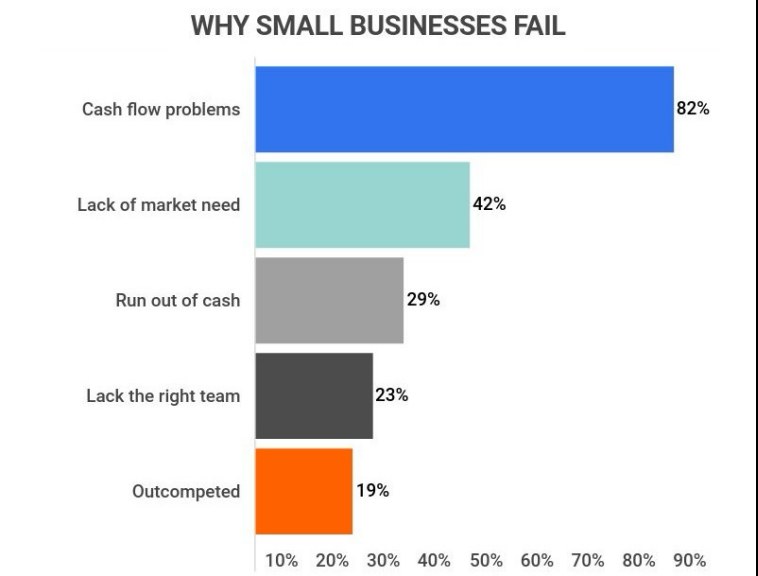
So They THINK THE MONEY IS THE PROBLEM. I Always Tell People If You Don’t Have The Money All You Need Is The Credit And You Can Get APPROVED FOR THE MONEY
Did you know it is possible to be APPROVED for $10,000, $30,000, or even $50,000+ in funding BEFORE you are able to EARN or SAVE that amount through a traditional 9-to-5 income, while still managing everyday expenses and financial obligations?
Even individuals with challenged credit may qualify. In many cases, the time it takes to dispute negative items, rebuild credit, and establish a stronger profile is shorter than the time it would take to save $10,000 through earned income alone.
For many people, saving large sums is difficult due to ongoing living expenses, which often leads to reliance on tax refunds, only to find that those funds are quickly used to catch up on bills rather than create financial growth.
When funding is approved, the key is to allocate it toward opportunities that generate additional income or long-term returns, rather than short-term expenses.
Examples:
These are just a few examples, but moral of the story the real goal is to have your PROFITS paying your Bills. Instead of you WORKING to pay your bills. Or 9/10 you’ll be working until the day you die. Because I realized this I haven’t worked a 9-5 since 2021.
Having Good Credit:
✓ Lowers interest rates
✓ Increases approvals
✓ Strengthens your profile
✓ Gives you leverage
✓ Saves real money
✓ Saves you time
Hard Truth:
Having “good credit” means more than a high score. If you are not in a position to confidently request six-figure funding from a financial institution, your credit profile may not be as strong as you believe.
For the statement “I have good credit” to be accurate, four key elements must be in place:
- Good Credit Score
- Clean & Accurate Credit Report
- Strong Credit Profile
- LLC SET UP PROPERLY
Why Do You Need All Four ? Because All 4 Combined Is WHAT MAKES YOU CREDIBLE. And Remember YOUR CREDIT IS YOUR CREDIBILITY.
- A Good Credit Score Doesn’t Mean You’re Approved But Without A Good Credit Score You Most Likely Won’t Qualify To Apply For Most Things.
- You Can Have A Good Credit Score & Still Fail The Application For Putting Wrong Information On A Application, Or Not Having An Accurate Credit Report
- You Can Have A Good Credit Score, Clean Credit & Accurate Credit Report. But Still Have A WEAK PROFILE.
Even with a good credit score, clean credit report, and strong people. Business funding can still be denied if the LLC is not set up correctly. Entity structure, compliance, and financial alignment play a critical role in lender approval. Your business is what gives you access 150K or more. Not to mention all of the tax benefits as a business owner.
However, if your personal credit is not strong, it is recommended that you address and improve it first, unless you can provide verifiable business bank statements and tax returns demonstrating consistent monthly profits of at least $10,000.
This is a separate, but equally important, conversation. If you would like to determine whether your LLC is properly established or need assistance with setup and compliance, you are encouraged to schedule a consultation.
Why Is Credit Repair So Important?
1️⃣ Credit Affects Things People Don't Expect
Credit isn't just loans:
- Renting an apartment
- Cell phone deposits
- Utilities (gas, electric, internet)
- Insurance rates
- Some jobs & promotions
Bad credit = more deposits, more scrutiny, fewer options.
2️⃣ Credit Repair Removes What's Holding You Back
Credit repair does NOT erase debt — it removes:
- Inaccurate
- Outdated
- Unverifiable
- Improperly reported items
That's important because lenders don't care why something happened — only what's showing right now.
3️⃣ A High Score ≠ Strong Credit
You can have a 720+ score and still get denied.
Lenders look at:
- Payment history
- Utilization
- Credit age
- Account mix
- Profile strength
Credit repair cleans the report so building actually works
4️⃣ Credit Repair Saves Time
Without cleaning the report first:
- New credit gets denied
- Utilization fixes don't move scores
- Hard inquiries hurt more
- Growth stalls
Repair first → then build → then apply.
That Said Every Single Person Wants Good Credit & eventually finds out the hard way that they actually NEED GOOD CREDIT. It kills me that people don't realize a few negative items are the main things holding them back from living the lifestyles they deserve. Whenever your credit is holding you back from something you have 4 Options.
1️⃣ Pay Someone To Fix It
Best option if you can find someone like me who's efficient, very informative, trustworthy, has real results, real testimonials, and a proven track record of consistency.
2️⃣ Stay In Debt & Wait For Everything To Fall Off
This option is Not as Simple as it sounds, and honestly isn't smart either. Mainly because of how late payments report. YOU'LL BE WAITING FOREVER LIKE YOU BEEN HAVE.
| Account Type | How Long It Stays On Your Credit Report |
|---|---|
| Late Payments | That's 7 Years ( PER LATE PAYMENT ) So if you got a late payment on your car note in 2023. It won't fall off until 2030. But what if you got another late payment in 2026? Now you have to wait until 2033. So when you have multiple accounts with multiple late payments you'll be waiting forever and hopefully you don't add any new late payments. |
| Inquiries | 2 Years |
| Collection | 7 Years |
| Charge-Offs | 7 Years |
| Repossession | 7 Years |
| Bankruptcy | 7-10 Years |
| Evictions | 7 Years |
| Medical Bills | 7 Years |
| Student Loans | Open Accounts can last a lifetime. Closed accounts can last 7 years. Most of the time Lenders never close student loans because there is no statue of limitation on the debt so if you don't get them removed, they can still hold you back 10–25+ years down the line. |
3️⃣ Do It Yourself ( Free But Understand This Takes Time. )
- You Might Research The Right Things. You Might Research The Wrong Things.
- If You Do Research The Right Things You Might Understand It Or You Might Not.
- If You Do Understand It You Might Do It Right Or You Might Do It Wrong.
Bottom Line You Keep Going Until You Get It Right And That Will Take However Long It Needs To Take. Question Is Do You Have That Time To Wait ? Probably Not but That's Your Decision.
4️⃣ Find someone who will accept you with your situation ( THIS IS THE TRAP )
I Guarantee if a company ever told you, WE ACCEPT BAD CREDIT. They are legally about to Rob you blind. And I will prove it. Take a look at Interest Rates where I explain to you how much life is costing you with Having Good Credit Vs Bad Credit.
Why Bad Credit Cost More Than Credit Repair ?
Did You Know That Having Bad Credit Is Costing You WAY MORE Than Credit Repair Ever Will?
- If You're Worried About The Cost Of Getting Started...
- You Should See The Cost Of Staying Exactly Where You Are…
- Credit repair is important because your credit controls the COST OF YOUR LIFE — not just approvals.
Credit Repair Is an Investment, Not a Bill. People hesitate or complain over paying $600–$2,000, then:
- Donate their money regularly to every single business everyday
- Overpay $8k–$30k on a car
- Pay $100k–$300K+ more on a mortgage
- Get stuck in high-interest cycles
Choosing To Stay With Bad Credit Is Costing You THOUSANDS OF DOLLARS MORE & I Will Prove It.
Incase it hasn't dawned on you by now I want to be very REALISTIC. I can charge you $5,000 to fix your credit and you will still come out of more money trying to reach your goals without just paying me the $5K first. Don't worry my prices are nowhere near $5K, but for this example let's say that was how much I charged for my services.
Most people would hear that price and think to themselves "he's crazy I'm not paying that" and they will keep searching until they find a company who "ACCEPTS BAD CREDIT". Or they will consider filing for Bankruptcy.
The Bankruptcy Trap Most People Don't See Coming
Most people have a major misconception about bankruptcy. They believe that once they file, it's a complete "fresh start." But in reality, it often creates a much more expensive problem long-term — one that most people don't realize until years later.
Let's start with a common scenario.
Many people file bankruptcy over what feels like a large amount of debt — often something like a repossessed vehicle or an auto loan balance of $8,000 to $10,000. At the moment, filing can seem like the easiest solution: the debt is discharged, the account is no longer collectible, you no longer have a car note, and it feels like the problem is gone.
But what most people fail to consider is THE COST OF BANKRUPTCY OVER TIME. They're going to spend 10 times whatever the price was of the original debt they were avoiding.
Once bankruptcy is on your credit report, it remains there for 7–10 years. During that time, LENDERS VIEW YOU AS HIGH RISK. That means 10/10 whatever you apply for within that timeframe will automatically cause… higher interest rates, fewer approvals, and stricter terms across the board.
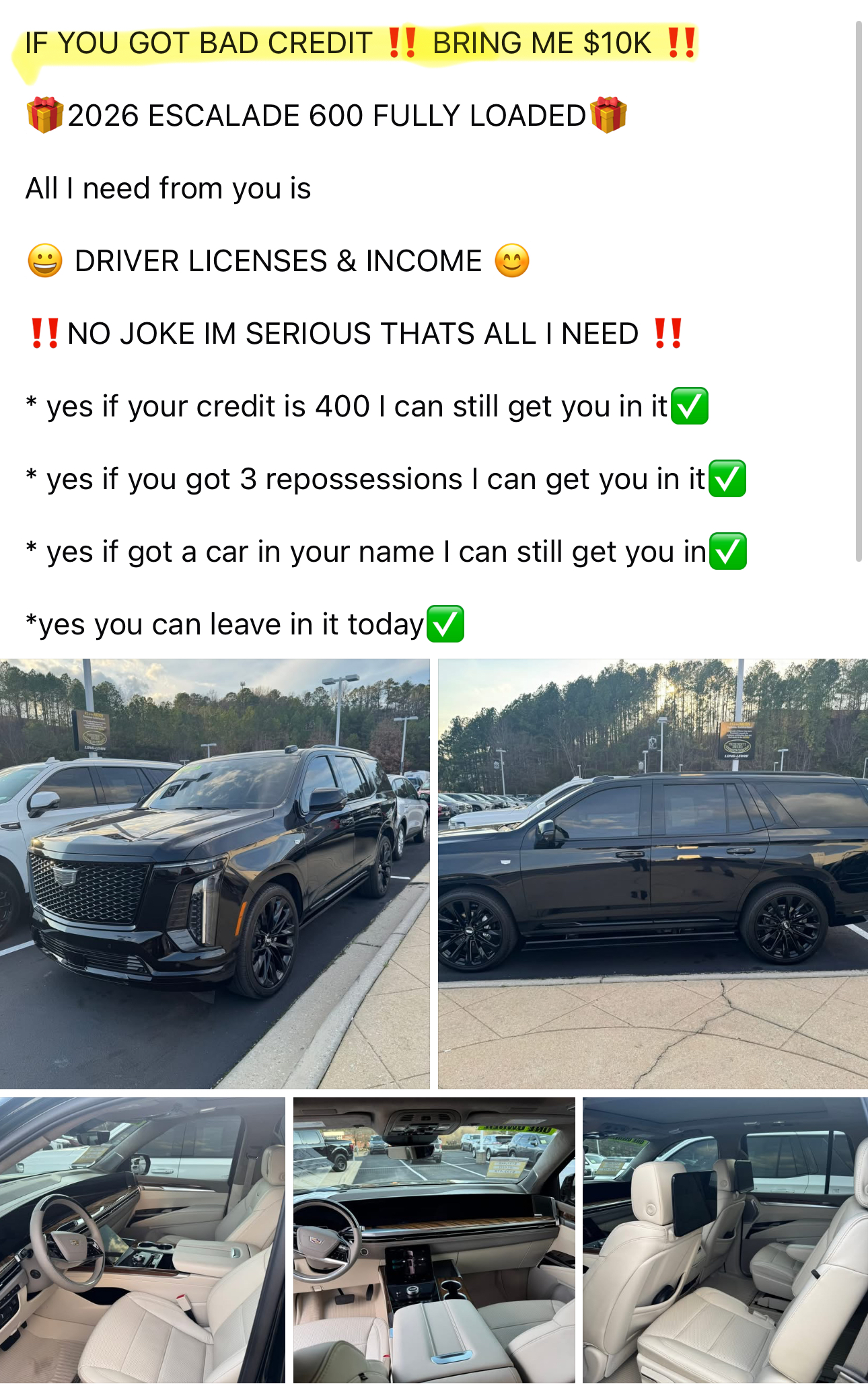
For example, after bankruptcy, many people still need transportation — so they go finance another vehicle. Even if the car costs only $20,000, they may be approved at a 25–30% interest rate, often with a longer loan term (60–72 months) just to keep the monthly payment affordable.
If you get charged that much, especially if you're getting about a six-year term — which most people do because the car note's already high, so in order to get the cheaper car note they get a longer term, not realizing a longer time means more interest — so with a 25% interest rate on a $20,000 car, you're already paying an extra $5,000 a year. That's already $30,000 in interest after the 6-year term is done.
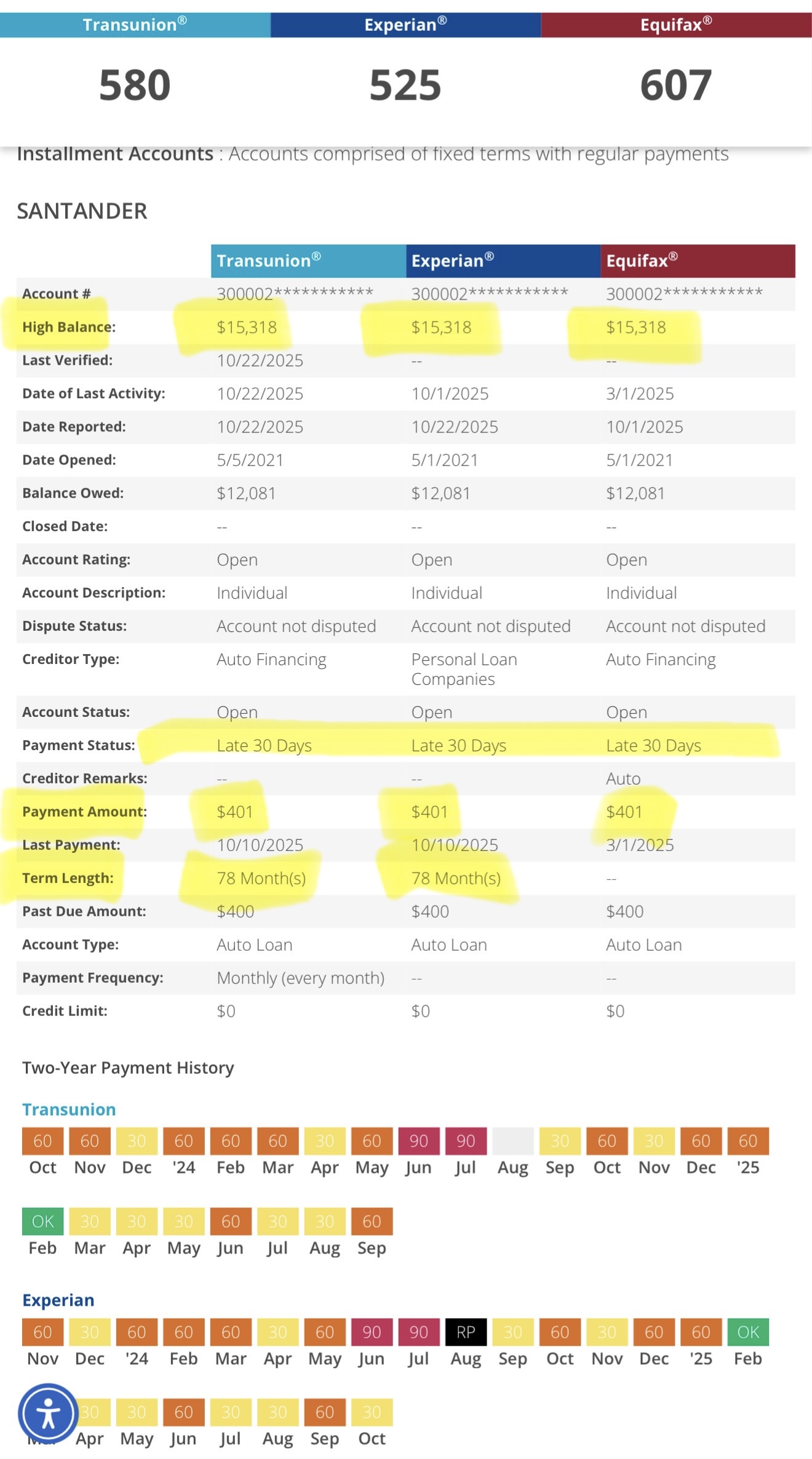
Take This Person For Example:
- The total price of this car was only $15,318
- 78-month term (6 years and 5 months)
- Car note is $401/Month
- $401 X 78 = $31,278.00 Total
- $31,278 - $15,318 = $15,960.00 EXTRA
- They are paying more in interest than for the car itself
- That's 104.20% Interest (Not including down payment, which was likely 10K+ due to bankruptcy)
Hopefully this car doesn't give you any issues because in most cases if the car is in bad shape, it will most likely be in and out the shop costing you thousands. And what do most people do? They figure why pay a car note if I don't have the car? When in reality the car problems has nothing to do with the bank that loaned you the money for the car. YOU STILL OWE THEM. And now your credit is even worse and you're back to square one.
Or let's say the car is in good shape. It's still not worth it because by the time you're ready to trade it in, it won't be worth the amount you owe. So if you still owe $12,000 by the time you trade it in, that $12,000 debt is considered NEGATIVE EQUITY — which means it will get added to the new loan.
So let's say you trade it in for another $25,000 car. You'll be paying $37,000 for a $25,000 car — and that's not even including the extra 25% interest you're about to get charged because you still have a bankruptcy on your report. Once again digging your grave even bigger.
Now a car is just one thing. And if that's how much extra you'll pay for a $20,000 car — how much extra do you think you'll pay to get a house, a building, or a business loan? All of those things cost way more than a car. Which means you're going to be spending so much money in interest every year that you could have already paid the $10,000 or whatever it was for the original debt. But life doesn't stop for you. So for the next 10 years, every approval costs more. Every loan carries heavier interest. Every financial move becomes more expensive.
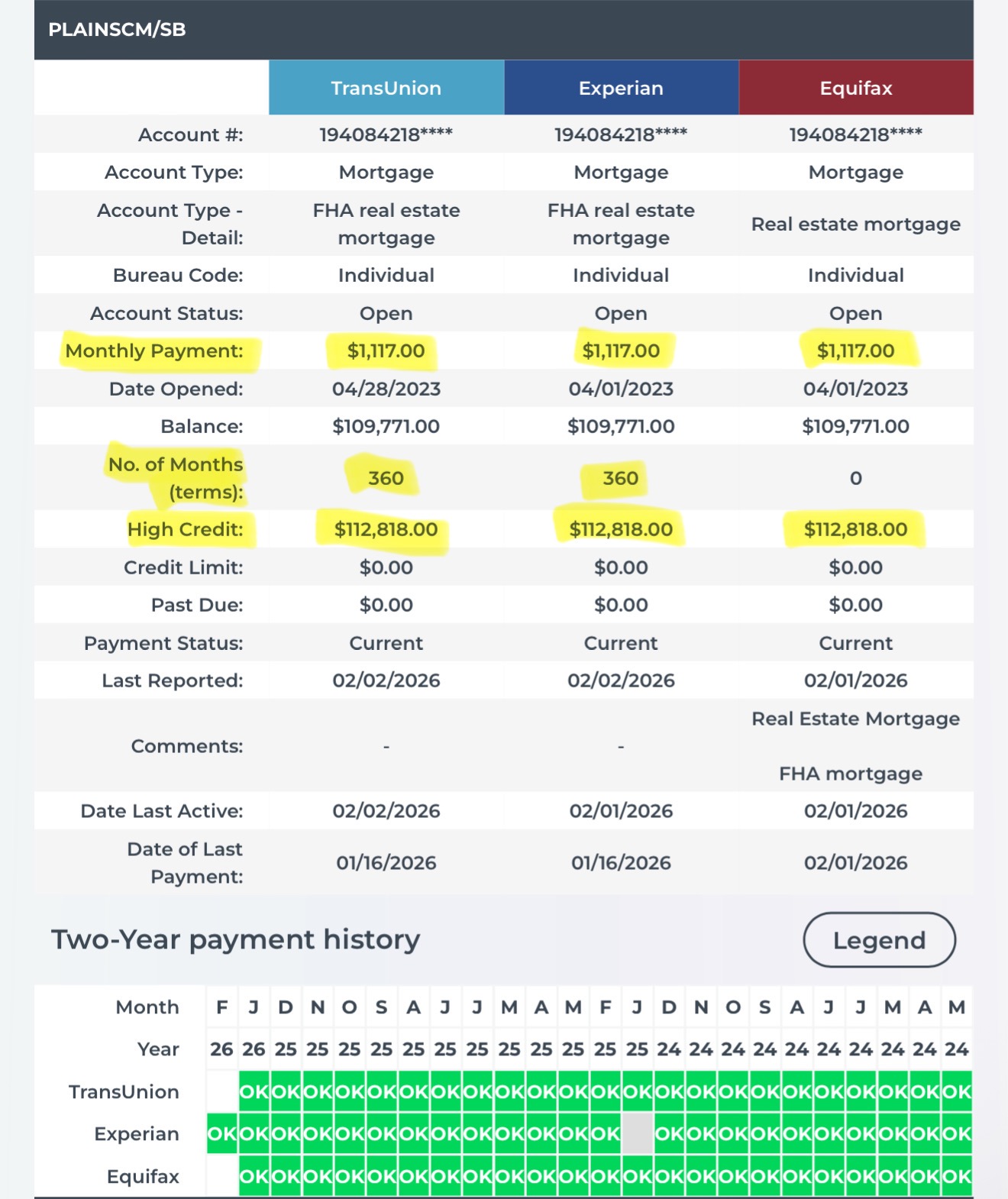
Take this house as an example:
- Total cost: $112,818
- $1,117/Month, 360-month term (30 Years)
- $1,117 X 360 = $402,120.00
- $402,120 - $112,818 = $289,302.00 EXTRA IN INTEREST
- That's 256% IN INTEREST
- Could have bought 3 Houses For The Same Exact Price & Still Had Over $63,666 Left
- My point is — one way or another, you will pay the money.
SO YOU MEAN TO TELL ME YOU REALLY PREFER TO DONATE ALL THAT MONEY RATHER THAN INVEST IN YOURSELF?
This is one of the main reasons people can't afford to or are scared to invest in themselves because they don't know what they're doing — they're JUST GIVING IT OUT. By choosing to stay with bad credit you are choosing to DONATE YOUR HARD EARNED MONEY.
When you add it all up, many people who filed bankruptcy to avoid paying $8,000–$10,000 end up spending well over six figures in extra interest over the next decade — simply because their credit profile was damaged. That's the part no one explains.
Bankruptcy doesn't erase debt — it reshapes your financial future, and usually not in your favor. In many cases, paying or strategically resolving a smaller debt upfront is far cheaper than carrying the long-term cost of bankruptcy. That's why bankruptcy should always be a last resort, not a quick fix.
Why Good Credit Allows You To Save Over $10,000+
Here Are A Few More Reasons Why Bad Credit Cost More Than Credit Repair Even If You Didn't File For Bankruptcy.
Watch The Video Passcode: 0wPk$mMg
What Credit Repair Actually Does
Credit Repair DOES NOT DELETE THE DEBT ‼️
No You DO NOT Owe The DEBT COLLECTOR. But You DO OWE The Original Creditor.
The Purpose Of Credit Repair Is To Hide The Negative Items From Your Report So That They No Longer Hold You Back. So Now You Can Get Approved For Things But You Do Still Owe The Original Creditor. But It DOES NOT MEAN THE DEBT IS DELETED.
So Why Not Just Pay It?
- 9/10 If You Have A Collection Your Information Has Been Passed On To A 3rd Party Debt Collector That You NEVER Did Business With So Therefore You DO NOT OWE THEM ‼️
- Every State Has A Statue Limitation On When A Creditor Can Collect On A Debt 💸 A lot Of Times Consumers Don't Realize That They Almost Are Scott Free Of Paying A Debt But When They Pay A Small Payment THE CLOCK STARTS OVER
- If You Pay Them It Will Be Harder To Get Removed Because Why Would Anyone Pay A Debt That Doesn't Belong To Them. So You Look Guilty
- Paying Them DOES NOT REMOVE IT FROM YOUR CREDIT REPORT
- If You Pay Them In Full It Will Show Up As A PAID COLLECTION
- If You Fall For That Letter Saying Pay 30-40% Off It Will Say SETTLED FOR LESS THAN FULL BALANCE
So When It Comes To Your Credit REPORT. Regardless Of If You Pay Some Or All Of Your Collections. It DOES NOT HELP YOU AT ALL.

The Smart Approach:
- If You're Ever Behind On an OPEN ACCOUNT Yes it is safe to get on a payment plan etc to pay it down
- But if that account has ALREADY BEEN CLOSED & SENT TO COLLECTIONS It's better to get it removed FIRST & Then Settle The Debt
- Because If You Settle First, It Will Still Be On Your Credit Report And That Doesn't Help You

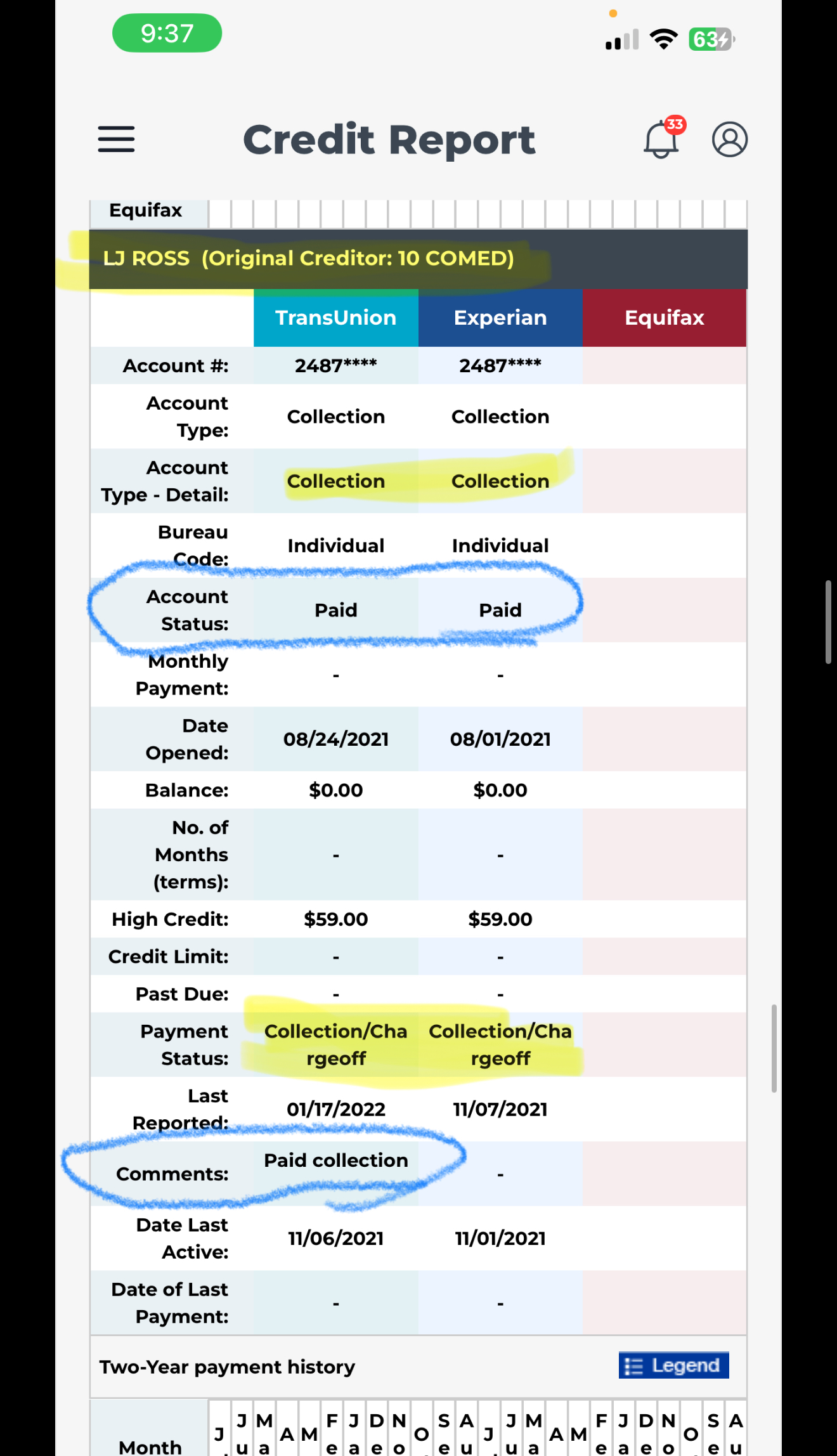
Credit Repair Is Still Important. Look at it as if you just got your RECORD EXPUNGED. Just because you get your record expunged doesn't mean you didn't do the crime and do the time. But when you apply for jobs THEY DON'T SEE THE FELONIES ETC…
So in this case just because you get something removed from your report doesn't mean you don't have collections etc but when you're applying for things. THEY DON'T SEE THEM…But yes you still owe the debt WITH THE ORIGINAL CREDITOR
Would It Be Better To Just Pay My Collections Off?
Short Answer: Only if the creditor offers a Pay-For-Delete. If so, yes. If not, then NO — not until the collection is deleted.
Here's Why
1. 9/10 if you have a collection, your information has been passed on to a 3rd party debt collector that you NEVER did business with — so therefore you DO NOT OWE THEM ‼️
Why pay a company you don't owe?
2. Even if it were the original creditor, paying them DOES NOT REMOVE IT FROM YOUR CREDIT REPORT.
3. If you fall for that letter saying "Pay 30-40% off and we will SETTLE this for you," it will still be on your credit report as a Paid Collection / SETTLED FOR LESS THAN FULL BALANCE — which is still a negative account and DOES NOT help you.
Not only were you already behind 120-180 days, but when you finally decided to pay them, they didn't even get all of their money? It doesn't look good.
4. If you pay them IN FULL, it will still show up as a PAID COLLECTION — which is still a negative account and DOES NOT help you.
But What's The Problem If I Paid It?
Short Answer: Paying a collection DOES NOT HELP YOUR CREDIBILITY.
Example: I go to jail for stealing money out of Walmart's register. I do my time for it. When I get out of jail, I apply to work for Chase Bank. Do you think they'll hire me? I can't say "But I went to jail for it" because something like that should never have happened to begin with.
No different here. How the banks look at you: if you defaulted on your agreement several times already, what makes this time different? Would you continuously lend money to someone who never pays back on time?
The Smart Approach
Nothing wrong with settling a debt. It's just WHEN you settle it. Please allow me to explain.
- If you're ever behind on an OPEN ACCOUNT — yes, it is safe to get on a payment plan to pay it down.
- But if that account has already been closed & sent to collections, it's better to get it removed FIRST & then settle the debt.
- Even if you have to send them $20/month, I doubt they respond saying they no longer want the money. Especially since most companies require payment or settlement if you want to do business with them again.
- But if you pay them first, you'll find out the hard way that YOU STILL NEED TO GET IT DELETED — and you will be mad.
The ONLY TIME paying a collection makes sense before getting it removed from your credit report is if the company offers what's called a PAY FOR DELETE.
A negotiated agreement where you offer to pay a collection account (in full or for a settlement) in exchange for the creditor or collection agency completely removing the negative account from your credit report — not just marking it "paid."
Important Things To Know About Pay-For-Delete
1. It's not automatic. Creditors & collection agencies are not required by law to do Pay-For-Delete — it's voluntary.
2. Always get it in writing FIRST. If a company isn't willing to send you something in writing before receiving payment, TRUST ME, IT'S A BLUFF. They're telling you what you want to hear so you'll feel comfortable enough to pay, and they have no intention of actually deleting the account. Never send payment until you receive written confirmation that they will delete the account indefinitely.
3. It works best with collection agencies. Original creditors (Capital One, Chase, etc.) rarely agree — but third-party collectors often will.
4. You can usually settle for less. Many accept 30%–60% of the balance for a PFD.
Simple Pay-For-Delete Script
"Hello, I'm calling regarding account #____. I'm willing to settle this balance today if you agree to delete the tradeline indefinitely from all credit bureaus upon payment. If you agree, please send written confirmation by email or mail before I submit payment."
Fun Fact: Every State Has A Statute Of Limitations On Debt Collection
Each state sets different time limits for different categories of debt. The clock doesn't run the same for everything.
Common Debt Categories That Matter (Illinois Example)
| Debt Type | Why It Matters | Statute Of Limitations |
|---|---|---|
| Written contracts | Credit cards, personal loans, auto loans | 10 years |
| Oral (verbal) contracts | Handshake agreements | 5 years |
| Open-ended accounts | Credit cards, lines of credit | 5 years (commonly argued) |
| Promissory notes | Student loans, auto loans, personal loans, installment loans | 10 years |
| Judgments | Court-ordered debts (completely different rules) | 7 years (renewable) |
How Statutes Of Limitations Actually Work
Each category can have a different statute — even within the same state.
What Starts The Clock? The statute of limitations clock usually starts at:
- Date of first delinquency (DOFD)
- OR date of last payment (varies by state & debt type)
⚠️ Any of the following can RESET the clock:
- Making a small payment
- Acknowledging the debt in writing
- Entering a payment agreement
If the statute of limitations has already surpassed, the only thing you really need to do is get the negative item deleted from your credit report so other lenders won't see the debt.
A lot of times consumers don't realize they're almost scot-free of paying a debt. When creditors & debt collectors convince you to get on a payment plan and you make that first small payment, THE CLOCK STARTS OVER.
This is why clients should NEVER casually agree to pay old debt without advice. If you pay them, it will be harder to get removed because now you look guilty. Why would anyone pay a debt that doesn't belong to them?
You may receive letters & emails threatening to garnish your check or sue. It's all a bluff to scare you into paying.
Credit SCORE vs Credit REPORT vs Credit PROFILE 📑
Fun Facts:
● Your Credit Score, Credit Report, & Credit Profile Are 3 Completely Different Things.
● Your #CREDIT Is NOT Your Credit SCORE. Your Credit Is Your Credibility Aka Your Reputation With Banks & Lenders 🤑
● When You Have Negative Items & Late Payments On Your Report YOU HAVE NO CREDIBILITY 😩
- Your Credit Score DOES NOT Get You Approved For Anything 😭
- Just Because You Have A Good Credit Score DOES NOT MEAN You Have GOOD CREDIT
- Someone With A 650 Credit Score Can Get Approved Over Someone With A 750 Credit Score due to the report and profile
- Your Credit Report & Credit Profile Is Far More Important Than Your Credit Score.
- You Can Have A 750 Credit Score And STILL NEED A CO-SIGNER
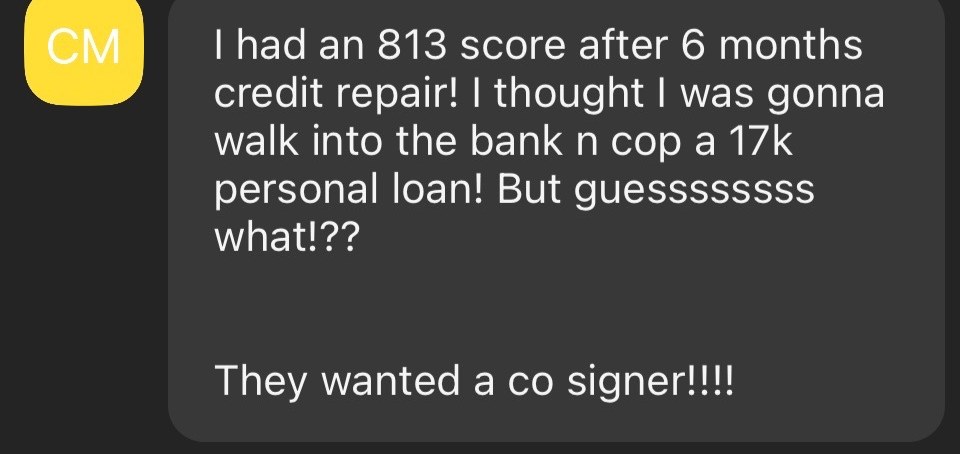 A real client: an 813 score after 6 months, and the bank still wanted a co-signer.
- Credit Is Just Like A Job… You Need The Experience To Get The Job, But You Need The Job To Get The Experience. In This Case You Need The History To Get The Credit & You Need The Credit To Get The History.
- Having No Credit History Is Almost The Same As Having Bad Credit. Either Way You Have NO CREDIBILITY
Credit SCORE

Your Credit Score = Your RESUME
( What Makes You Qualify To Apply )
A Good Resume Does Not Mean You Automatically Got The Job. The Resume Is Only Enough For The Employer To CONSIDER YOU.
For Example: A Trucking Company Is Hiring On The Flyer It Says " MUST HAVE VALID CDL " I Can't Even APPLY Without Having A CDL. But Just Because I Have A CDL That Doesn't Mean I Will Get The Job. I'll Still Have To Complete A Interview & Background Check.
Just Like A Resume Your Credit Score Makes You QUALIFIED TO APPLY. ( Example: You Must Have A 650 Credit Score To Apply For This Apartment )

- What If 12 Other People Also Have A 650? Why Should They Choose You ?
- Just Because You Might Have A 650 Credit Score Doesn't Mean You Will Be Approved.
- You Just QUALIFY TO APPLY.
Credit APPLICATION
Credit Application = The INTERVIEW
When applying for credit, several factors influence approval, including your income, existing debt, employment history, and overall financial profile. However, what many people don't realize is that even with a 700+ credit score and no collections, your application can still be negatively impacted by inaccurate or inconsistent personal information.
Credit bureaus rely heavily on personal identifiers to verify identity. If your name or details appear differently across reports-for example, Cordell D. Collins on one bureau, Cordell Collins on another, and Cordell Collins Jr. on a third-those discrepancies can cause verification issues. On paper, these variations can appear as separate individuals. The last thing you want to do is be held responsible for someone's else mistakes.
Ultimately what you want to see on your credit report is ONE NAME, ONE DOB, & ONE EMPLOYER. All 3 of them should MATCH TO THE T.
Many consumers have multiple name variations and outdated addresses listed on their credit reports. This can trigger red flags during the application process, leading lenders to question identity verification, suspect potential fraud, or confuse you with another individual who shares the same name. While this is not a common reason for denial, it does happen—and I've seen it occur.
How To Prevent This:
The best way to prevent and correct this issue while undergoing credit repair is to ensure that the address on your government-issued ID matches your current residence. Additionally, when applying for credit, it's important to use the same personal information consistently on every application.
Consistency and accuracy play a critical role in protecting your credit profile and improving approval outcomes.
Credit REPORT 📋
Credit Report = The BACKGROUND CHECK
(This Is What Gets You Approved Or Denied)
Derogatory Marks Are Like Felonies. You Can Have The Best Resume In The World Along With All The Work Experience. The Chances Of You Becoming Manager At Any Establishment With Armed Robbery On Your Record Is Slim. A lot of times people often downplay their credit reports.
Don't ever think just because you only have a "few negative items" or only owe small debts that your credit report is "NOT THAT BAD" In Most Cases 1 Collection can and will get you denied regardless of the amount owed.
Smaller collections are actually worse. A $10,000 collection makes sense but when you have small collections you just make yourself look very irresponsible. If You couldn't handle a $300 credit card, Why should anyone trust you with a $30,000 auto loan?
You Can Have A 750 Credit Score. 1 Collection Can Get You Denied. Having A Bankruptcy On Your Report Is Like Committing Murder 😳 It's The Absolute Worst Thing You Can Have On Your Credit Report.
Good Credit Report Vs Bad Credit Report

Good Credit Report - This Is What You Want To See
• This Person Has 0 Late Payments
• 0 Collections
• 0 Public Records ( Which would also be considered a Derogatory account )
• Less Than 2 Inquiries Per Credit Bureau
If Your Report Doesn't Look Like This YOU NEED CREDIT REPAIR.

Bad Credit Report - This Is What You Don't Want To See

• This Person Has 2 Delinquent Accounts ( meaning accounts with late payments)
• They Also Have A Total Of 12 Derogatory Accounts ( Meaning Accounts In Negative Standing Such As Repos, Charge-offs, Evictions Etc ) 2 Collections
• They Also Have 3 Public Records ( usually bankruptcies )
That's A Total Of 19 Negative Accounts. That's Not Including The 22 Inquiries.
SideNote: Your Report Is Always Worse On Paper Than Real Life. You Might Have 1 Collection With T-Mobile But If That Collection Is Reporting On Transunion, Experian, & Equifax, On Paper That's 3 Collections. In Conclusion This Report Is HORRIBLE. Would You Loan Someone Money If You Knew For A Fact They Owed 19 People?
Credit PROFILE
Credit Profile = This Is What Separates You From Everyone Else.
When Applying For Things Like Auto Loans, Personal Loans, Business Loans, & Mortgage Loans. Without A Strong Profile You May Be Asked To…
- Provide a co-signer
- Show proof of income (pay stubs, tax returns, bank statements)
- Put up collateral (vehicle, cash, assets, or liens)
- Accept a higher interest rate or unfavorable terms
- Make a larger down payment
- Accept a lower approval amount than requested
- Pay origination, funding, or risk-based fees
- Open additional accounts with the lender (checking/savings)
- Agree to shorter loan terms (higher monthly payments)
- Provide business financials (P&L, balance sheet, EIN history)
- Face manual underwriting instead of instant approval
- Receive a conditional approval that can be revoked
Take This Story As A Great Example. She Thought Her Credit Score Was Her Credit. 10/10 She Had A Weak Profile & That’s Why She Still Needed A Co-signer.
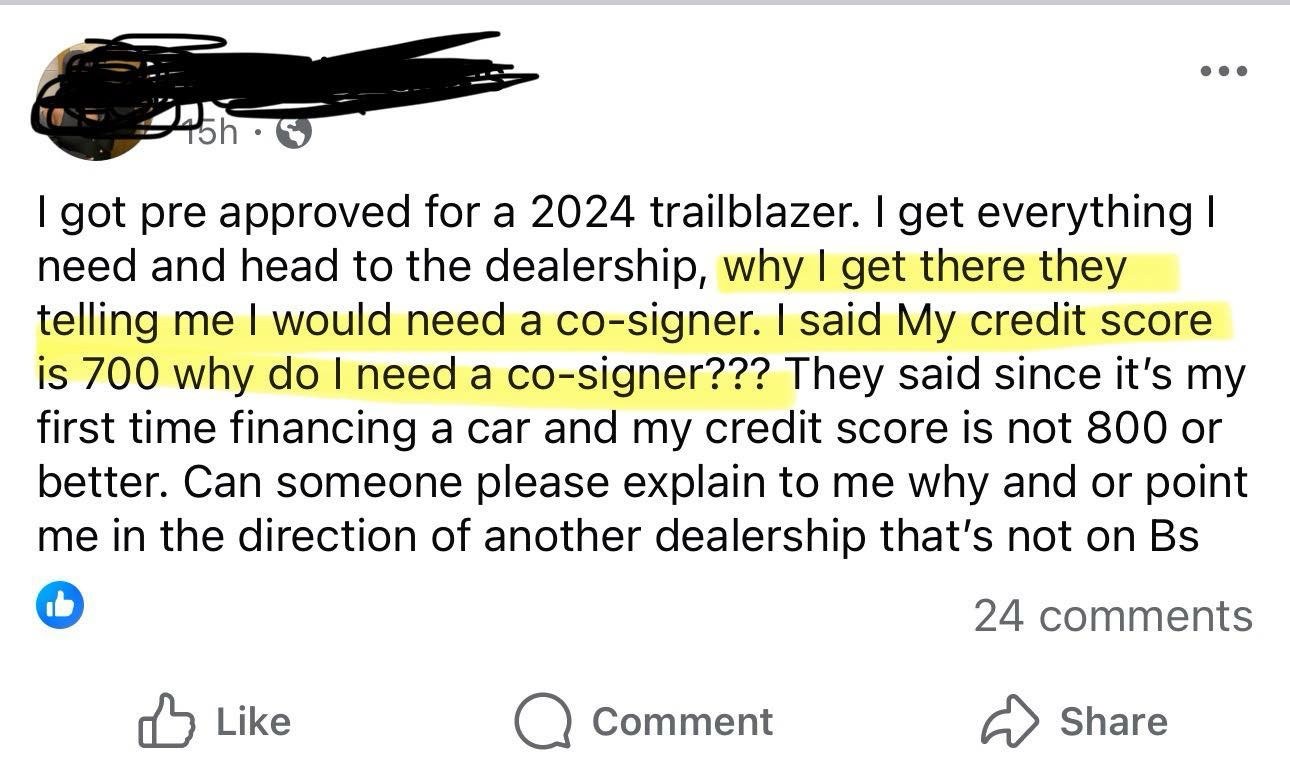
Another Example with a similar scenario. A client bought a bunch of tradelines and her credit score shot up to a 813. She automatically thought she would get an instant approval… Your Credit Profile is far more important than the score. I can’t stress this enough. I really need you to understand this.
Example: You & I Just Applied For The Same Exact House. The Minimum Credit Score Required Is A 700
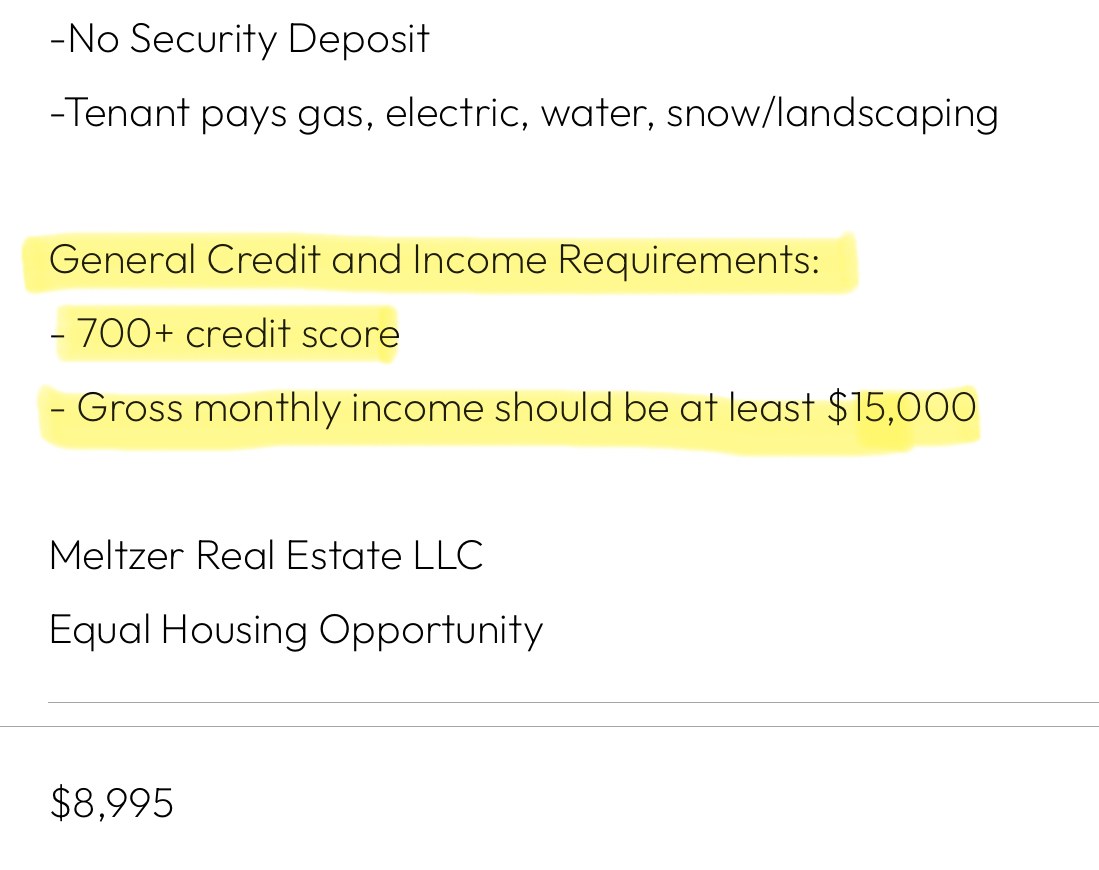
We Both Have A 750 Credit Score
We Both Have 5 Credit Cards 💳
We Both Have 1 Auto Loan
We Both Have 100% Payment History
We Both Have 0 Collections
We Both Have Only 2 Inquiries
If We Both Have A 750 Credit Score, Then We Both QUALIFY TO APPLY.
If We Both Have A Clean Credit Report, Then 9/10 We Both Will Be Approved.
Now ask yourself, if there are 20 other people who meet this same criteria, why should they choose YOU? If We All Meet These Requirements That Only Means WE ALL QUALIFY TO APPLY. It DOES NOT mean that WE ALL HAVE GOOD CREDIT. (Aka good Creditably)
So How Does The Loan Officer Decide Who’s The Better Candidate? THE PROFILE.
WEAK PROFILE VS A STRONG PROFILE ?
FREE GAME ✍🏾
Your Credit History Is 15% Of Your Credit Score
Your Credit Mix Is 10% Of Your Credit Score.
The LONGER The Credit HISTORY & The More DIVERSE The Credit MIX. THE STRONGER THE PROFILE 💪🏾
Credit Card Tier Rank
| Tier Type | Card Category | Who they're for | Example | Purpose | Average Credit Limits |
|---|---|---|---|---|---|
| Tradelines / Authorized User | Depends on the owner (Banks Will Know You Are Not The Owner) | Everyone | Doesn't Really Count Towards Your Creditability. At The End Of The Day Banks Want To Know WHAT HAVE YOU DONE? | Can help lower utilization reporting, can help increase credit scores, can help improve credit Age Reporting | Depends On Primary Owner |
| Tier 0 | These Cards Are Not Ranked | Beginners & Rebuilders | Chime, Self Lender, Kikoff, Tomo, Ava, Credit Strong | These Accounts Were Designed To Help Build Payment History But Do Not Count As Real Credit Cards. | Multiple options available. Can vary. |
| Tier 1 | Subprime / Starter Credit Cards | Poor or limited credit (typically 300–579) | Discover it® Secured • Capital One Platinum Secured • OpenSky® Secured Visa | Entry-level access / rebuilding. Secured cards, First-time builder cards | $200 – $1,000 |
| Tier 2 | Near-Prime / Fair Credit Cards | Fair credit (580–669) | Capital One QuicksilverOne • Discover it® Chrome • Credit One Bank Platinum Visa | Transition phase | $1,000 – $3,500 |
| Tier 3 | Prime Credit Cards | Good credit (670–739) | Capital One Quicksilver • Chase Freedom Unlimited® • Navy Federal cashRewards | Strong everyday use (cash back) | $3,500 – $10,000 |
| Tier 4 | Super-Prime / Premium Credit Cards | Excellent credit (740–799) | Chase Sapphire Preferred® • American Express® Gold Card • Navy Federal More Rewards | High rewards & perks | $10,000 – $25,000+ |
| Tier 5 | Ultra-Premium / Charge & Elite Cards | Top-tier profiles (800+, strong income & profile) | American Express® Platinum Card • Chase Sapphire Reserve® • American Express® Centurion | Lifestyle, leverage, and prestige | $25,000 – $100,000+ (or No Preset Limit) |
You think your CREDIT IS NOT THAT BAD? Grade Yourself - How Many Categories Did You Check Off? Example 1/27, 10/27, 17/27 27/27
If You Do Not Know The Answers To These Questions, You May Need To Access All 3 Of Your Full Credit Reports & Scores To Take This Quiz
View My Reports & Scores
Sign Up Here 👉 https://member.identityiq.com/creditpreferred.aspx?offercode=431297LA
Your Profile Is Where They Pay Attention To More Details Such As…
Credit Profile Scorecard - Weak vs Strong
| Category | Weak Profile | Strong Profile | Magic Question | Score Board |
|---|---|---|---|---|
| 1. Credit Score | 300 - 679 (680-719 Is Mid) | 720 Or Higher | Is Your Credit Score A 720 Or Better? | Give Yourself One Point If Yes. |
| 2. Total Open Accounts | 1-9 Accounts and or recently | 10 Or More. | Do You Have 10 Or More Open Positive Accounts? | Give Yourself One Point If Yes. |
| 3. Closed Accounts | Paid but with late payments, some paid collections | Everything paid off 100% good standing (NO LATES) | Are All Of Your Closed Accounts Paid With 0 Late Payments? Paid Collections Don't Count | Give Yourself One Point If Yes. |
| 4. Credit History / Credit Age (15% Of Your Score) | 1 month – 4 years | 5+ years of established credit | Is Your Credit Age At Least 5 Years? | Give Yourself One Point If Yes. |
| 5. Payment History (35% of Your Score) | 20%–80% on-time payments, Any 30/60/90/120-day late payments, Missed payments on Credit Cards, installment loans | 100% on-time payments every month, No late payments at all (or none showing) | Do You Have 100% Payment History? (This Also Includes Closed Accounts You Have Paid Off) | Give Yourself One Point If Yes. |
| 6. Credit Card Type | Authorized User | Primary Owner | Do You Have At Least 3-5 Real Credit Cards? | Give Yourself One Point If Yes. |
| 7. Credit Card Tier | 0-2 Tier | 3-5 Tier | Based Off The Information Above, What Tier Do Your Credit Cards Rank? Are Any 4 & 5 Tier Cards? | Give Yourself One Point If Yes. |
| 8. Credit Card History | Opened 6-12 Months | (2-4 Years = Mid) 5+ Years = Good | Do you have at least 1 credit card with a 5 year payment history? | Give Yourself One Point If Yes. |
| 9. Individual Credit Card Limits | $200 – $4,999 | $5,000 Or Higher | Do You Have 3 Credit Cards With A Credit Limit Of $5,000 Or More? | Give Yourself One Point If Yes. |
| 10. Total Credit Limit | $14,000 Or Below | $15,000–$50,000+ total available credit | Do You Have $15,000–$50,000+ in Total Available Credit? | Give Yourself One Point If Yes |
| 11. Credit Card Utilization (30% Of Your Score) | Above 30% or maxed out | 1%–10% utilization (never above 30%) | Is Your Credit Card Utilization Under 10%? | Give Yourself One Point If Yes. |
| 12-14. Credit Mix (Can Score 1, 2, Or 3 points) | Only 1-3 accounts (usually cards only) | Credit Cards + auto + personal/installment & Open Credit | Do You Have Revolving Credit Cards, Installment Loans, And Open Credit (Utility Bills Or Rent) Reporting To Your Credit? | If You Have Revolving Accounts Add 1 Point. If You Have Installment Accounts Add 1 Point. If You Have Open Credit Add 1 Point. |
| 15-16. Installment Accounts (Can Score 1 Or 2 Points) | Only small installment loans ($500 – $3,000) | Mid =$5,000-$9,000. High-value installment loans ($10,000 – $50,000+) | Do you have any installment loans $10,000+ paid off or 100% payment history | If paid off add 1 point. If open but 100% payment history add 1 point. |
| 17. Installment Account History | Recently opened installment loans | Installment loans aged 12–36+ months | Do you have any installment loans with payment history 12-36+ months old? | Give Yourself One Point If Yes |
| 18. Hard Inquiries (10% Of Your Score) | 3-10+ per bureau | 2 or fewer per bureau | Do You Have 2 Or Less Inquiries Per Credit Bureau? | Give Yourself One Point If Yes. |
| 19. Hard Inquiry Type (Good Vs Bad Inquiries) | Not attached to open accounts (most likely got denied but still has inquiry reporting) | Attached to open accounts (Applied for something and actually got approved) | Do you have any inquiries that ARE NOT attached to open accounts? | If the answer is NO. ADD 1 POINT. |
| 20. Hard Inquiry History | 5 Months Or Less | 6 Months Old Older | Are Your Inquiries At Least 6 Months Old? | Add 1 Point If Yes. |
| 21. Debt To Income Ratio (DTI) | 44%–50%+ | 0%–35% | Is Your DTI 0-35%? | Give Yourself One Point If Yes. |
| 22-23 LLC (can score 1 or 2 points) | Less Than 2 Years Old, Not Set Up Properly, Or No LLC | 2 Or More Years Old, Set Up Properly | Do You Have A LLC & Has It Been Established For At Least 2 Years? | If You Have A LLC Add 1 Point. If you had it for 2 years add another point. |
| 24. Tax Liens | Federal or State Tax Liens present | No tax liens reported | Do you have any tax liens reporting on your credit report? | If the answer is no add one point. |
| 25. Derogatory Accounts (Derogatory = Negative) | 1+ Negative Account | Clean credit report (0 derogatory accounts) | Do You Have Any Negative Accounts On Your Credit Report? Collections, Repos, Evictions, Charge Offs, Student Loans, | If Yes, Subtract All Points. You Have Been Disqualified And Do Not Have Good Credit. If The Answer Is No Add One Point |
| 26. Bankruptcies | Open Bankruptcy, Dismissed, Or Discharged (Chapter 7, 11, or 13) | No bankruptcy on file | Do you have a bankruptcy reporting on file? | If The Answer Is No Add One Point. If Yes Subtract All Points. A Bankruptcy Is The Worst Thing You Can Have On Your Credit Report |
| 27. Funding Outcome | Denials or terrible loan terms | Lower interest & higher approval limits | If you apply for a personal or business loan and can't get a minimum 50K. You do not have good credit. You may have decent credit but not good credit. | If you have been approved for over 50k within the last 6 months add 1 point. |
| Approval Results | Requires cosigner, proof of income, collateral, or high interest rates etc | No cosigner, proof of income, or collateral needed. Also low interest rates. | Based off of your recent experience when applying for things using credit you should be able to tell if your report is Bad, Decent, Good, Or Great. | No need to add points here |
Hard Truth: What’s Your Total Out Of 27? I Scored 23/27
Because I didn’t care about my credit until a few years ago even I’m still building payment history. No one can run from this. Tradelines won’t save you.
Because I am financing so many things at once my DTI is now higher than 35%. As I slow down and keep paying my bills on time it’ll go back down.
Although I have 3 installments over 10K, (10K, 45K & 50K) Neither has been fully paid off but all 3 does have 100% payment history so I only got 1 point for that.
I was approved for 50K within the last 6 months so I gained a point for that but that also means I also have a hard inquiry that is recent so I lost a point for that.
For those who believe their credit situation isn’t that bad, I hope this provides helpful clarity and insight. There’s no reason for embarrassment, awareness is the first step toward improvement. Now that you know what areas need attention, you can take the right steps forward. Check out the To-Do-List and fill in the areas you may be lacking. If you need assistance with any of the steps, don’t hesitate to book a consultation. I’m here to help you restore and strengthen your credit profile.
What Makes Up Your Credit Score?
Please Understand That Credit Repair DOES NOT Boost Your Score. ‼️ The Only Person That Can Increase Your Credit Score Is YOU.
I Cannot Make Your Scores Go Up Or Down. So If You Want A Higher Credit Score You First Need To Know What Makes Up Your Credit Score? These Are Called #The5Factors ‼️
| Factor | Points It's Worth | Explanation | Expectations |
|---|---|---|---|
| Payment History 35% |
192.5 Points | Nobody pays your bills BUT YOU. So if you get a late payment you can expect your scores to drop 40-60 points & the only person should be to blame IS YOU. I Do Not Pay Any Of My Clients Bills. Even if you haven't recently received a late payment, old accounts & previous late payments DO MATTER. So if you do not have a 100% payment history your scores will be affected. | It answers the question: How Often Do You Pay Your Bills On Time when you owe? Is it 20%, 50%, 80% Or 100% Of The Time? Meaning You Pay Your Bills On Time Every Month? Payment History is the most important factor in your credit score. |
| Credit Card Utilization 30% |
165 Points | Nobody should be using any of your credit cards BUT YOU so if your credit card balances are over 30% or maxed out and your score drops. Once again that is not my fault. I have 0 access to any of my clients credit cards | Banks & Lenders like to see utilization under 10%. |
| Credit Age/History 15% |
82.5 Points | This is the one that gets everyone including myself. Unfortunately people don't care about their credit until it stops them from getting approved for things. So if you waited last minute to prioritize your credit and you have no credit history or short history…. THAT IS NOT MY FAULT. | It answers the question: How Long Have You Been Establishing Credit? Has It Been For 3 Months, 6 Months, 1 Year, 3 Years, Or 5 YEARS OR MORE? • Calculated based on the average age of all your accounts • Older = better for your score |
| Inquiries 10% |
55 Points | Every time you apply for something that is a HARD PULL… You WILL RECEIVE A INQUIRY. And every time you receive an inquiry whether you are Approved Or Denied YOUR SCORE WILL DROP. I don't apply for anything in anyone's name So if you have too many inquiries or receive new inquiries once again… NOT MY FAULT | In reality you want to have was than 2 inquiries per Bureau (Equifax, Experian, Transunion) and whenever you have inquiries you want them to be at least 6 months apart. |
| Credit Mix 10% |
55 Points | So incase you didn't know there are different types of credit. If you have no positive accounts on your profile then you have no credit mix. And since I have not and will not apply for anything in anyone's name if my client's names. Once again… NOT MY FAULT. | Banks & Lenders love profiles with good Credit Mixes. Revolving Accounts (Credit Cards) Recommended: 3–5 accounts. Major credit cards (Visa, Mastercard, Amex) Installment Accounts (Loans) 1–2 or more Active short term loan (Self lender, credit builder loan, secured loan) — Recommended: 2–3 or more Active long term loan (Car, mortgage, personal loan etc) Open Credit / "Other" Accounts (Credit Builders) Rent reporting, phone bill, utility bills — Recommended: 1–3 accounts |
| Reality | 550 points controlled BY YOU. 300 points at setup automatically. You can easily achieve 100+ points by controlling payment history and utilization. | Credit score changes are based on account activity and lender reporting. I do not make payments, use your credit cards, or apply for credit on your behalf. | This Is Why I Can Never Be The Reason Your Score Increases Or Decreases. The Most I Can Do Is Give You Suggestions On How To Build Your Scores |
Hard Truth:
Remember your Credit Is Your CREDIBILITY AKA YOUR REPUTATION WITH BANKS & LENDERS. There's absolutely NO WAY to have good credit without having positive reporting accounts. You can get everything deleted off of your credit report and STILL have bad credit (no credibility) due to failure of REBUILDING your credit profile. Rebuilding means you have positive reporting accounts that report to the credit bureaus monthly.
Take a look at the chart above where it says "EXPECTATIONS" — This section represents what the banks & lenders like and expect to see whenever viewing your credit report. If you cannot go through your report and find any of the following, you should be making it your business to visit my ACTIVE CLIENT TAB & CLICK ON THE "TO DO LIST."
Credit repair works only when WE work.
I'm not a miracle worker, I'm a strategist. You have to do your part as well. Please take your credit seriously — it represents your financial credibility.
What Is The Difference Between Payment History & Credit History?
These two terms sound similar but they measure completely different things on your credit report. Understanding the difference is key to understanding your credit score.
FREE GAME ✍🏾 Bold Wordings = What Banks & Lenders Like To See 👏🏾
PAYMENT HISTORY = 35% Of Your Score
It answers the question: How Often Do You Pay Your Bills On Time when you owe?
Is It 20%, 50%, 80% Or 100% Of The Time? Meaning You Pay Your Bills On Time Every Month?
Payment History is the most important factor in your credit score.
CREDIT HISTORY (AKA Credit Age) = 15% Of Your Score
It answers the question: How Long Have You Been Establishing Credit?
Has It Been For 3 Months, 6 Months, 1 Year, 3 Years, Or 5 YEARS OR MORE?
• Calculated based on the average age of all your accounts
• Older = better for your score
Key Takeaway
Together, these two factors alone count for 50% of your total credit score.
How To Calculate Your Credit History / Age
Credit Age (also called Length of Credit History) makes up 15% of your credit score and is calculated using multiple factors, not just one account.
CREDIT AGE IS BASED ON:
1. Age of Oldest Account
- The very first account ever opened on your credit report
- Older = better
- This is why closing old accounts can hurt
2. Age of Newest Account
- Your most recently opened account
- Opening new accounts lowers your average age
3. Average Age of Accounts - MOST IMPORTANT
This is what most people miss.
Formula:
(Total age of all accounts) ÷ (Number of accounts)
Example: Let's Say You Only Have 3 Accounts On Your Credit Report
- Account A: 6 years Old
- Account B: 4 years Old
- Account C: 2 years Old
6+4+2 = A Total Of 12 years
12 ÷ 3 accounts = 4-year average credit age
4. Open AND Closed Accounts Count
- Closed accounts still count toward credit age
- They usually remain on your report for up to 10 years
- Once they fall off, your average age can drop
HOW LENDERS & BUREAUS SEE IT
All three bureaus calculate age slightly differently:
- Experian
- Equifax
- TransUnion
That's why one bureau may show 4.2 years while another may show 3.8 years. This is normal.
COMMON ROOKIE MISTAKES
- Closing old cards "because they don't use them"
- Opening too many accounts too fast
- Relying only on authorized user accounts
- Thinking a single old account = strong profile
IN CONCLUSION: Credit age is not about how old ONE account is. It's about how long you've been responsibly managing MULTIPLE accounts over time.
You can have one 10-year-old account and five brand new accounts... and still have a weak average credit age.
Banks & Lenders Like To See Profiles That Have 5 Or More Years Worth Of Credit History/Age
Credit Age Calculator (AAoA Estimator)
Add each account on your credit report (open + closed) and enter its age. The calculator will automatically compute your Average Age of Accounts (AAoA).
Note: This is an estimate. Credit bureaus may calculate age slightly differently and may include closed accounts until they fall off your report.
Different Types Of Credit (Credit Mix + Credit History = Credit Portfolio)
Revolving Credit - Credit Cards 💳
Revolving Accounts that would generally have a different amount due each month depending on the current balance. The full balance is not required to be paid in order to keep the account in good standing. Interest is accumulated each month that a balance is carried over into the following month.
Installment Credit
- Auto Loan
- Mortgage Loan
- Student Loans
- Personal Loans
- Secured Loans
Open Credit
- Utilities
- Phone Bill
- Rent
Primary Account vs Authorized User
| Primary Account | Authorized User |
|---|---|
| You are the owner of the account. You have full responsibility of everything that comes with the account. | A primary account holder has the option to add an authorized user to their account. They can use the card but the responsibility and owner of the account is the primary account owner. |
Different Types Of Revolving Accounts
Credit Cards Issued By Banks Or Credit Unions
• Always backed by familiar logos such as Visa, Mastercard, American Express, or Discover.
• Generally A 680+ Would Get You Approved
• Multiple options available for customers who have no credit to established credit.
Credit Cards Issued By Retail Stores
• Store credit cards are great for saving money on purchases at your favorite stores.
• Generally, a minimum of 640+ credit score will get you approved for a retail store credit card.
Examples: Amazon Prime Store Card, Macy's Credit Card, Target RedCard, Walmart Rewards Mastercard
Credit Cards Issued By Oil & Gas Companies
• These cards are great for saving money at the gas pump.
Examples: ExxonMobil Smart Card, BP Credit Card, Shell Fuel Rewards Card, Techron Advantage Card (Texaco & Chevron)
Installment Accounts
• Accounts with a fixed monthly payment for a fixed period of time.
• Interest could be fixed or variable.
Examples: Auto Loans, Mortgage Loans, Student Loans, Credit Builder Loans, Personal Loans
How To Pay Your Credit Card Bill Correctly
Rule #1
NEVER SPEND WHAT YOU DO NOT HAVE
When It Comes To Paying Down The Balance There Are Two Types If People
Type 1: Pay After Every Purchase. ( THIS IS THE SAFER ROUTE )
My Lil Sister Prefers This Method Her Balance Is Always Low As You See In The Screenshot It’s Only $36.08
Type 2: Is To Let It Build Up Then Pay.
( I Prefer This Method ) For Some Reason I Like The Way The Money Looks In My Actual Account Rather Than On The Credit Card 😂
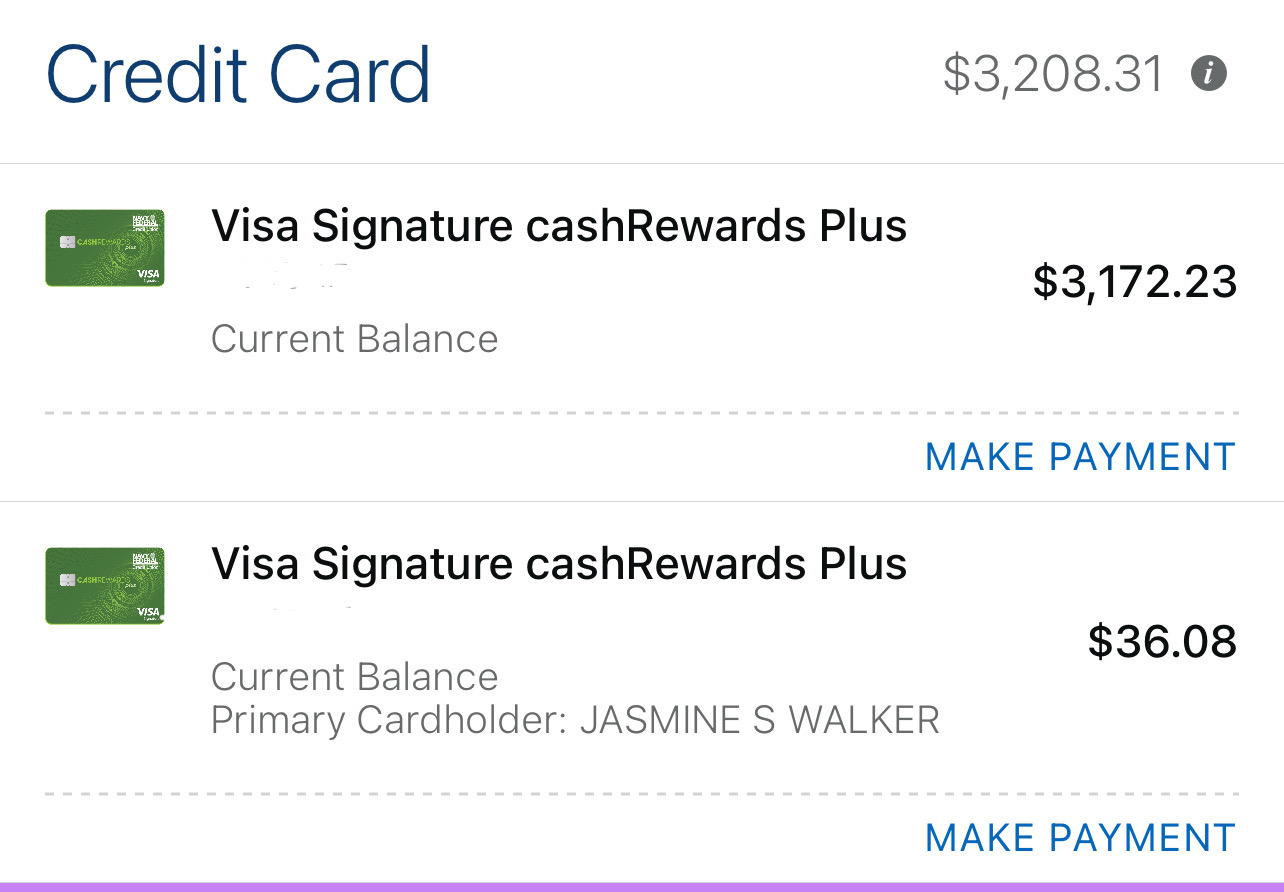
At The End Of The Day There Is No RIGHT OR WRONG ANSWER.
However If You Are Going To Be A Type 2 Kind Of Person, You Need To Know How To Do It Correctly.
When it comes to paying down your credit card bill you have 4 options
| Option A | Option B | Option | Option D |
|---|---|---|---|
| Pay IN FULL | Pay To Aim For 10% Balance | Pay To Aim For 30% Balance | Pay Minimum Balance & Catch Up As You Go (Highly Recommend to put the minimum balance on auto pay for all credit cards ) |
| 0% Utilization = Best Debt To Income Ratio. | If Your Utilization Is 1-10% You Can Expect Your Scores To Increase. | 11%-30% Your Scores Will Fluctuate In The Same Range You Been At. | Anything 31% Or Higher You Can Expect Your Scores To Drop Even If You Paid Your Bills On Time. |
Why This Matters: Credit card utilization makes up 30% of your credit score. Keeping balances below 10% of your limit gives you the best score boost. Even getting under 30% will make a noticeable difference.
The Percentage Hack:
| 0-10% | You Can Expect Your Scores To Consistently Increase |
|---|---|
| 11-30% | You will maintain whatever current credit score range you already have. |
| 31% or Higher | You can expect your credit scores to drop even if you paid your bill on time. |
Rule #2 Never Ever Get A Late Payment ‼️
Inside The Active Client Tab If You Click On “Educational” The 2nd Dropdown Is Titled “HOW TO AVOID LATE PAYMENTS”
If You Sense Ahead Of Time That You May Not Be Able To Pay A Bill. It Is Important To Act SOONER THAN LATER. Late Payments Can Last For 7 Years And Affect Negatively For 4 Years.
Rule #3 Understand The Difference Between Statement Date Vs Due Date
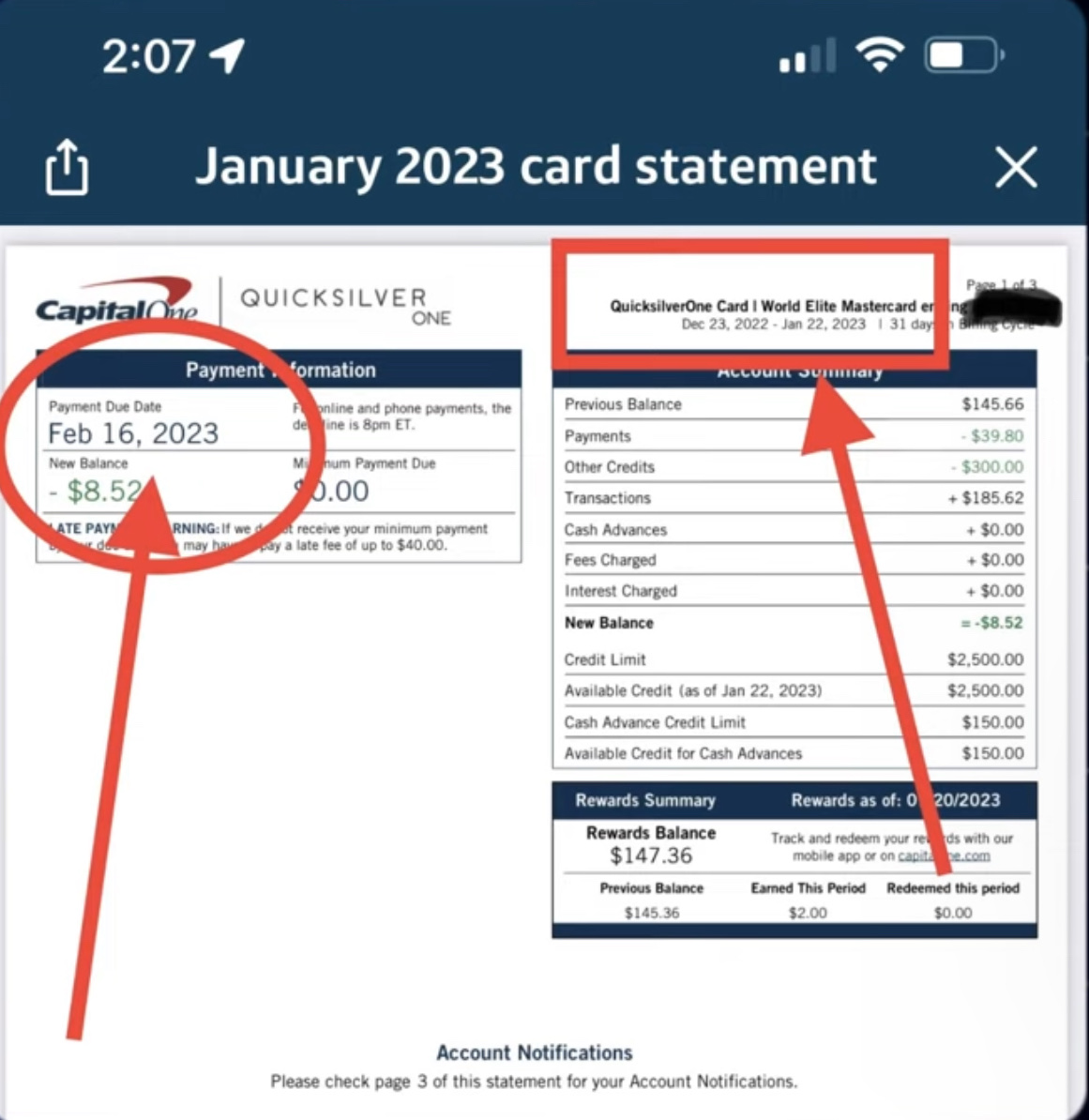
Example:
$300 Credit Card Limit You Spent $90 (This Is How Much You Owe) Because You Spent $90 Your Utilization Is Now 30% Your Due Date Is The 1st Of Every Month Your Statement Date Is The 15th Of Every Month
Due Date:
Must Make Minimum Payment 3 Days Before The Due Date
Statement Date :
Pay Credit Card Down IN FULL 3 DAYS BEFORE STATEMENT DATE & Then Wait 7 Days Before Spending Again. ( This Is How You Avoid Interest )
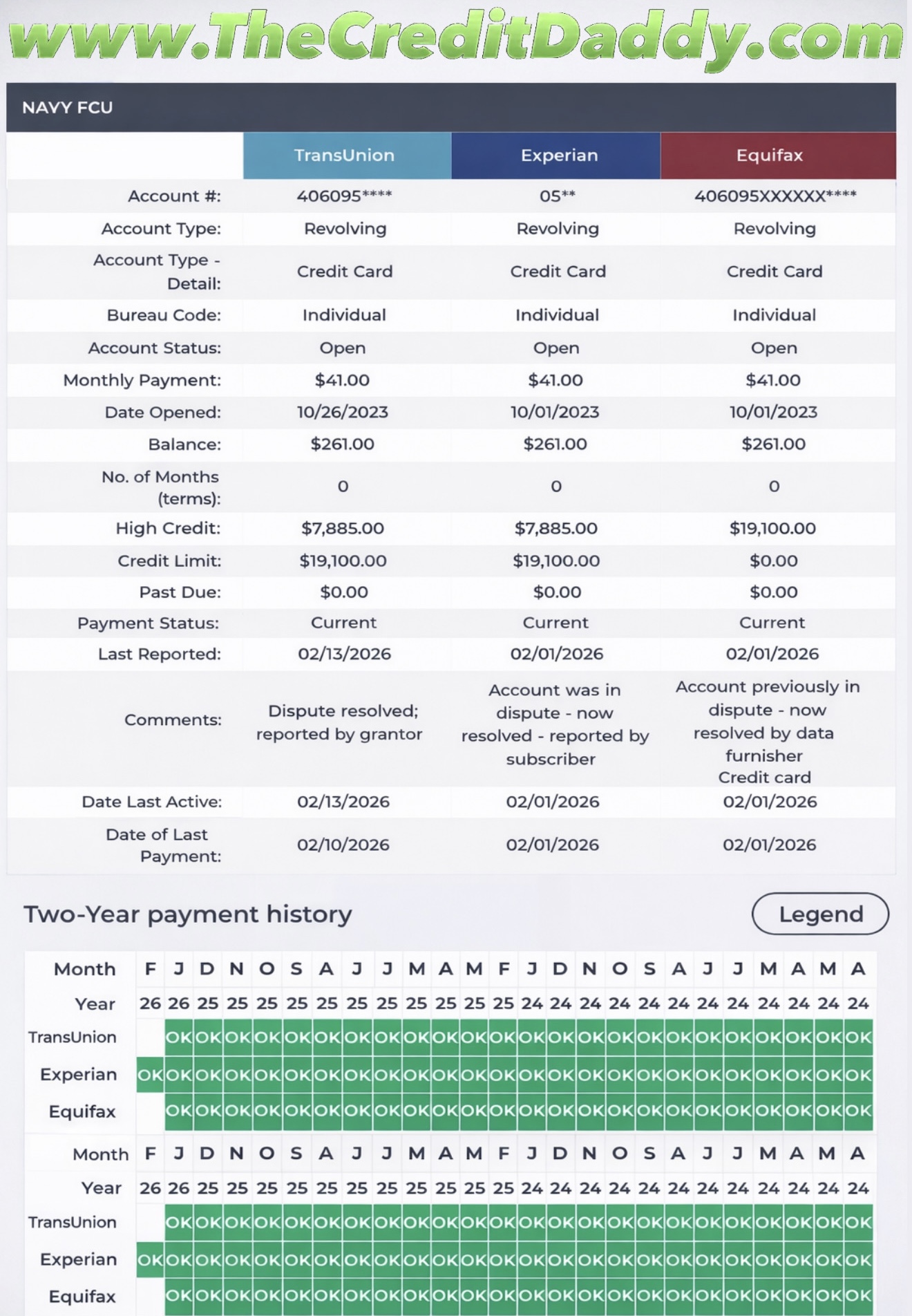
| Credit Limit | The Total Amount Your Credit Card Is Worth Assuming You Owe $0 | The Credit Limit For This Account Is $19,100 |
|---|---|---|
| Due Date | Your Due Date Is What Reports Your PAYMENT HISTORY. | You Can Find This On Mobile Credit Card App. Usually Right Next To The Balance Or When You’re Attempting To Pay The Bill |
| Statement Date | Your Statement Date Is What Goes On Your Credit Report. | You Can Find This On Mobile Credit Card App Under Statements & Documents |
| Balance | Balance = ( How Much You Owe ) Pay your Full balance down 3 days before your Statement Date. Whatever your balance is after your statement date… THAT'S WHAT WILL SHOW ON YOUR CREDIT REPORT & DETERMINE YOUR UTILIZATION‼️ This is where you want to make sure your balance is either paid in full or below 30% preferably 10% | The Balance For This Account Is $261. Utilization = 1.36% That is excellent utilization and shows responsible credit use. |
| Monthly Payment | Monthly Payment = Minimum Balance: If for whatever reason you can't pay the full credit card balance, If you just pay the MINIMUM BALANCE 3 days before the Due Date 📅 you will have 100% payment history on your credit report. I recommend putting minimum balance on autopay. | My Minimum Balance Is $41. So Even If I Were To Max Out This Card. ( which is not recommended) By Paying At Least The Minimum Balance I Keep The Account Active & Avoid A LATE PAYMENT |
| High Credit | High Credit = This let banks and creditors know what is the MOST Amount of money you spent on this Credit Card 💳 | My High Credit Is $7,885. This Means At One Point This Was My Balance AFTER THE STATEMENT DATE. Before I Paid It Down, And It’s Highest Balance I’ve Had So Far. |
Rule #1
NEVER SPEND WHAT YOU DO NOT HAVE
How To Pay Your Credit Card Bill Correctly
When It Comes To Paying Down The Balance There Are Two Types Of People:
✅ Type 1: Pay After Every Purchase
( THIS IS THE SAFER ROUTE )
My lil sister prefers this method — her balance is always low. It keeps your utilization near 0% at all times, which is best for your score.
💳 Type 2: Let It Build Up Then Pay
( CORDELL'S PREFERRED METHOD )
I like the way the money looks in my actual bank account rather than on the credit card 😂 — just make sure you always pay before the statement date.
Pay down in this priority order:
• Preferably pay IN FULL
• If you can't pay in full, pay to where you only owe 10% or below
• If you can't get it under 10%, try to get it to where you only owe 30% or below
• If you can't get it under 30%, pay the minimum balance & go watch the recording on How To Get Out Of Credit Card Debt
Why This Matters: Credit card utilization makes up 30% of your credit score. Keeping balances below 10% of your limit gives you the best score boost. Even getting under 30% will make a noticeable difference.
Credit Card Utilization Calculator
Your Credit Card Utilization is one of the most important factors in your credit score - it makes up 30% of your total score. Keeping it low shows lenders you're responsible with credit.
The Golden Rule: Keep your utilization at 10% or below for the best credit scores. Anything over 30% starts to hurt your score.
Enter your credit card details below to see your utilization rate on the visual bar, and get personalized payment options for Options A, B, C, and D.
Utilization Calculator
See your utilization and get personalized payment options
Your Utilization Rate
How To Get Out Of Credit Card Debt
Watch the full training on how to get out of credit card debt — a step-by-step breakdown on how to use your credit cards correctly, eliminate debt, and never pay interest.
What Is A Debt To Income Ratio (DTI)?
Debt-to-Income Ratio (DTI) is a simple but very important number lenders use to decide whether to approve you, how much to approve, and what terms you get.
Your DTI is the percentage of your gross monthly income that goes toward monthly debt payments. In short: It tells lenders how much of your income is already spoken for.
DTI = (Total Monthly Debt ÷ Gross Monthly Income) × 100
Why DTI Matters
• Determines loan approval
• Affects credit limits
• Impacts interest rates
• Can stop you from getting a mortgage even with a 750+ credit score
🔑 You can have a great credit score and still get denied because of high DTI.
DTI Guidelines Lenders Use
• 0-36% → ✅ Excellent - Most lenders love this
• 37-43% → ✅ Acceptable for most loans
• 44-50% → ⚠️ High - harder to get approved
• 50%+ → ❌ Most lenders will deny
DTI Calculator
Calculate your Debt-to-Income Ratio
Your Debt-To-Income Ratio
How To PROPERLY Set Up Your LLC Step By Step
It is important to understand that owning an LLC comes with expenses. You may have monthly or yearly costs such as:
Business email Business website Business phone number Business address Domain and hosting fees Other business-related expenses
Now, many of these expenses can potentially become tax write-offs, but you still need to make sure they fit comfortably within your current budget. So if these costs will not hurt you financially, then I would say go ahead and start your LLC now.
Do These In This EXACT ORDER. Because When You Do Step 6, You Will Need To Put Steps 1–5 On The Application.
| Step 1 | Business Name | Not In A Restricted Industry |
|---|---|---|
| Step 2 | Business Address | Brick & Mortar |
| Step 3 | Business Phone | 800 Number |
| Step 4 | Business Email | Not A Gmail |
| Step 5 | Website | Nothing Related To Anything Restricted (Social Media Not Enough) |
| Step 6 | Apply For Business Entity | LLC |
| Step 7 | E.I.N | Your business social |
| Step 8 | Open Business Checking & Savings Bank Account | No Personal Bank Account. (MUST NOT BE IN CHEXSYSTEMS) Put $100 In Checking & Savings |
| Step 9 | Duns & Bradstreet Number | Making Sure Your Company Is Verified |
| Step 10 | Ask For Money | You have 30 days to remove the inquiries before they hit your credit report |
Picture A $50,000 Line Of Credit Waiting On You. For Every Red Flag 🚩 You Lose $5,000
| Find Out If Your Business Is In A High Risk Industry | $50,000 | https://fairfigure.com/blog/low-risk-naics-codes |
|---|---|---|
| Wrong Business Name? -$5,000 | $45,000 | Search For The Business Name Here — https://apps.ilsos.gov/businessentitysearch |
| No Business Email? -$5,000 | $40,000 | Google Workspace — $7–$14/Month https://workspace.google.com/business/signup/welcome |
| No Business Address? -$5,000 | $35,000 | Google Registered Agent For Your State ( Ex: Registered Agent Illinois ) |
| No Business Number -$5,000 | $30,000 | Google Voice, Grasshopper, RingCentral, SideLine, TextNow |
| No Business Website -$5,000 | $25,000 | Contact Harry — He's The One Who Created My Website. harry-castaner.vercel.app |
| No Duns & Bradstreet -$5,000 | $20,000 | Get Your D&B Number https://www.dnb.com/en-us/smb/duns/get-a-duns.html |
| No Business Bank Account | $0.00 | Must Have An ACTUAL BUSINESS BANK ACCOUNT To Reach A Business Loan |
What Is A Fraud Alert 🚨
No worries a fraud alert is NOT A BAD THING. It is a free safety tool that helps protect you from identity theft.
A fraud alert is a notice placed on your credit reports that tells lenders and creditors to take extra steps to verify your identity before approving new credit in your name. That extra step is usually to text, call or email you for confirmation before actually running your credit.
Although this is a safe way to protect yourself from identity theft—having an active fraud alert can delay the process because a fraud alert is a strict security feature. The credit bureaus will not process any changes, updates, or actions on your credit report while it remains active and we do not want that.
To remove a fraud alert, see To Do List Step 2: Remove All Fraud Alerts for the bureau phone numbers and links.
What Are Student Loans?
A student loan is borrowed money used to pay for education that you must repay—with interest—after (and sometimes during) school.
🏦 The 2 Main Types of Student Loans
1. Federal Student Loans
Issued by the U.S. government
Pros:
- Lower interest rates
- Flexible repayment plans
- Deferment & forbearance options
- Possible loan forgiveness
Cons:
- Still hard to discharge in bankruptcy
Common federal loans: Direct Subsidized Loans, Direct Unsubsidized Loans, PLUS Loans (parents or grad students)
2. Private Student Loans
Issued by banks, credit unions, or lenders
Pros:
- Can cover gaps federal loans don't
- Faster approval sometimes
Cons:
- Higher interest rates
- Credit-based approval
- Fewer protections
- Almost never forgiven
⏳ When Do You Start Paying Them Back?
- Usually 6 months after leaving school (grace period)
- Interest may build while you're still in school
- Payments can last 10–25+ years if not managed properly
📉 How Student Loans Affect Credit
Student loans:
- Appear as installment loans
- Can help credit if paid on time
Can destroy credit if:
- Late
- Defaulted
- Sent to collections
How Student Loans Work
If you do not have student loans please skip this step and move on to Step 11
The size of your student loan doesn’t change the basic strategy.
Short Answer: This may seem like a lot because I am providing a lot of knowledge for those who may not understand exactly how student loans work. They are all important but the main ones are 4, 5, 6, 8, 9, 10, 17, & 18
Whether you owe $3,500, $35,000, or $100,000+, you need to do 11 things:
THE SIMPLE FORMULA 🧠
- KNOW WHAT YOU OWE 💵
- KNOW WHEN PAYMENTS ARE DUE 📆
- NEVER IGNORE THE SERVICER 📄
- CHECK FOR FORGIVENESS PROGRAMS BEFORE PAYING EVERYTHING OFF 🏛️
- MAKE THE REQUIRED PAYMENT ✅
- UNDERSTAND HOW MUCH INTEREST IS ACCRUING 🧮
- PAY EXTRA WHEN POSSIBLE 💸
- TARGET HIGH-INTEREST LOANS FIRST 🔎
- USE EXTRA INCOME TO ATTACK THE BALANCE 🧾
- REVIEW YOUR BALANCE EVERY MONTH 🧐
- REPEAT UNTIL THE BALANCE = $0 👏🏾
If you want to know what this actually looks like step by step… I will explain in more detail below ⬇️
- Ignoring emails from loan servicer
- Forgetting to update their address, phone number, or email
- Assuming payments don’t start yet
- Thinking loans are still paused (like during COVID)
- Drop below half-time enrollment without realizing their grace period may begin
- Know a payment is due but ignore it because money is tight
- Don’t contact their servicer when they can’t afford the payment
👉 Late = 30 days past due → hits your credit
IMPORTANT: Missing a payment makes a federal student loan delinquent. Federal Student Aid states that delinquency of 90 days or more can be reported to the three major credit bureaus.
To avoid this you have to actually begin paying down the loan. If you can’t—The solution is to address the problem BEFORE it reaches that point.
STEP 1 — CHECK YOUR ACCOUNT
Go to:
👉 StudentAid.gov
Log in and review:
- Total student-loan balance
- Individual loan balances
- Original loan amounts
- Interest rates
- Loan types
- Loan status
- Loan servicer
- Repayment plan
- Upcoming payment information
Then log directly into your loan servicer’s website and review your billing information.
Your servicer may be a company such as Nelnet, Aidvantage, MOHELA, Edfinancial, etc.
Don’t depend solely on emails to tell you what’s happening. Check the account yourself.
Before worrying about paying a loan off faster, figure out exactly where you stand.
IDENTIFY YOUR CURRENT STATUS 🔎
Your strategy depends on the status of your loan.
🎓 IN SCHOOL
If you’re enrolled at least half-time, qualifying federal student loans generally don’t require paym ents yet.
⏸️ GRACE PERIOD
For Direct Subsidized and Direct Unsubsidized Loans, there is generally a 6-month grace period after graduating, leaving school, or dropping below half-time.
💰 REPAYMENT
Your scheduled monthly payments are now required.
⚠️ DEFERMENT / FORBEARANCE
Your required payments may be temporarily postponed or reduced, but interest may continue accumulating, depending on the loan and situation.
🚨 DELINQUENT / DEFAULT
This requires immediate attention. Contact your servicer and determine what options are available.
Don’t assume:
“I’m still in school, so I don’t have to pay.”
The important question is whether your school considers you enrolled AT LEAST HALF-TIME.
“Drop below half-time” means you’re still attending school, but you’re no longer taking enough classes or credit hours to be considered at least a half-time student.
For federal student loans, your school determines what counts as half-time enrollment based on its academic program.
For example, if your school considers:
- 12 credit hours = full-time
- 6 credit hours = half-time
Then:
As long as you have a minimum 6+ credit hours: You’re at least half-time.
But if you droppped Below 6 credit hours: You’ve dropped below half-time.
So you do not necessarily have to graduate or completely leave school for the grace period to begin. If you reduce your course load enough that your school reports you as less than half-time, that can trigger the typical 6-month grace period for certain federal student loans.
So for your educational material, I’d frame it as:
January: You drop below half-time → grace period begins
January–June: Approximately 6-month grace period
Around July: Required monthly payments may begin
Dropping below half-time isn’t necessarily a bad thing, but it can start the clock toward repayment. Even if you haven’t graduated, your student loans may eventually require monthly payments because you’re no longer enrolled at least half-time.
What happens if you go back to school?
If you return to at least half-time BEFORE your 6-month grace period expires, your loans generally return to in-school status. You don’t have to make monthly payments, and you regain the full 6-month grace period for the next time you graduate, leave school, or fall below half-time.
However, If you were below half-time long enough that your 6-month grace period already ended and payments actually started, returning to school at least half-time can still qualify you for an in-school deferment. That means your required payments can stop while you remain enrolled at least half-time. However, if you later drop below half-time AGAIN or GRADUATE, payments may resume immediately because you’ve already used the grace period.
In Conclusion, KNOW THE DATE. Don’t guess.
BEFORE YOU PAY ANYTHING, see what can be waived FOR GOOD. Aggressively paying thousands of extra dollars toward a balance that may ultimately qualify for forgiveness could work against your financial objective. Determine whether you may qualify for a legitimate federal forgiveness or discharge program. This is separate from deferment, forbearance, and repayment plans.
Example: PSLF Program.
PSLF Stands For Public Service Loan Forgiveness 🎓💰
Ask your pastor if they are familiar with this program. Many churches are nonprofit organizations and can be qualifying PSLF employers. But the KEY WORD is EMPLOYER — you generally need to work for the church, not just attend or be a member. Federal Student Aid specifically says PSLF eligibility is based on who you work for, and eligible employers can include qualifying 501(c)(3) nonprofit organizations. You submit a PSLF form, and an authorized official from the church/employer certifies that you actually worked there and your dates of employment. It doesn’t necessarily have to be the pastor; it needs to be someone authorized to certify employment. I’m not saying get your pastor to lie for you 😂 but see if they are willing to help you out. Ask them what would Jesus do? 😭🙏🏾
How Does Interest Work ?
Let’s assume you originally borrowed $3,500 in student loans with a 14.29% interest rate
You can easily find out your daily interest by simply multiplying your Principal Balance × Interest Rate ÷ 365. This gives you an approximation of how much interest accrues PER DAY.
$3,500 X 14.29%
$500 / 365.
The first thing that happens right away is Interest Accrues.
What does this mean:
Student loans usually have daily interest. Even though you only borrowed $3,500, If you don’t make payments for a period of time (or your payments don’t cover all of the interest), your balance can grow because interest has been added to the loan.
EXAMPLE:
$3,500 At a 14.29% interest rate:
- Approximate Interest Per Day: $1.37
- Approximate Interest Per Month: $41.67
- Approximate Interest Per Year: $500
$3,500 + $500
- Your balance is increasing daily, Assuming you make 0 PAYMENTS, your New Balance will be $4,000 at the end of the year Instead Of $3,500.
Now that the balance has reached $4,000. If NOTHING HAPPENS AGAIN… we now treat $4,000 as the balance accruing interest at 14.29% annually. NOT $3,500
This would add up to approximately
- Per Day: $1.57 in interest
- After 3 Months: $142.90 in interest → New Total Balance = $4,142.90 balance
- After 6 Months: $285.80 in interest → New Total Balance = $4,285.80 balance
- After 1 Year: $571.60 in interest → $4,571.60 balance. Obviously these numbers will continue to increase if no payments are ever made.
Although there is no rule that says your BALANCE must stay BELOW the original loan amount. Some lenders and scoring models PREFER profiles where you’ve paid off all accrued INTEREST and are REDUCING the principal you ORIGINALLY BORROWED.
For example:
Original amount borrowed: $3,500
Balance grew to: $4,571.60
You pay $1,071.60
You reduced the balance back to: $3,500
Why Does This Matter?
Notice how your yearly interest changes as your balance decreases.
Remember in the first example you went two full years with 0 payments. If you compare a $3,500 balance with a $4,571.60 balance, both at 14.29% annual interest.
$3,500 Balance ( no additional payments )
- Approximate interest per year: $500.15
- Approximate balance after 1 year: $4,000.15
VS
$4,571.60 Balance ( no additional payments )
- Approximate interest per year: $653.28
- Approximate balance after 1 year: $5,224.88
The Difference
$653.28 − $500.15 = $153.13
By reducing your balance from $4,571.60 to $3,500, you have reduced the amount you owe by a total of $1,071.60. At a 14.29% interest rate, that lower balance means you could save approximately $153.13 in interest PER YEAR in this simplified example. A Penny Saved Is A Penny Earned. 💰
DON’T STOP JUST BECAUSE YOU REACHED THE ORIGINAL BALANCE. From here now you can start making regular payments. The ultimate target is $0.
If you can’t make a large payment to bring the account back to the ORIGINAL BALANCE. Your first priority should ALWAYS be keeping the account CURRENT.
If your required payment is $150:
Pay the $150.
Don’t send $100 just because that’s more than the monthly interest if your required payment is $150. The rule is simple… REQUIRED PAYMENT FIRST → EXTRA PAYMENT SECOND
The idea is that interest is generally calculated based on your outstanding principal balance. The smaller your principal balance, the less interest that can grow over time.
Lower Principal = Less Interest 📉
CREATE YOUR EXTRA-PAYMENT NUMBER. This should be one of your first financial goals. This is RIGHT AFTER you have successfully brought the account back to CURRENT.
If approximately $47.63 of interest is accruing each month Knowing this number gives you a target. 🎯 Paying only $20/month toward the loan isn’t enough to offset $47.63 of new interest.
When possible, you want your payments to cover the interest that is accumulating AND begin reducing principal.
A simple personal target could be:
Monthly Accruing Interest + Extra Principal Payment
For example:
Approximate monthly interest = $47.63
You decide to pay = $100
Approximately $47.63 addresses the interest and the remaining amount can begin helping reduce the balance, subject to how your servicer applies the payment.
The goal is simple:
DON’T JUST MAKE PAYMENTS — MAKE PROGRESS. 📉
Once the required payment is covered, determine how much extra you can realistically afford.
Even an additional:
$25
$50
$100
$250
each month can make a difference over time.
The faster you reduce principal, the less principal remains available to generate future interest.
You don’t necessarily need thousands of dollars. Consistency matters.
🔥 OPTION 1: AUTOPAY
Recommended for borrowers who consistently maintain enough money in their payment account.
Benefits:
💸 Often gives 0.25% interest rate discount
✅ Payment automatically processed
✅ Eliminates the chance of forgetting
Always make sure enough money is in the account before the withdrawal date.
🔥 OPTION 2: MANUAL PAYMENTS
If you prefer controlling every payment:
- Create calendar reminders
- Set reminders 7–10 days before the due date
- Pay before the deadline ( recommended 3 days )
Don’t assume clicking “Submit” means you’re finished. VERIFY THE PAYMENT CLEARED & Later confirm that the payment successfully posted.
Suppose you have:
Loan A → $3,000 at 4%
Loan B → $5,000 at 7%
Loan C → $8,000 at 10%
Continue making the required payments on ALL THREE.
Then consider directing your extra money towards the HIGHEST-INTEREST LOAN FIRST.
In this example:
🔥 Attack Loan C first.
Once Loan C is eliminated, redirect the money you were paying toward Loan C to the next-highest-rate loan.
This is commonly called the Debt Avalanche Method.
Mathematically, this approach generally saves more interest than prioritizing the smallest balance regardless of rate.
You don’t have to rely exclusively on monthly payments.
Consider using part of:
💰 Tax refunds
💰 Bonuses
💰 Commissions
💰 Overtime
💰 Side-hustle income
💰 Birthday/holiday money
💰 Unexpected extra income
toward your student loans.
A $2,000 lump-sum payment today can prevent that $2,000 of principal from continuing to generate interest for years.
The lowest monthly payment isn’t automatically the cheapest option overall.
A lower payment may help your monthly cash flow, but depending on the plan and circumstances, a longer repayment period can mean carrying debt longer. REMEMBER—YOU WANT THIS LOAN GONE AS FAST AS POSSIBLE.”
Compare:
Monthly Payment
vs.
Total Interest
vs.
Payoff Date
Once a month, record:
Beginning Balance: $_____
Required Payment: $_____
Extra Payment: $_____
Interest Charged: $_____
Ending Balance: $_____
Then ask yourself:
DID MY BALANCE GO UP OR DOWN?
If it’s going down:
KEEP GOING. 🔥
If it’s staying roughly the same:
Investigate why.
If it’s increasing:
Determine whether your payments are covering the accruing interest and whether your repayment strategy needs to change.
The goal isn’t PERFECTION. The goal is to STAY CURRENT, CONTROL THE INTEREST, REDUCE THE PRINCIPAL, AND EVENTUALLY REACH $0.
I understand sometimes life happens, But this should be your LAST LINE OF DEFENSE.
You can’t just run from the debt. This is where most people go wrong. PAUSED PAYMENTS DOES NOT ALWAYS MEAN PAUSED INTEREST. Interest may continue accumulating during deferment or forbearance
If you legitimately cannot make payments, temporary relief can be valuable.
If you know for a fact the next upcoming months you won’t be able to make payments on your loans…DO NOT just ignore it ❌
In many cases, lenders are willing to work with borrowers who communicate proactively. If an agreement is approved, it can help bring the account back into good standing and may positively impact your credit over time.
Instead Apply for:
- 💰 Income-Driven Repayment (IDR)
- ⏸️ Deferment
- 🛑 Forbearance
- Consolidate your loan
- Set up a payment arrangement
- Move the past-due balance to the end of the loan
- Offer any hardship assistance programs to prevent additional late payments from reporting
👉 This keeps your account in good standing
Here’s a recommended script:
If your credit scores have already dropped due to student loan late payments, contact your student loan servicer immediately. Explain that you are currently trying to qualify for housing and that the late payments are negatively affecting your approval chances.
Let them know that you were unaware payments had resumed and believed the loans were waived due to the COVID period. Then respectfully ask if there are any options available to help reverse the late payments or prevent further negative reporting.
Most importantly, once an arrangement is made, make sure you begin making payments consistently — if money is still tight consider paying at least $5 more than the amount of interest that accrues each month, or $5 more than your required monthly payment, whichever is greater. This helps ensure your balance continues to DECREASE instead of staying the same or growing.
Student Loan Calculator
Student Loan Payment Calculator
Estimate your daily interest, monthly interest, payment breakdown, extra-payment target, and how much you need to pay to bring your balance back to the original loan amount.
Enter Your Loan Information
If you cannot make a large payment to bring the account back to the original loan amount, your first priority should be making at least your required payment so you can help keep the account current.
Your Estimated Results
Car Note Calculator
Car Note Payment Calculator
Estimate your daily interest, monthly interest, how much of your car note goes to interest vs. the car, your extra-payment target, and how much sooner you can pay the car off.
Enter Your Car Loan Information
If you cannot make a large extra payment, your first priority should be making at least your monthly car note on time so the account stays current and the car stays yours. Extra payments only help once the note is covered.
Your Estimated Results
What Is ChexSystems?
ChexSystems is a consumer reporting agency that banks and credit unions use to decide whether to approve or deny you for checking and savings accounts.
It's like a credit report—but for bank accounts, not loans or credit cards.
What ChexSystems tracks
ChexSystems collects information about negative banking activity, including:
- Unpaid overdrafts
- Negative balances left unpaid
- Account closures for cause
- Suspected fraud
- Excessive bounced checks
- Abandoned accounts with balances owed
It does NOT track credit cards, loans, or credit scores.
How it affects you
If you have negative info in ChexSystems, banks may:
- Deny you a checking or savings account
- You can NEVER Get a business loan while In chexsystems
- Require a second-chance account
- Limit features (no overdraft, no checks)
- Charge higher fees
- Won't qualify for pay in four options like Afterpay, Klarna, Acima, Zip, Affirm, PayPal Etc
This is why people say: "My credit is good, but the bank still denied me."
How long ChexSystems stays on your record
- Most negative items stay up to 5 years
- Even small amounts (like $50–$200) can block approvals
- Paying the debt does not automatically remove it
What People Don't Realize
If you are in chexsystems or early warning then that means that you have been violated. Read 15 USC 6802- 15 USC 6805. If you read your terms and conditions and privacy agreements of your credit card accounts banking information it tells you that they do not share your personal information with any 3rd party non affiliate….
Third Party Non-Affiliates Include:
- Lexis Nexis
- Experian
- Equifax
- Transunion
- Early Warning System
- ChexSystems
What we don't realize it when we open up these accounts we have the option to opt out so they don't share our information but they don't out right tell us that in plain English either. But in there privacy agreements and terms and conditions it states that they don't but yet they do anyway which is a violation.
What Is Early Warning Services?
Early Warning Services (often just called Early Warning or EWS) is a consumer reporting agency used by banks to decide whether to approve you for checking and savings accounts and to monitor for fraud.
It's similar to ChexSystems—but more powerful—and is heavily used by major banks.
What Early Warning tracks
Early Warning Services collects:
- Bank account openings & closures
- Unpaid negative balances
- Overdraft abuse
- Suspected fraud or identity risk
- Transaction behavior patterns
- Zelle-related activity
- Account misuse flags
Unlike ChexSystems, Early Warning is often real-time and behavior-based.
Many top U.S. banks rely on Early Warning, including:
- Chase
- Bank of America
- Wells Fargo
- Capital One
- PNC
If Early Warning flags you:
- You may be denied instantly
- No explanation from the bank
- Even "second-chance" accounts may be blocked
- Zelle can be restricted or shut down
How long Early Warning stays on your record
- Typically up to 5 years
- Fraud-related flags may last longer
- Paying a balance does not guarantee removal
What Is A Charge-Off?
A charge-off account is a debt that a lender has decided is unlikely to be collected, so they mark it as a loss in their accounting—but you still owe the money.
How a charge-off happens (simple timeline)
- You miss payments (usually 120–180 days late)
- The lender gives up trying to collect
- They charge off the account as a loss
- The debt may:
- Stay with the original lender, or
- Be sold to a collection agency
Important truths about charge-offs
- Not forgiven – you still legally owe the debt
- Not the same as a collection, but they often come together
- Very negative on your credit
- Can stay on your credit report for 7 years from first delinquency
What Is A Collection Account?
A collection account is a negative credit item that appears when a bill goes unpaid for a long period and the original creditor sends or sells the debt to a collection agency.
Common types of collection accounts
- Credit cards
- Medical bills
- Utility bills
- Phone/cable/internet bills
- Auto loan deficiencies
- Apartment or rental balances
Why collections are serious
- They can drop your score 50–150+ points
- They stay on your credit report for 7 years from the first missed payment
They make it harder to get:
- Credit cards
- Auto loans
- Mortgages
- Apartments
Paid vs. unpaid collections
- Unpaid collections obviously will still hurt your score, BUT Paying a collection does NOT guarantee removal
- Paid collection → Settled for less than full balance, A collection is still a collection at the end of the day and needs to be removed from your profile. If you get out of jail for robbery even though you did your time will jobs still look at you sideways?
What Is A Repossession?
A repossession (often called a repo) happens when a lender takes back property you're financing—most commonly a car—because payments weren't made as agreed.
How a repossession happens (simple timeline)
- You finance a vehicle (or other property)
- You miss payments (often 60–90 days late, varies by state & contract)
- The lender declares default
- The vehicle is repossessed (often without warning)
- The lender may:
- Sell the vehicle at auction
- Bill you for the remaining balance (deficiency balance)
Important things to know
- Repossession does NOT erase the debt
- It's a major negative on your credit
- It can stay on your credit report for 7 years from the first missed payment
- You may still owe money after the car is taken
Deficiency balance (very important)
If you owed $18,000 and the car sells for $11,000:
- $7,000 = deficiency balance
- Plus fees (towing, storage, auction costs)
- That balance can be sent to collections or charged off
Voluntary vs involuntary repossession
- Voluntary repo: You turn in the vehicle
- Involuntary repo: The lender takes it
⚠️ Credit impact is the same for both
What Is An Eviction?
An eviction is a legal process where a landlord forces a tenant to move out of a rental property—usually because the tenant violated the lease or failed to pay rent.
🏠 Common Reasons Evictions Happen
- Non-payment of rent (most common)
- Repeated late payments
- Violating lease terms (unauthorized occupants, pets, damage)
- Illegal activity
- Staying after the lease ends (holdover tenant)
⚖️ How the Eviction Process Works (Simple Version)
- Notice is given (Pay rent, fix the issue, or leave by a certain date)
- Court filing If the issue isn't resolved, the landlord files an eviction case
- Court judgment A judge decides whether the tenant must leave
- Physical removal (if necessary) Law enforcement may remove the tenant if they don't leave voluntarily
⚠️ You're not officially evicted until there's a court judgment—not just a notice or threat.
📄 Eviction vs Eviction Filing (Important Difference)
- Eviction notice → ⚠️ Warning (not on your record)
- Eviction filing → ⚠️ Court case (can show up in tenant screenings)
- Eviction judgment → ❌ The real damage (harder to remove)
Even dismissed cases can still hurt rental approvals.
⏳ How Long an Eviction Stays on Record
- Tenant screening reports: 7 years
- Court records: varies by state
- Collections tied to eviction: 7 years
That's why evictions hurt housing approvals more than credit cards do.
What Is Bankruptcy?
A bankruptcy is a legal process that gives a person or business relief from overwhelming debt when they can no longer afford to pay what they owe.
90%+ of personal bankruptcies are either:
- Chapter 7
- Chapter 13
Everything else is rare and situational.
⚠️ Credit Impact (Quick Truth)
- Bankruptcy stays on your credit report 7–10 years
- Scores usually drop 150–350+ points
💳 Debts That DO Get Wiped Out (Usually)
These are called dischargeable debts:
- Credit cards
- Medical bills
- Personal loans
- Payday loans
- Collections & charge-offs
- Old utility bills
- Certain business debts
🚫 Debts That DO NOT Get Wiped Out (Usually)
These survive bankruptcy:
- Child support & alimony
- Most student loans
- Recent income taxes
- Court fines & criminal restitution
- Debts from fraud
- Most government-backed loans
Key things people misunderstand
- Paying a public record like bankruptcy for example does not automatically remove it from your credit report
- It doesn't disappear because it's old (until time limits expire)
- Removing it often requires legal accuracy disputes or completion
- Just because your bankruptcy has been Dismissed or discharged doesn't mean it will not report on your credit report
What Are Medical Bills?
A medical bill is a charge you receive for healthcare services that were provided to you—but not fully paid for by insurance (or not insured at all).
Medical bills can include charges for:
- Doctor visits
- Emergency room visits
- Hospital stays
- Surgeries
- Ambulance rides
- Lab work & imaging (X-rays, MRIs, blood tests)
- Prescriptions
- Mental health services
What happens if a medical bill isn't paid
- Late fees may apply
- It can be sent to collections
- It can appear on your credit report if:
- It's over $500, and
- It's unpaid for 12+ months
What Are Public Records?
A public record on a credit report is a negative legal or financial event that comes from court filings or government records and is reported to the credit bureaus because it involves unpaid obligations or legal responsibility.
Historically, these included:
- Bankruptcy (Chapter 7, 11, 13) ✅ still reported
- Judgments (court-ordered debts)
- Tax liens (unpaid federal or state taxes)
- Civil lawsuits
- Evictions
⚠️ Important update:
Today, bankruptcy is the main public record that still appears directly on credit reports. Most judgments, tax liens, and civil suits no longer appear due to reporting rule changes—but they can still exist in court records and affect things like employment, housing, or lending decisions.
How public records affect your credit
- Considered major derogatory items
- Can cause large score drops (100+ points)
- Signal high risk to lenders
- Stay on your credit report for a long time
How long public records stay on your credit
- Chapter 7 bankruptcy: 10 years
- Chapter 13 bankruptcy: 7 years (sometimes sooner if completed early)
- Other public records: Usually not reported anymore, but still legally valid elsewhere
Key things people misunderstand
- Paying a public record like bankruptcy for example does not automatically remove it
- It doesn't disappear because it's old (until time limits expire)
- Removing it often requires legal accuracy disputes or completion
What Is A Tradeline?
A credit tradeline is the industry term for an account included on your credit report. For example, when you have a credit card, auto loan, mortgage, or student loan, the lender generally reports information about that account to the credit bureaus. That reported account is considered a tradeline.
You may also hear about “authorized-user tradelines” or people “buying tradelines.” When people talk about purchasing access to someone else’s established credit-card history as an authorized user (AU).
A purchased tradeline is essentially renting someone else’s positive credit-card history by being temporarily added as an authorized user. Meaning you have ACCESS TO THAT ACCOUNT. But you are not the primary owner. This may help your SCORES, but it doesn’t replace building strong primary accounts in your own name.
Reasons For Buying Tradelines
- Not Enough Credit History
- Credit Limits Too Low
- Utilization Too High
- No Credibility At All
- Credit Scores too low to qualify for loans, credit cards, apartments etc.
Tradelines are entirely legal and often provide an effective tool for improving your credit scores with the credit bureaus. It is essential to exercise caution when considering tradelines, as identity theft protection should always be paramount in any financial decision making.
Tradelines on average will appear on your credit report within 3 weeks, and sometimes even faster, in as little as 7 to 11 days, but 30 Days at the most. This depends on many factors, including the date the AU is added, the reporting period of the tradeline. And when your actual credit report updates.
Remember there is a big difference between your Credit SCORE, Credit REPORT, & Credit PROFILE. A Credit Profile that Only has Tradelines is considered a WEAK PROFILE. The banks aren’t Stupid. They know when you have a Tradeline, it literally says AUTHORIZED USER. Yes It Helps with your SCORES, But NOT YOUR PROFILE. They still want to know what YOU HAVE DONE PERSONALLY.
It’s never a bad idea to buy a Tradeline, but it’s not always necessary if you already have great payment history. The Recommended amount is 2 to 4. You don’t need to flood your report with Tradelines.
Understand you are the ONLY person that can boost Your Credit Score Permanently. However buying a Tradeline is the fastest way to do so temporarily. Tradelines can potentially increase your credit scores and you can see results within 2 to 3 Weeks.
Although it is ideal for a Tradeline to post to all three major bureaus (Experian, Equifax, and TransUnion). NOBODY can guarantee that a tradeline will post to all 3 credit bureaus EVERY SINGLE TIME. If they do they’re just saying that to make you feel comfortable enough to pay them. I will only Guarantee that your tradeline will post to at least one bureau of the three.
Tradelines usually last only 2 to 3 Months. So Unless You’re Ready To Apply For A House, Car, Apartment, Credit Card, Or Funding 💰 Within The Next 2 to 3 Months, It Doesn’t Make Sense To Buy A Tradeline. It’s not doing anything for you.
After a tradeline is Closed, it can potentially still have a positive effect on your Credit History and Scores. But it is also possible for your scores to go right back to what they originally were. Most Tradelines will stay on your Credit Reports for a very long time. I cannot guarantee the exact amount of time they will show on your Credit Reports.
Absolutely 👍 Once you have credit cards with 100% Payment History, and either HIGH LIMITS, or GOOD AGE You can now start charging people to add them on to your credit cards for 2 to 3 Months. I actually use this method to pay down my credit cards bills.
By someone adding you as an authorized user on their credit cards it will cause your credit score to go up. Why? Once you are added to a credit card it’s going to show up on your credit report that you have ACCESS to that card.
So for example, if your mom has a $10,000 Chase credit card and she had it for 10 years, the utilization is reporting below 10% to 30%, and she has 100% Payment History on that card. If she was to add you as an AUTHORIZED USER this does multiple things for you:
| What You Gain | Why It Moves Your Score |
|---|---|
| Payment History 35% |
It gives you 10 years worth of PAYMENT HISTORY, which is 35% of your credit score. |
| Credit Card Utilization 30% |
That $10,000 limit gets added to your available credit. If You Have A $1,000 Credit Card And You're Spending $700, Your Utilization Is 70%, Which Is TOO HIGH. Remember you want to keep your utilization UNDER 10%, which would be $100 and below on a $1,000 limit. So When That $10,000 Limit Gets Thrown In, Your Available Credit Goes From $1,000 To $11,000. Now You're Using $700 Out Of $11,000, So Your Utilization Is Roughly 6.4%, Which Is Under 10%. That Is Good, Causing Your Score To Increase 🚀 |
| Credit Mix 10% |
The Credit Card 💳 Itself Is Considered A REVOLVING Account. The Revolving Account Goes Into Your CREDIT MIX, which is 10% of your credit score. |
| Credit Age / History 15% |
Because she had that card for 10 years, that is also 10 years worth of Credit Age / History, which is 15% of your credit score. |
This will cause your score to sky rocket 🚀 and by you having a higher credit score you are able to get approved for more money and have lower interest rates. So it helps you in many ways while not affecting them at all.
1. Make Sure Your Credit Report Is Clean & Accurate
Remember the tradeline will help boost your Credit SCORES, But that will only make you QUALIFIED TO APPLY. Your Credit REPORT Is What Gets You APPROVED OR DENIED! So negative items can still potentially hold you back.
2. Make Sure You’re Actually Ready To Execute
Remember Tradelines only last 2 to 3 Months. So unless you’re ready to apply for something within the next 2 to 3 Months, It doesn’t make sense to buy a Tradeline.
3. Know What Type Of Tradeline You Need Before Just Buying A Random One
It’s never a bad idea to buy a tradeline but it’s not always necessary. Knowing the kind you need based off of your Credit Report & current situation can help you save a lot of money 💵
Reasons For Buying Tradelines
- Not Enough Credit History
- Credit Limits Too Low
- Utilization Too High
- No Credibility At All
- Credit Scores too low to qualify for loans, credit cards, apartments etc.
Different Tradeline Scenarios
| Your Situation | What I'd Recommend |
|---|---|
| You are trying to apply for funding but your credit card debt is holding you back. You already have a high credit score 720+. Your credit age is solid. 5 to 10 years+. Your Credit Card limits are also high. 5K-10k+, But your utilization is TOO HIGH, over 30%. You may not have $8,000 to pay down your balances, but you might have $500-$1,000 for a few tradeline. | By understanding this you can potentially save money. You don't necessarily need a tradeline with 10+ years worth of history. The history can be 6 months, but the limit might be $30,000, helping lower your utilization which can lead to you getting approved for that loan. |
| You have a 720+ credit score, great credit card limits 5 to 10k plus, utilization under 10%, but you've only had the cards for 2 years or under. | You want a tradeline that has maybe a 1K limit but 20 years worth of history. But if you can find a deal that has good history and a nice limit, you take that 10 out of 10. |
| You don't have good history or high limits. | Obviously you need a tradeline that has nice limits, preferably 10K+, and good history. Then I would recommend buying two tradelines: one with history and one with a nice limit. |
| Everything is decent but your credit score just isn't meeting the requirements. | For example you have a 620 credit score but the house, credit, or bank lender says you need a 680 or 700+. I would recommend buying one Tradeline: Maybe one with a nice limit should do the trick. |
Once Again, Even Though It’s Not Always Necessary, It’s Never A Bad Idea. Banks Like To Match Energy, So When It Comes To Your Credit, The More You Put In The More You Get In Return.
The cost of tradelines can range from several hundred dollars to several thousand dollars. Pricing may vary depending on how long the account has been opened and the size of the credit limit, as well as how many you purchase.
When Buying A Tradeline Or Two You Can Expect To Either Get Approved For More Money Than You Would Have Gotten Without The Tradeline, Or Get A Lower Interest Rate Than You Would Have Originally Gotten, Saving You Thousands. MOST OF THE TIME YOU GET BOTH.
So At The End Of The Day, Even If You Spent $3,000, It’s Worth Every Dime Because You Get And Save More Money Than It Costed, Instantly Getting Your Money’s Worth 🤑 If You Apply For A Chase Credit Card 💳 And Get Approved For $5,000, It Could Have Easily Been $10,000 Had You Bought A Tradeline First.
Yes I offer Tradelines. For now you can text me your budget and I’ll help find you the best option available.
What Is Debt Consolidation?
Debt consolidation is a financial strategy where you combine multiple debts into one single payment, usually with the goal of lowering your interest rate, reducing your monthly payment, or simplifying your finances.
Why people do it (what's advertised)
- One payment instead of many
- Lower interest rate (sometimes)
- Easier to stay organized
- Can help cash flow each month
Important downsides to know
- Does NOT erase debt — you still owe it
- Can hurt your credit if mismanaged
- Some options require good credit
- Risky if you rack up new debt afterward
- Secured options (like home equity) put assets at risk
🚨 Reasons Why I Don't Recommend Debt Consolidation
So whenever you apply for debt consolidation essentially all they will do is combine all of your debt into one big debt right? Now tell me what's stopping you from doing this yourself?
Then they will give you a monthly fee. And in most cases, debt consolidation does include interest. So you just made your debt even bigger.
What They Don't Tell You:
They don't actually start paying off any debt until everything is paid off. So if that's the case you could have just paid off everything over time yourself.
And to make matters worse — when it's all said and done any open accounts you had will be closed. And that doesn't benefit you at all.
My Recommendation:
I personally do not recommend debt consolidation at all, but debt settlement may be a better approach.
Help Your Kids Build Credit
Adding a child as an authorized user on your credit card can help them begin building their credit history early. This can lead to better credit offers, lower interest rates, auto loans, mortgages, and more as they get older.
Our parents weren't taught about credit—and that's not their fault. But today, we know better. You are responsible for your children's financial future. Getting a credit card with one of these banks and adding them as an authorized user can give your children the head start you never had.

Note: Authorized user reporting policies vary by issuer. Responsible use required.
TO DO LIST
Action items to help boost your credit score and build strong credit
(THINGS YOU SHOULD BE DOING ON YOUR END)
TO DO LIST Template
One of the most common questions clients ask me "IS THERE ANYTHING I SHOULD BE DOING ON MY END?"
May I remind that there’s a BIG DIFFERENCE Between your Credit SCORE, Credit REPORT, and your Credit PROFILE. These are 3 COMPLETELY DIFFERENT THINGS & are not to be mixed up. Which means it is important to understand that Credit REPAIR focuses on your Credit REPORT. NOT THE SCORES & PROFILE.
Credit REPAIR DOES NOT build your Credit PROFILE, & it also DOES NOT BOOST YOUR SCORES! This means I CAN NEVER be the reason your credit scores haven’t gone up or the reason they may have dropped. Although I can't physically make your scores go up ⬆️ I can give you a Step By Step Action Plan to increase your scores and build a strong profile. This is how we raise our scores from the 300s to the 700s plus.
The TO-DO-LIST was designed to help build payment history, strengthen your credit profile, build better relationships with banks, to help you qualify for things such as Credit Cards , Auto & Mortgage Loans, and even Personal & Business loans in the future. If your scores are truly important to you. We recommend that you complete as many steps on this To-Do-List as you can. If you are confused about a certain step, you can always book a FREE CONSULTATION.
🚨 Important Notice
✅ You DO NOT HAVE TO WAIT FOR EVERYTHING TO BE DELETED to start on your to do list. YOU CAN START ON THIS NOW.
✅ If a step has already been completed and is already active on your credit report, you can Skip To The Next Step.
⚠️ STEPS 5 & 6 ARE ESPECIALLY IMPORTANT FOR THOSE WHO ARE LOOKING TO REFINANCE OR FINANCE A CAR. OR APPLY FOR ANY LOANS MORTGAGE, PERSONAL, or BUSINESS
✅ Even if you can't do Steps 4-8… YOU CAN DO STEPS 1-3 & 9. And You Can Start RIGHT NOW.
⚠️ If you are in ChexSystems or Early Warnings you may not be able to do steps 4 & 5. If this is the case, go to my FAQ or DIY Tab to see how to get removed.
Are You A Visual Learner ?
Zoom recordings explaining each step will be emailed for reference. To view the recordings please check your email & spam. Search for “ TO DO LIST “ if you do not see them please text 312-584-9969 and my team will resend them to you promptly.
What Happens If I Don’t Complete My To Do List?
Although it is in every client’s best interest to complete this phase of the program please understand that This to-do-list is NOT MANDATORY. I cannot force anyone into completing this phase nor will I continuously follow up or pressure clients to do so.
I will just show a few examples below showing people who did everything, people who did a little bit, and people who didn’t do anything.
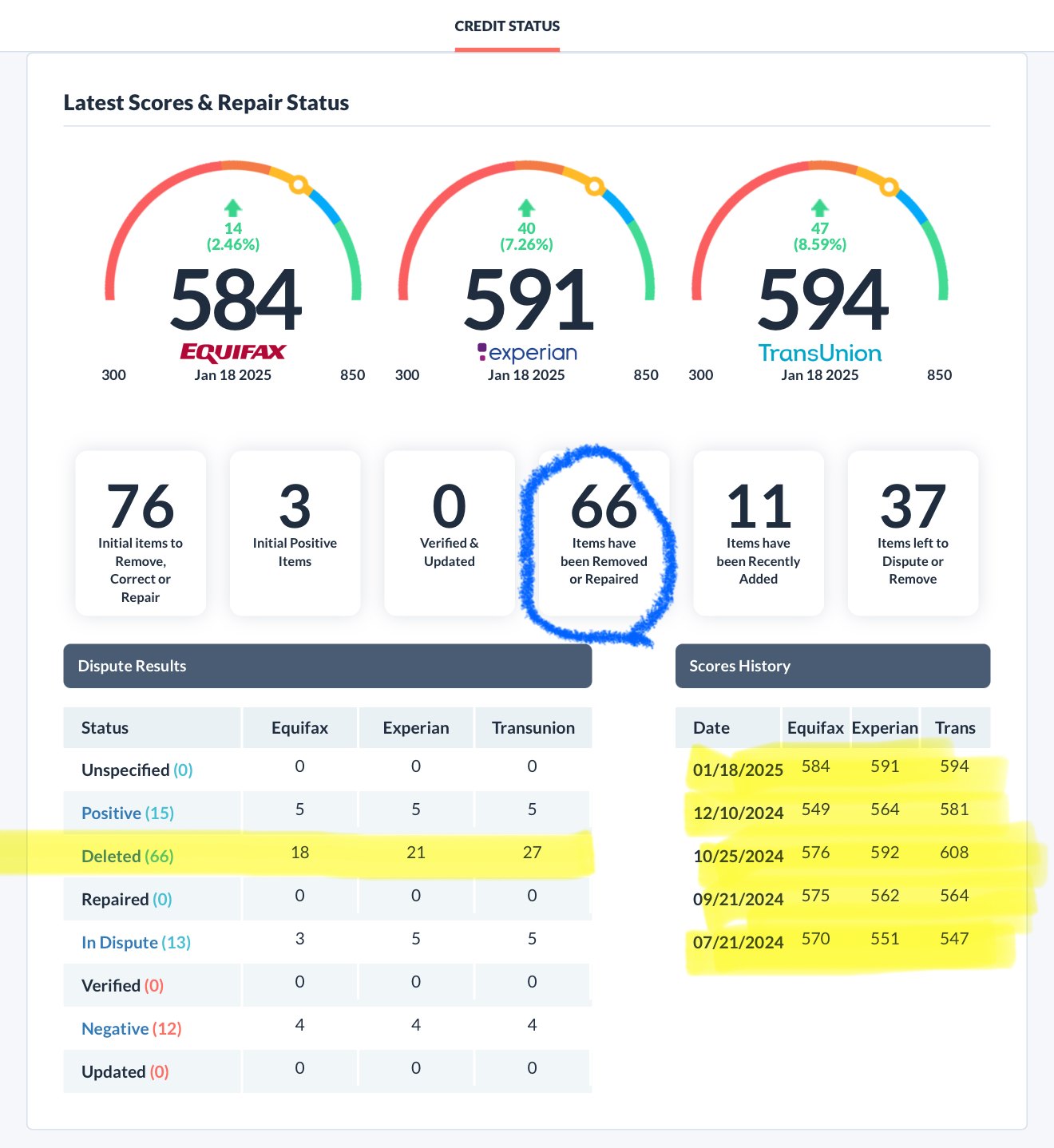
If we take a close look we can see that this particular client has completed four rounds with us and is currently awaiting for her Round 5 to end. This client started with 76 negative items & has gotten over 66 DELETED ( at the time of this screenshot) WHICH IS PHENOMENAL‼️ But her scores haven’t really went anywhere. They are still just below the 600s. Up to this point 0 steps on the to do list have been completed.
Eventually she started feeling discouraged and wondering “ why hasn’t my scores gone up by now” Some will even be in this same situation and then get mad and reach out claiming “ I haven’t seen anything” as if I haven’t been doing my job. But you paid me for CREDIT REPAIR. Credit Repair works only when WE work. I'm not a miracle worker, I'm a strategist. And that’s when I have to ask… DID YOU COMPLETE THE TO DO LIST ? By me cleaning up your credit report I AM DOING MY PART. I cannot complete the to do list for you. YOU HAVE TO DO YOUR PART AS WELL. Make sacrifices if you have to you won’t regret it.
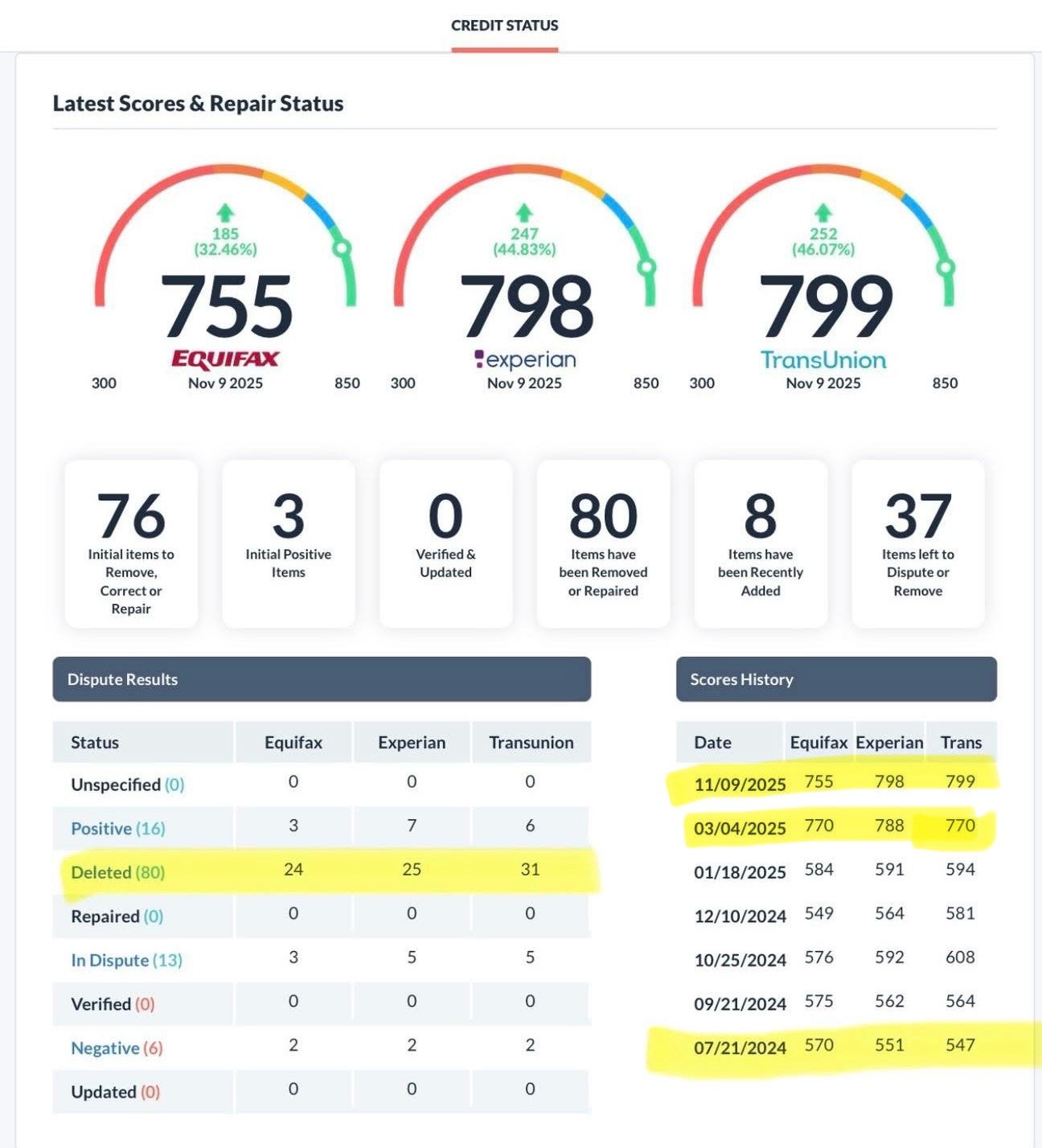
If you pay attention to the dates on the far right you will notice this is the Same exact client above. The moment she finally did her TO DO LIST. Her scores shot up almost to the 800s. 🚀 So once again CREDIT REPAIR DOES NOT BOOST YOUR SCORES!
Had she been completed the to do list she could have possibly been in the 700 club. Now had she not done it at all, She would have just had a CLEAN CREDIT REPORT. But her scores would have still been in between the 584-594 Range. Which is fine, She would have just been limited to what she can apply for. Depending on what the minimum score requirement is.
Example: I live in a condo building and the company is called Greystar. The minimum credit score requirement is 700. Which means you can’t apply to move into my building with a 584 credit score, But maybe Pangea might accept you as a tenant. At the end of the day, whether you have a 584, 684, or 784 Credit score, it’s still the CREDIT REPORT that will get you approved or denied.
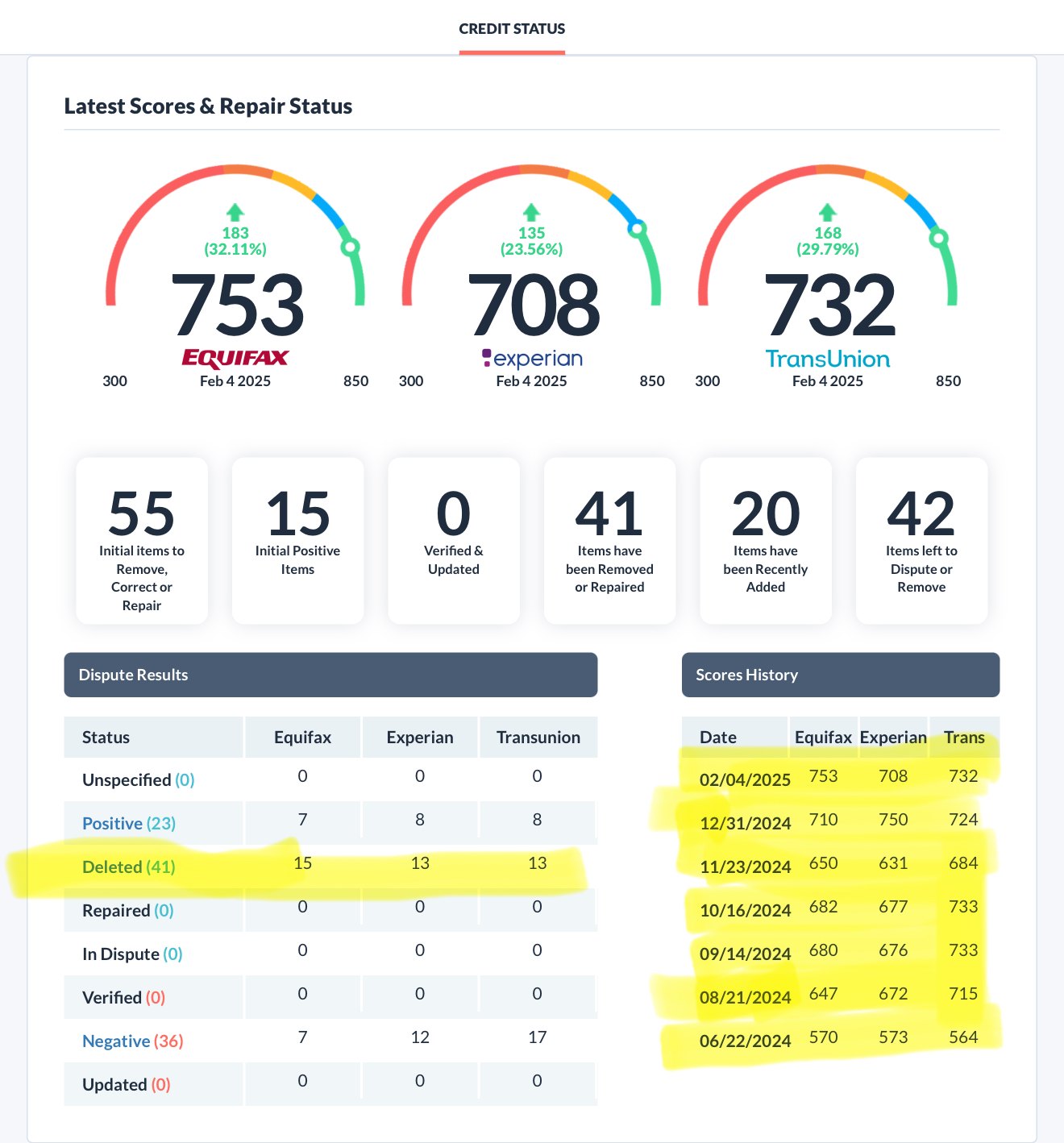
Now let’s look at this client. She is 6 rounds in and is currently awaiting for her round 7 to end. 41 Negative & Items were Deleted So Far. She has been doing every step on the To Do List & her score range grew from 564-573 To 708-753.
By the time we got everything removed from her report she was GOOD TO GO. She did every step on the To-Do-List. Her Scores Were Good. Her Report Was Clean. And Her Profile Was STRONG.

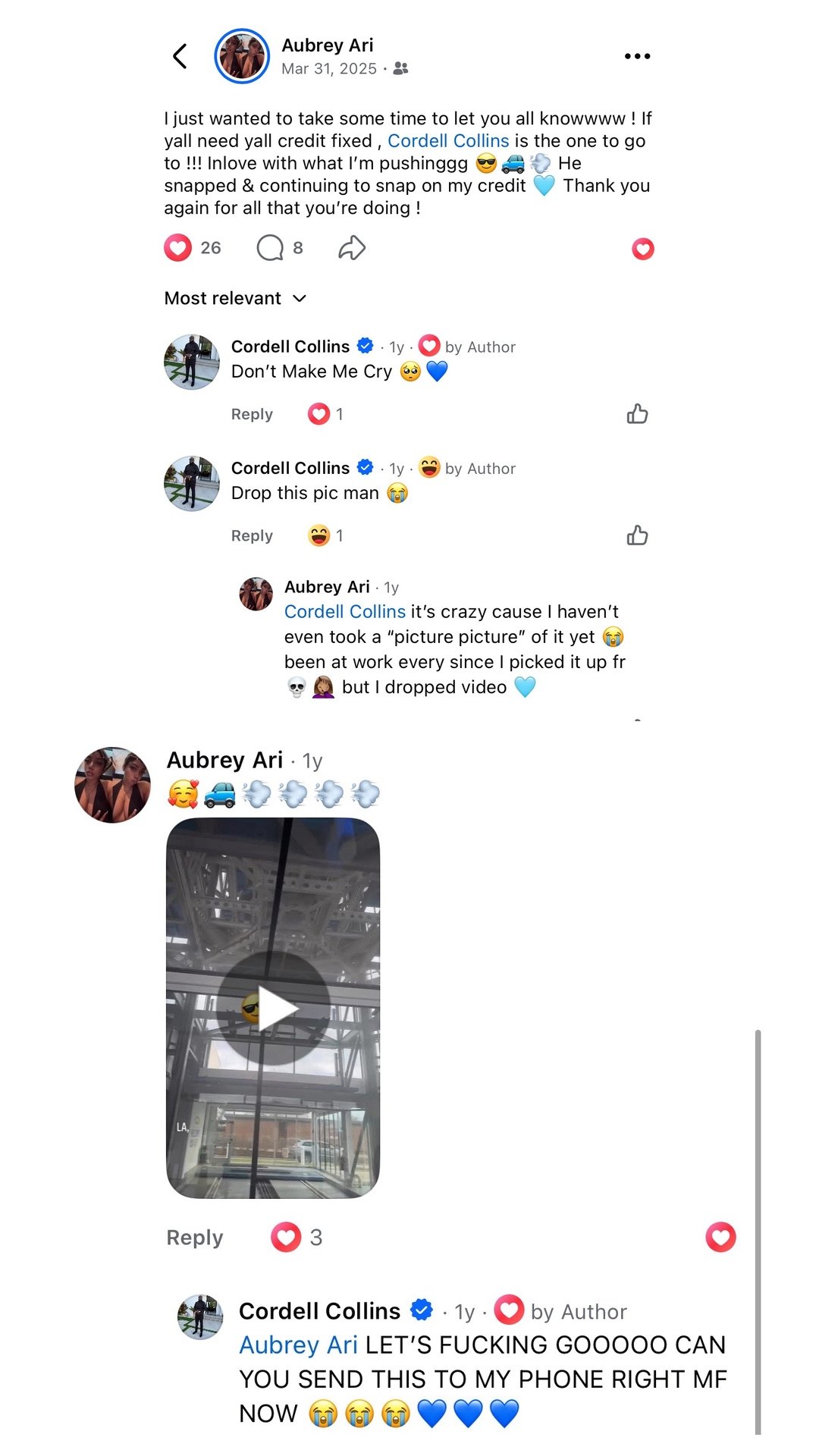
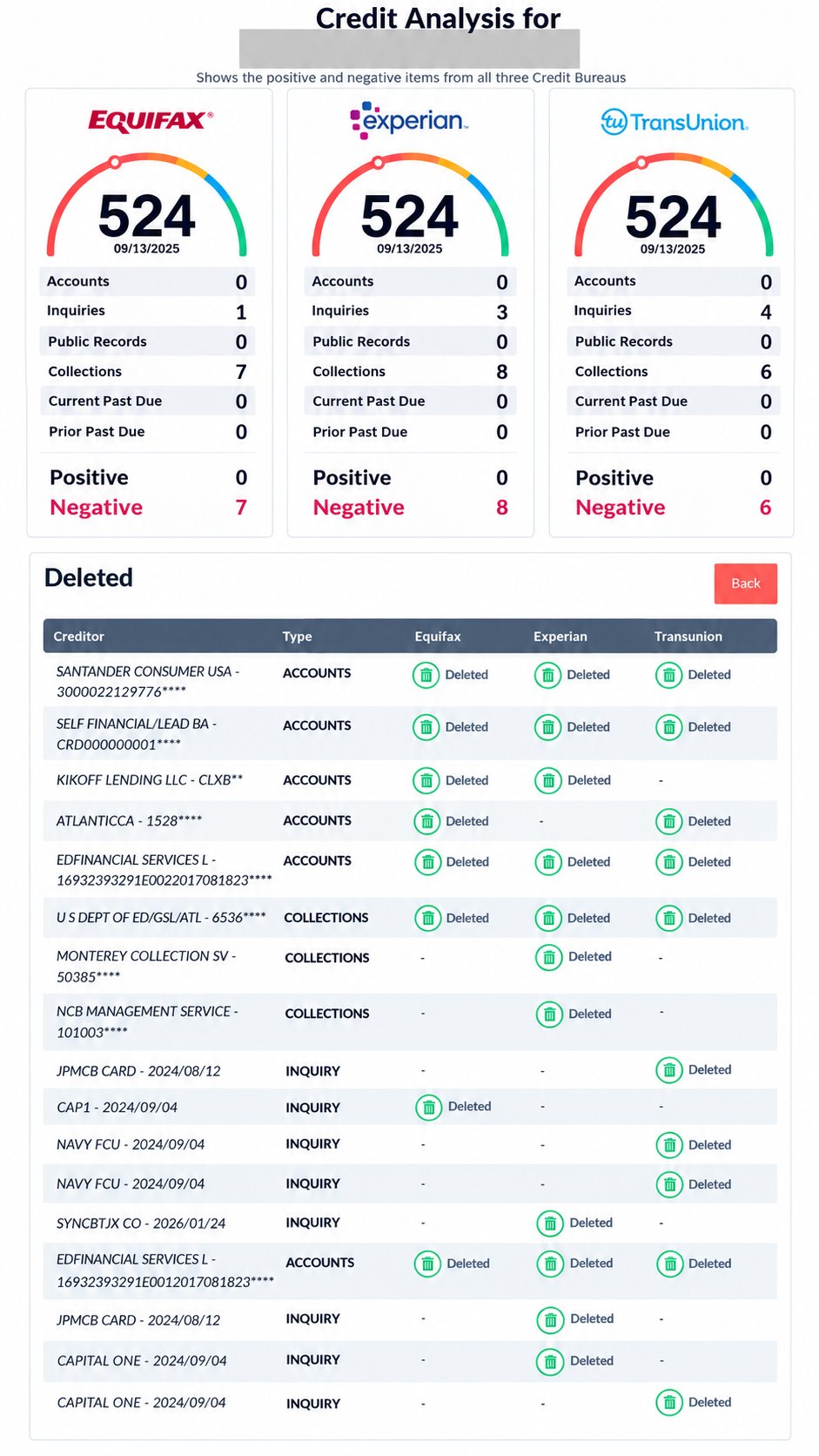
We got a total of 29 items from this client’s profile. 3 Auto Loans, 7 Charge Offs, 9 Student Loans, 2 Collections, & 8 Inquiries Deleted from her report. Her report was wiped completely clean. So we held up our end of the bargain.
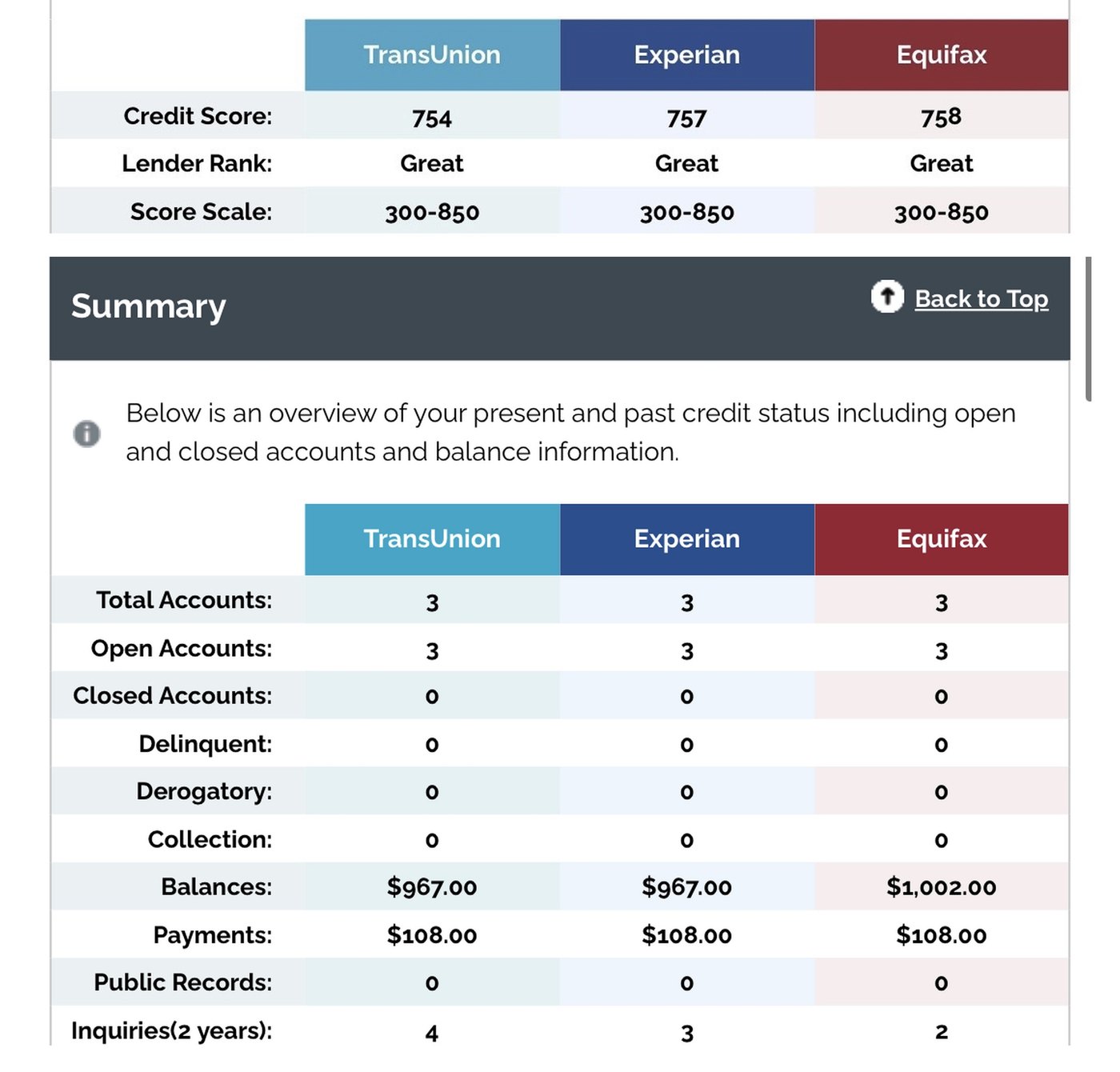
The only step she completed on the To-Do-List was having someone add her as an authorized user. Which is essentially the same thing as buying a tradeline. That alone caused Her Scores to grow from A 524 To A 754-758 Range. She failed to build any type of payment history or credit history OF HER OWN. She assumed that since she now had a GOOD CREDIT SCORE, & since we removed all of the negative items from her REPORT, that her ACTUAL CREDIT WAS GOOD.
But What About The Profile? Remember, Credit REPAIR focuses on your Credit REPORT. It DOES NOT boost your Credit SCORES. and it DOES NOT strengthen your Credit PROFILE. You as the client have to do YOUR PART. The more steps you do the better it will be for you.
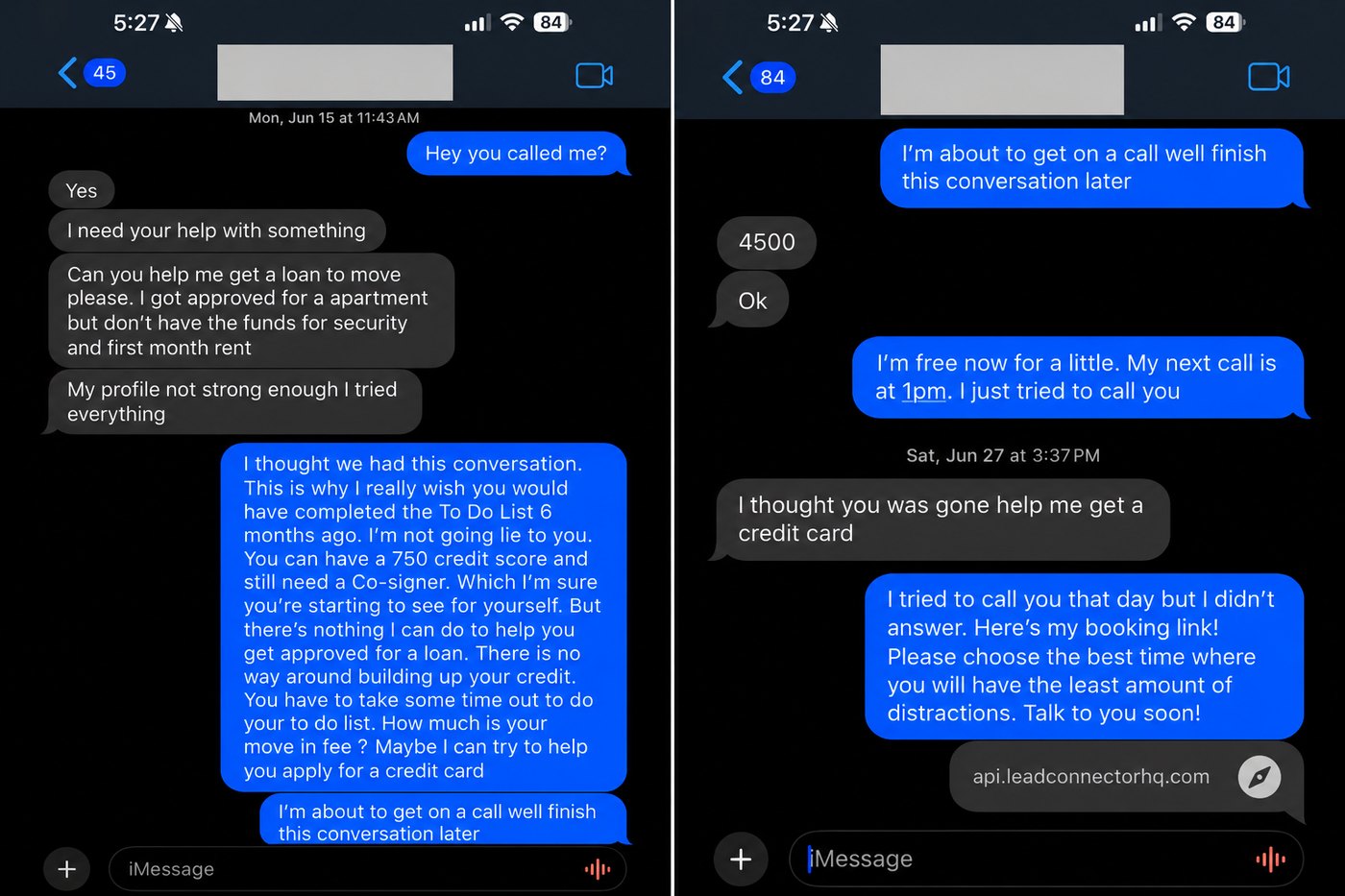
Months Later when she needed to take out a personal loan she was denied multiple times and just added multiple unnecessary inquiries.
Now Imagine if she later builds payment history & tries to apply for the loan again. Her profile is good but now the inquiries are a problem because she has too many and it’s making her look desperate. Had she been did the To-Do-List this could have been avoided. And had she went through the education tab she would have learned when to apply for things & how to avoid unnecessary inquiries. This is what I mean by without the education phases that clients hate so much they’ll most likely end up right back where they started. If she comes back to me to get the inquiries removed I could charge her again because I did my part already, This would be considered a brand new service.
TO DO LIST RECORDINGS
Are you a visual learner?
Go to your email and search for "Dear Credit Client" or wealthyintentionllc@gmail.com to find multiple recordings where I break down how to build up your credit scores, credit report, and credit profile.
If you do not see this email, please text (312) 584-9969 and I will make sure it gets resent out.
To Do List Step 1
📢 Connect With A Financial Advisor

At Wealthy Intention we want to provide our clients with additional financial resources and services.
🎉 As a Wealthy Intention LLC client, you now qualify for a FREE Financial Review! With a LICENSED FINANCIAL ADVISOR
Our partnered Wealth Management team will review your financial needs and goals and introduce you to resources that may help you protect, build, and prepare for your financial future.
Services include:
- 🏦 Trust & Estate Planning
- 📄 Wills
- ❤️ Life Insurance & Cash-Value Options
- 🩺 Health Insurance
- 💰 Financial Planning & Wealth-Building Strategies
There is NO CHARGE for your initial Financial Review as part of this added client benefit.
and EXPECT A CALL SOON FROM: 754-218-5910
THIS IS NOT MANDATORY and there is Absolutely — no pressure at all! Even if you already have life insurance, a will, trust, health insurance, or other financial plans in place, it can still be beneficial to periodically review them to make sure everything is not only SET UP PROPERLY, but that they all are actually WORKING TOGETHER as part of your overall financial plan.
Understand you can have all of these things in place. But if they are not ACTIVELY WORKING TOGETHER, it’s doing you little to no justice and your hard earned money can still be at RISK.
So please understand just because it’s “set up” doesn’t mean it’s SET UP PROPERLY! Ask yourself 🧐 Where is my money going? Where is it coming from? How much of it is being invested & saved? How much of it is protected? How much is at risk if things don’t go as planned? If I were to pull out some money, what would be the best option to pull from? How much is being taxed if I need to pull out for an emergency or to invest? That’s what we mean by WEALTHY INTENTION—BE INTENTIONAL WITH YOUR FINANCES.
Your circumstances and goals can change over time, so the purpose of the review IS NOT necessarily to replace what you already have. It’s an opportunity to better understand what you already have, Identify any potential missing gaps & questions, but also MAXIMIZE any benefits while reducing any RISK. Because 💳 WHEN YOU HAVE CREDIT, YOU HAVE OPTIONS.
We appreciate you being a part of Wealthy Intention LLC! 💛
To Do List Step 2
Remove All Fraud Alerts 🚨
⚠️ If you have no fraud alerts on your report you can skip this step and move on to Step 3.
No worries a fraud alert is NOT A BAD THING. It is a free safety tool that helps protect you from identity theft.
A fraud alert is a notice placed on your credit reports that tells lenders and creditors to take extra steps to verify your identity before approving new credit in your name. That extra step is usually to text, call or email you for confirmation before actually running your credit.
Although this is a safe way to protect yourself from identity theft—having an active fraud alert can delay the process because a fraud alert is a strict security feature. The credit bureaus will not process any changes, updates, or actions on your credit report while it remains active and we do not want that.
To resolve this, our team has already sent a request letter to the bureaus on your behalf to remove the fraud alert. However, waiting for the bureaus to process mailed requests can take some time and we do not want to depend on them removing the alerts. To expedite the process, we highly recommend that you call the three credit bureaus directly to request the removal or deactivation of the alert.
Please note that you can do this online. Calling them is completely optional, but doing it over the phone bypasses mail processing times so we can resume work on your credit report much faster.
If you choose to call them, you can reach the fraud divisions at the following numbers:
📞 Equifax: 1-800-525-6285
📞 Experian: 1-888-397-3742
📞 TransUnion: 1-800-680-7289
If you choose to do it online here are the exact links:
Once you have the alerts deactivated, please let us know as soon as it is completed so we can immediately continue working on your file. Once we’re done working on your profile, feel free to add them back if you like.
The Representative will most likely ask you if there’s anything else they can help you with? Say One More Thing, and SEE STEP 3 FOR DETAILS.
Thank you for your cooperation!
To Do List Step 3
Call To Clean Up Your Personal Information 📞
THIS IS NOT MANDATORY. However, THIS STEP IS TO HELP US EXPEDITE THE PROCESS.
Please understand WE ARE DOING ALL OF THE HARD WORK FOR YOU. However, the most we can do is send out dispute letters. We only ask for your assistance if it helps speed up the process and if it involves you actually calling The 3 Major Credit Bureaus.
If we were to call on your behalf, we most likely would fail the verification stage due to lack of knowledge about you & your family’s history. We do not have a list of what questions they will ask. These are not all, but some common questions are..
- What is your mother’s maiden name?
- What hospital were you born?
- Which of these were your previous phone number?
- What was your first car.
- Which one of your family members lives in ____?
The list goes on and won’t be able to answer all security questions correctly. Which is why we are asking for your help. Help us help you!
Credit bureaus often tie negative accounts (like collections, charge-offs, & late payments) to old addresses, previous phone numbers, and misspellings of your name. By calling them to delete this outdated information as we dispute the negative items, we can break the link between you and those bad accounts.
While we can still proceed without you doing this, you taking 15-20 minutes to make these calls can drastically shorten your time in our program and increase our success rate.
Equifax
Phone: 1-866-349-5191 (or 1-800-685-1111)
Hours: Monday – Friday, 9AM to 9PM
Prompt Navigation: Press 1 for English, then say “Agent” or press 0 to speak to a representative.
Experian
Phone: 1-888-397-3742
Hours: Monday – Friday, 8AM to 6PM
Prompt Navigation: Press 2, then press 1, then press 3 to route to a live agent.
TransUnion
Phone: 1-800-916-8800
Hours: Monday – Friday, 8AM to 11PM
Prompt Navigation: Press 1 for English, then press 4, then press 1 to speak to an agent.
Before you call, make sure you have:
- Your Social Security Number
- Your current address and previous address
- Your driver’s license or state ID
The Phone Script (Read this to the representative)
Please call Equifax, Experian, and TransUnion using the numbers above. To make this as easy as possible, we have provided a script for you to read to the representatives. See Dropdown #4 – The Script.
“Hello, my name is [Your Full Name]. I am reviewing my credit file and noticed several inaccurate and incomplete personal identifying information being listed under my personal information.
I want to correct all inaccurate information.
MY ONLY NAME IS: [Correct Name]
MY ONLY DOB IS: [Correct DOB]
MY ONLY ADDRESS IS: [Correct Address]
MY ONLY Employer IS: [Correct Employer]
Under the FCRA (Fair Credit Reporting Act) I am requesting that my credit file reflect accurate identifying information consistent with the FCRA’s accuracy requirements under 15 U.S.C. § 1681e(b). Can you please delete all other addresses, employers, and incorrect name variations from my profile for me, because it’s holding me back from getting approved from housing which is a violation of my consumer right. As they are invalid.” Can please process this for me right now and provide confirmation of the results?
Ask how long it will take before your credit report will show up.
If the representative tells you that an old address cannot be deleted because it is tied to an active trade line, politely reply:
“That address is not valid or safe for my profile. I need it removed from my personal information section immediately to prevent any potential fraud or confusion.”
If they still refuse to remove the information simply say….
“If you are declining to correct or delete the disputed information, please complete the dispute investigation and provide me with the results in writing, including your determination regarding the information I disputed.”
They may ask you to send them a “cover letter”. Please make sure your State ID or Driver’s License is updated with your current address BEFORE sending out this cover letter.
Addresses:
- Equifax: P.O. Box 740256, Atlanta, GA 30374
- Experian: P.O. Box 4500, Allen, TX 75013
- TransUnion: P.O. Box 2000, Chester, PA 19016
Date: __________
To Whom It May Concern,
I am writing to verify my identity so that my [Bureau Name] credit report and score can be released and made available.
My information is as follows:
Full Name: __________________________
Date of Birth: ______________________
Last 4 of SSN: ______________________
Current Address: ___________________
City, State, Zip: ___________________
Phone Number: _____________________
I have enclosed copies of my government-issued photo ID and proof of address for verification. Please process my identity verification as soon as possible so my credit file can be properly displayed.
Sincerely,
________________________ (Signature)
________________________ (Printed Name)
Documents to Include (VERY IMPORTANT):
✅ Copy of Driver’s license or state ID (cannot be expired)
✅ Proof of address (utility bill, bank statement, or lease — dated within 60 days)
To Do List Step 4
Become An Authorized User
If you have a family member or a close friend who has good credit, ask them to add you on their credit cards as an Authorized User. This can help improve your scores WITHOUT AFFECTING THEM AT ALL.
When you are added to a credit card it's going to show up on your credit report as an authorized user (this lets the banks know that you have ACCESS to that card).
Example: If someone has a $10,000 Chase credit card and they had it for 10 years, the utilization is reporting below 10%, and they are always on top of their bill - this does multiple things for you:
- 1) Payment History (35% of your credit score) - It gives you 10 years worth of PAYMENT HISTORY
- 2) Utilization (30% of your credit score) - That $10,000 limit gets added to your Debt To Income Ratio
- 3) Credit Mix (10% of your credit score) - That credit card would be considered a revolving account
- 4) Credit Age (15% of your credit score) - It also would be 10 years worth of Credit Age History
So this is why people's scores go up whenever they purchase tradelines.
If someone is skeptical about adding you as an authorized user, please explain this to them:
YOU DO NOT NEED THE CARD! They can have it sent to them and they can then cut it up. You just need it to piggy back off the history.
Whenever someone adds you as an authorized user it could affect you, but NEVER THEM. Reason being is because when they add you on that account, usually it means that you have access to THAT ACCOUNT. Which means whatever happens with that account YOU'RE JUST AS RESPONSIBLE. Now of course that won't be the case if they sent the card to them and cut it up, but that's still how banks & lenders will look at it.
On the flip side you can be late on every credit card you have and it would not affect them at all. They can be late for every other credit card they have as well without affecting you negatively. The only thing that matters are the specific accounts that you are listed as a AUTHORIZED USER.
Good Authorized User Vs Bad: Things To Look For
GOOD AU - Things To Look For:
- Payment History - 35% Of Your Credit Score. This Account Has No Late Payments
- Credit History - 15% Of Your Credit Score. This Account Was Opened In 2015 So That's 11 Years Worth Of Credit History (Bank's Like To See 5+ Years)
- Credit Limit - Although We Would Prefer Something Over A 5K Limit, $2,500 Is Not Bad Especially If You Don't Already Have Your Own Account With That Limit. Keep In Mind It Has The History To Back It.
- Credit Card Utilization - 10% Of Your Credit Score. This Credit Limit Is $2,500 Which Means 10% Is $250. And 30% = $750. The Balance Is Only $247 Which Means It's Under 10%. THAT'S WONDERFUL.
This AU IS GOOD TO GO
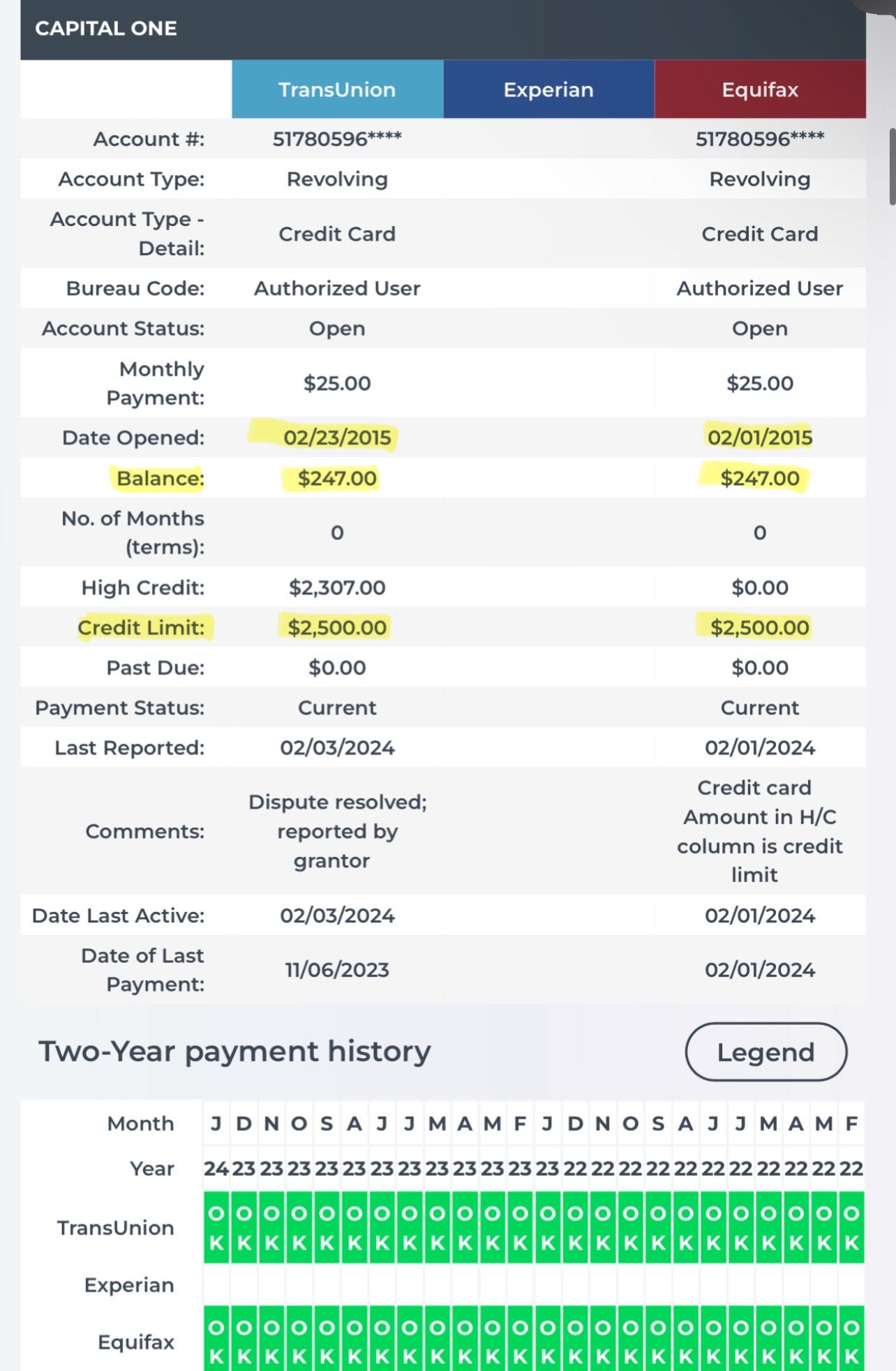
BAD AU - Red Flags:
- Payment History - This Account Has Multiple Late Payments (RED FLAG)
- Credit History - Only 3 Years Old. The Banks Like To See 5+ Years. 3 Is Only Acceptable If Everything Else Checks Off or if it is better than your actual credit age itself.
- Credit Limit - $550. The Banks Like To See A Minimum 5K Limit
- Credit Card Utilization - This Credit Limit Is $550 Which Means 10% Is $55. And 30% = $165. With a balance of $711 which is higher than the actual credit limit. This Card Is Clearly Maxed Out
This AU Is A NO GO. If you're listed on a card like this you need to ask the primary owner to remove you immediately or call the creditor for help.
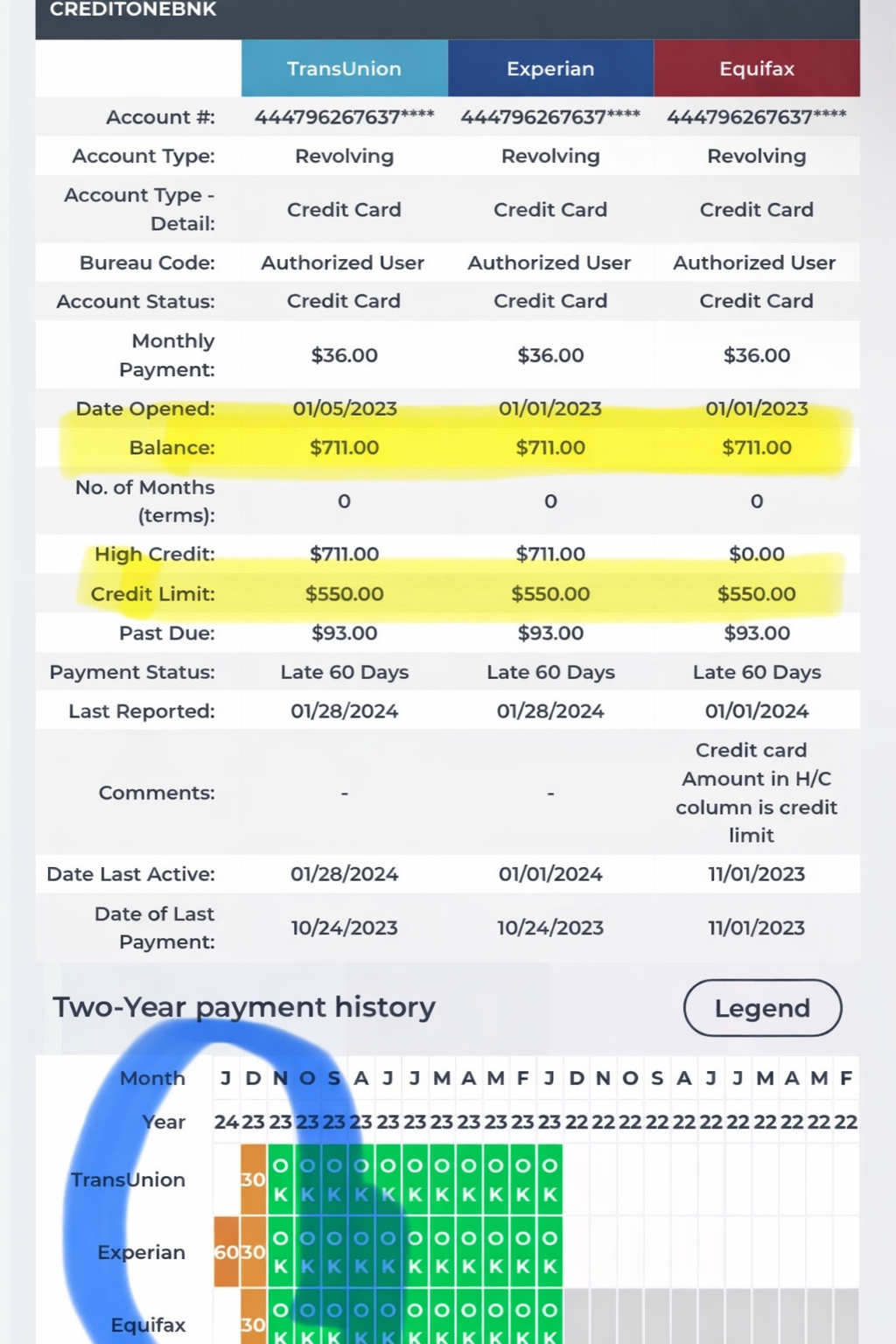
To Do List Step 5
Part 1. Open Up A PERSONAL Checking & Savings Account With A CREDIT UNION
ALWAYS START WITH THE SAVINGS ACCOUNT FIRST FOR ANY BANK… Then The Checkings.
SIDE NOTE: If you are currently listed in ChexSystems or Early Warnings then you will most likely be denied for this step. You can visit www.TheCreditDaddy.com/Faq and look for ChexSystems / Early Warnings to request your consumer report. If you need assistance getting out I can definitely help. However that is a separate charge, as checking is separate from credit.
If you ARE NOT listed in ChexSystems / Early Warnings then you can start this step RIGHT AWAY. If you are already a part of a credit union you can use them, or you can literally google “credit union near me”, open an account and do a secured loan. If you can’t find a credit union you can also do this with whoever you currently bank with, but a credit union would be the better option.
I will list my top 4 recommendations below. Navy Federal is the top choice only because it works best with STEP 6. But realistically, IT DOES NOT MATTER WHICH ONE YOU CHOOSE.
⭐ Navy Federal (Top Choice — works best with Step 6)
- Low interest rates
- Outstanding credit card approvals
- ATM fee reimbursement
- Great with auto loans & refinancing
You will need an access code. If you don’t have one, call 1-888-842-6328 and use this script instead:
“Hello, my granddad was in the navy. He’s no longer with us, but I remember before he passed he said I can get an account with you guys. I don’t remember his access code, but I would still like to open a PERSONAL CHECKING AND SAVINGS account if possible.”
They will then ask you two questions:
- Was your granddad in the Navy, Marines, Army, or Military? (You can say Military)
- Then they will ask how did he leave? (Say “Honorable”)
If they ask why you want an account with them, tell them you want to build a LONG TERM RELATIONSHIP WITH THEM.
They’re going to ask what type of account you want to open. Say regular personal checking and savings. You will need to deposit a minimum of $10–$20 to open the account. If you can, I recommend putting $100 in both (see Part 2 for more instructions).
They will ask if they can assist you with anything else — you can say no for now.
Open An Account →🏦 Consumers Credit Union (CCU)
- Good for auto loans
- Anyone can join
- Interest rates as low as 5%
- Will fund you up to 100% of the car’s book value
- Loan terms up to 84 months
💻 Digital Credit Union (DCU)
- Good for auto loans
- Anyone can join
- Interest rates as low as 5.74%
- Will fund you up to 130% of the car’s book value
- 84 month terms, & a delayed payment for 60 days
🏛️ PenFed Credit Union
- Good for auto loans
- Rates as low as 4.49%
- Can finance up to 125% of the car’s book value
- Can get a pre-qualification before the approval, meaning you don’t have to take a hard inquiry
Part 2. Deposit Money In Both Checkings & Savings
Once you have chosen your desired credit union or bank, deposit money in both the checking & savings. The more the better, but do whatever is comfortable within your budget. We call this the 50/50 plan.
Examples:
• $100 in Checkings & $100 in Savings
• $500 in Checkings & $500 in Savings
• $1,000 in Checkings & $1,000 in Savings
• $5,000 in Checkings & $5,000 in Savings
Part 3. Set Up Direct Deposit
If you get direct deposit, I prefer you to have it transferred to the credit union or bank you signed up for. If not your entire check, at least half. I understand some of you may love Chime, Cash App, PayPal etc. so that you can get paid early or whatever the case is. But understand Chime will not give you a $30,000+ auto loan or a $100,000+ business or mortgage loan.
So realistically speaking, the bank who will be splurging on you in the near future is the bank who deserves your money. Trust me, this will benefit you a whole lot later down the line when you start applying for things.
If you work for yourself and don’t have an actual 9-5 where you receive check stubs, it would be smart to just make sure you’re CONSISTENTLY making weekly, biweekly, or monthly deposits.
To Do List Step 6
Open Up A Secured Loan For $2,500 💵
( Don’t worry — you will get your money back. )
Don’t stress if you don’t have $2,500. The minimum requirement for a secured loan is $250. I only recommend $2,500 because that’s how much I did mines for during my credit journey. Also, realistically speaking — what looks better? That you paid off a $250 loan, or a loan for the amount of $2,500+?
You can go higher. OBVIOUSLY THE MORE THE BETTER.
- If you don’t have $2,500 try $1,500
- If you don’t have $1,500 try $1,000
- If you don’t have $1,000 try $500
- If you don’t have $500 try $250
You can do this with literally ANY BANK OR CREDIT UNION. Your collateral is still your money. However, depending on the financial institution, some or all of it may remain unavailable to you until you repay the corresponding portion of the loan.
This is why I recommend to specifically do this with Navy Federal — because unlike many traditional credit unions and banks, they don’t require you to wait until the end to receive your money back. You can have your money back within 10 business days.
Short Answer: A secured loan is basically borrowing against money you already have.
Why do people do this? The goal isn’t to borrow money because you need the money. The goal is to establish positive LOAN payment history, and to strengthen the credit profile. It’s a lot easier to get approved for loans if you have already proven you can pay some.
Taking out a secured loan is equivalent to you going to a bank or credit union and saying:
“Hey look, I understand that based on some mistakes I have made in the past, you may not be comfortable giving me a traditional loan right now. But I want to prove to you that I’m now responsible. So instead, I am asking to borrow some money, but I am also willing to put up my own money as collateral to prove that I can responsibly make payments on a loan. If I don’t pay it back you keep my money and you take no risk. But if I do pay it back on time, now you give me back my money and do business with me.”
Remember… “YOUR CREDIT” is your credibility. And unless you have already paid off a house, a car, or plenty of other loans in the past, right now with these negative accounts on your report you have no credibility. So when you do a secured loan it’s kind of as if you paid someone to report on your credit report that you have successfully paid off a loan.
Secured loans were designed to give you a 2nd chance and make you look good on paper. THAT’S IT, THAT’S ALL. Please do not over think it.
Call or go into Navy Federal and open up a SECURED PLEDGE LOAN for $2,500. (If you do this with another bank it’s just called a secured loan.)
When you request to put down $2,500 for the secured loan, the bank will take that $2,500 out of your savings account and deposit it into a SEPARATE SAVINGS ACCOUNT.
Important
Then wait one week and call back and say you want to pay it off 90% and leave the rest on autopay for the next 12 months. DO NOT pay off the full balance and DO NOT forget to mention AUTOPAY. The goal is to get majority of the loan out the way, but also to leave a history of on-time monthly payments. (35% of your credit score)
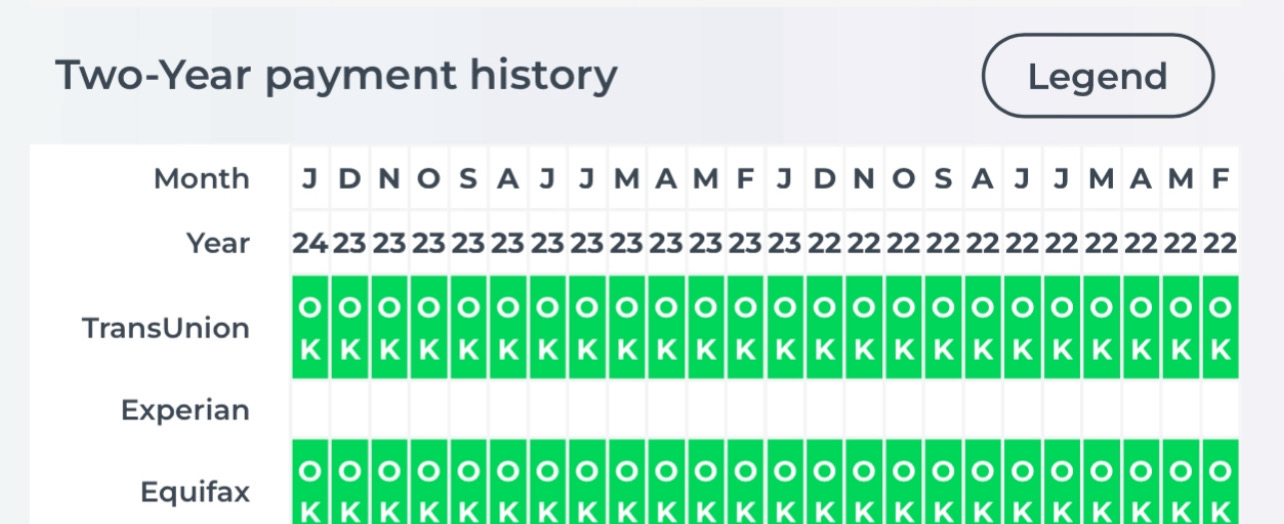
You are not coming out of pocket again. You are paying them back with the same exact money you gave them.
So when you say you want to “pay back 90%”, they will take $2,250 out of the $2,500 that you gave them, and deposit it back into your checking or savings account. (Whichever you decide — it doesn’t matter.)
Now, instead of $2,500, the new balance you owe for the secured loan will be $250. For the next 12 months that $250 will be on Autopay. So every month they will take about $21.25 out of that separate savings account and deposit it back into your checking or savings account until that number hits $0.
The next time your credit report updates, it will show that you paid off a $2,500 loan by 90% — even though you never actually took out an actual loan. You can take that same money and do it again.
It’s not mandatory, but it’s always best to do this at least twice. Every time you do this, try to double or triple the previous amount you did it for.
If you have Navy Federal, this step is NOT for you — unless you want to do it again with another bank or credit union, which is completely fine.
Call or go into the credit union or bank you decided to join or already have. Tell them you want to open up a SECURED LOAN for $2,500.
When you request to put down $2,500, the institution places that $2,500 into a SEPARATE SAVINGS ACCOUNT and puts a hold on it. It’s still your money, but you generally can’t withdraw it while it’s securing the loan.
The institution then lends you $2,500. Once approved, they give you the loan. So you put up $2,500 as collateral and received approximately $2,500 back as “borrowed money.”
You now owe the $2,500 loan plus interest. For example, on a 12-month term, your payment might be roughly $215–$225 per month, depending on the interest rate and fees.
$225 × 12 = $2,700
$2,700 − $2,500 = $200
These numbers aren’t final — this is just an example. So you’re only coming out of pocket an extra $200. Look at it as if you’re BUYING CREDIT.
Important
Then wait one week and call back and say you want to pay it off 90% and leave the rest on autopay for the next 12 months. DO NOT pay off the full balance and DO NOT forget to mention AUTOPAY. The goal is to get majority of the loan out the way, but also to leave a history of on-time monthly payments. (35% of your credit score)
So the $2,500 that they let you borrow — use that same money for the monthly payments to pay down 90% of the loan. The lender typically reports the loan and payment history to the credit bureaus.
Now your new balance for the secured loan will be $250 instead of $2,500.
Your collateral is released according to the lender’s rules. Some institutions keep the entire original $2,500 locked until the loan is completely paid. Others gradually release portions of your collateral as you pay down the loan.
So no, you did not actually take out a real loan, but it will reflect on your credit report that you paid off a loan for the amount of $2,500 — which helps you build payment history.
Once the loan is paid off, your original $2,500 collateral is yours again. So it isn’t really a “refund” — the bank wasn’t charging you $2,500, it was holding your money as collateral.
AFTER completing Steps 5 & 6 from the To Do List, and ONLY AFTER EVERYTHING IS DELETED FROM YOUR REPORT — if you want to finance or refinance a car:
Search around for the car you like, test drive it, and ask questions about the vehicle. Specifically ask questions about your personal preferences. Remember, dealerships often buy cars from other dealerships and lots — so even if they don’t have the specific one or color you want, if you know a location who does, they’re usually willing to buy it from them and you can still finance through them. I got my car shipped from Massachusetts.
Once you have the car you want picked out, go to the dealership or car lot and ask for a Purchase Order / Buyer’s Order (sometimes called a Purchase Agreement).
Do Not Skip This
If they ask why, let them know: “I’m obtaining outside financing through my current bank.” DO NOT LET THEM RUN YOUR CREDIT and DO NOT GIVE THEM YOUR SOCIAL!
Then go directly to Navy Federal, or whichever credit union or bank you did your secured loan with. You should be able to do this online as well, but I personally went inside.
Give them the Purchase Order and ask them directly for an auto loan. They will give you the PAPER CHECK 🧾 for the car. (Make sure you have the VIN number.)
There is no need for the dealership to run your credit and give you a million inquiries, because you don’t need to qualify for a loan through them. YOU HAVE THE CHECK! Your auto loan will be financed through your bank.
This same concept applies for refinancing a car. Just call or go to your bank and tell them you want to refinance.
Take the check to the dealership. Sign your papers 📑 and drive off blasting your favorite song 🎵 DON’T FORGET TO TAKE PICTURES AND GIVE ME A SHOUTOUT — tagging me on Facebook & Instagram. If you prefer to remain anonymous, just take pictures and videos and I’ll post them without tagging you.
To Do List Step 7
Pay Down Any Credit Cards That Are Over 30%
⚠️ If You Don't Have Any Credit Cards Yet — Skip To Step 8.
If you have completed Step 6, you can do this immediately after getting your money back from the Secured Loan.
Bonus: If you are confused or in credit card debt — go watch the recording on "How To Get Out Of Credit Card Debt." There is a full training on how to get out of credit card debt. (Link at the bottom of this step.)
Rule #1
NEVER SPEND WHAT YOU DO NOT HAVE
How To Pay Your Credit Card Bill Correctly
When It Comes To Paying Down The Balance There Are Two Types Of People:
✅ Type 1: Pay After Every Purchase
( THIS IS THE SAFER ROUTE )
My lil sister prefers this method — her balance is always low. It keeps your utilization near 0% at all times, which is best for your score.
💳 Type 2: Let It Build Up Then Pay
( CORDELL'S PREFERRED METHOD )
I like the way the money looks in my actual bank account rather than on the credit card 😂 — just make sure you always pay before the statement date.
Pay down in this priority order:
• Preferably pay IN FULL
• If you can't pay in full, pay to where you only owe 10% or below
• If you can't get it under 10%, try to get it to where you only owe 30% or below
• If you can't get it under 30%, pay the minimum balance & go watch the recording on How To Get Out Of Credit Card Debt
Why This Matters: Credit card utilization makes up 30% of your credit score. Keeping balances below 10% of your limit gives you the best score boost. Even getting under 30% will make a noticeable difference.
Rule #1
NEVER SPEND WHAT YOU DO NOT HAVE
When It Comes To Paying Down The Balance There Are Two Types If People
Type 1: Pay After Every Purchase. ( THIS IS THE SAFER ROUTE )
My Lil Sister Prefers This Method Her Balance Is Always Low As You See In The Screenshot It’s Only $36.08
Type 2: Is To Let It Build Up Then Pay.
( I Prefer This Method ) For Some Reason I Like The Way The Money Looks In My Actual Account Rather Than On The Credit Card 😂
At The End Of The Day There Is No RIGHT OR WRONG ANSWER.
However If You Are Going To Be A Type 2 Kind Of Person, You Need To Know How To Do It Correctly.
When it comes to paying down your credit card bill you have 4 options
| Option A | Option B | Option | Option D |
|---|---|---|---|
| Pay IN FULL | Pay To Aim For 10% Balance | Pay To Aim For 30% Balance | Pay Minimum Balance & Catch Up As You Go (Highly Recommend to put the minimum balance on auto pay for all credit cards ) |
| 0% Utilization = Best Debt To Income Ratio. | If Your Utilization Is 1-10% You Can Expect Your Scores To Increase. | 11%-30% Your Scores Will Fluctuate In The Same Range You Been At. | Anything 31% Or Higher You Can Expect Your Scores To Drop Even If You Paid Your Bills On Time. |
Why This Matters: Credit card utilization makes up 30% of your credit score. Keeping balances below 10% of your limit gives you the best score boost. Even getting under 30% will make a noticeable difference.
The Percentage Hack:
| 0-10% | You Can Expect Your Scores To Consistently Increase |
|---|---|
| 11-30% | You will maintain whatever current credit score range you already have. |
| 31% or Higher | You can expect your credit scores to drop even if you paid your bill on time. |
Rule #2 Never Ever Get A Late Payment ‼️
Inside The Active Client Tab If You Click On “Educational” The 2nd Dropdown Is Titled “HOW TO AVOID LATE PAYMENTS”
If You Sense Ahead Of Time That You May Not Be Able To Pay A Bill. It Is Important To Act SOONER THAN LATER. Late Payments Can Last For 7 Years And Affect Negatively For 4 Years.
Rule #3 Understand The Difference Between Statement Date Vs Due Date
Example:
$300 Credit Card Limit You Spent $90 (This Is How Much You Owe) Because You Spent $90 Your Utilization Is Now 30% Your Due Date Is The 1st Of Every Month Your Statement Date Is The 15th Of Every Month
Due Date:
Must Make Minimum Payment 3 Days Before The Due Date
Statement Date :
Pay Credit Card Down IN FULL 3 DAYS BEFORE STATEMENT DATE & Then Wait 7 Days Before Spending Again. ( This Is How You Avoid Interest )
| Credit Limit | The Total Amount Your Credit Card Is Worth Assuming You Owe $0 | The Credit Limit For This Account Is $19,100 |
|---|---|---|
| Due Date | Your Due Date Is What Reports Your PAYMENT HISTORY. | You Can Find This On Mobile Credit Card App. Usually Right Next To The Balance Or When You’re Attempting To Pay The Bill |
| Statement Date | Your Statement Date Is What Goes On Your Credit Report. | You Can Find This On Mobile Credit Card App Under Statements & Documents |
| Balance | Balance = ( How Much You Owe ) Pay your Full balance down 3 days before your Statement Date. Whatever your balance is after your statement date… THAT'S WHAT WILL SHOW ON YOUR CREDIT REPORT & DETERMINE YOUR UTILIZATION‼️ This is where you want to make sure your balance is either paid in full or below 30% preferably 10% | The Balance For This Account Is $261. Utilization = 1.36% That is excellent utilization and shows responsible credit use. |
| Monthly Payment | Monthly Payment = Minimum Balance: If for whatever reason you can't pay the full credit card balance, If you just pay the MINIMUM BALANCE 3 days before the Due Date 📅 you will have 100% payment history on your credit report. I recommend putting minimum balance on autopay. | My Minimum Balance Is $41. So Even If I Were To Max Out This Card. ( which is not recommended) By Paying At Least The Minimum Balance I Keep The Account Active & Avoid A LATE PAYMENT |
| High Credit | High Credit = This let banks and creditors know what is the MOST Amount of money you spent on this Credit Card 💳 | My High Credit Is $7,885. This Means At One Point This Was My Balance AFTER THE STATEMENT DATE. Before I Paid It Down, And It’s Highest Balance I’ve Had So Far. |
Utilization Calculator
See your utilization and get personalized payment options
Your Utilization Rate
To Do List Step 8
Get A Secured Credit Card
ONLY If You Don't Already Have At Least 2 Credit Cards With Limits At Least $500. The More The Better But Minimum $500. These are the banks I recommend getting a secured card from because they all graduate.
⭐ Wealthy Intention — Credit Builder Card (Cordell's pick)
- Built by Wealthy Intention LLC — designed specifically for clients in the credit-repair journey
- Reports to all 3 bureaus — great for building a fresh positive trade line
- Graduates after consistent on-time payments (deposit returned, account converts to unsecured)
- Pairs with the rest of the program — no need to bank elsewhere first
🏦 U.S. Bank Secured Visa Card
- Refundable security deposit determines your credit limit ($300–$5,000)
- Reports to all 3 bureaus — helps build payment history fast
- Graduates to an unsecured U.S. Bank card with on-time payments
- Cash-back rewards on gas & groceries (rare for a secured card)
🏛️ Bank of America Secured Card
- Refundable deposit ($200 minimum, up to $5,000) sets your limit
- Reports to all 3 bureaus
- BofA reviews account periodically — graduates to unsecured with deposit returned
- Easier approval if you already bank with BofA
🔒 Discover it® Secured Card
- 💳 Builds credit from scratch — still earns cash back (rare for secured)
- 2% cash back at gas & restaurants (up to $1K/quarter), 1% on everything else
- Cashback Match — Discover doubles all cash back at the end of year 1
- 🔁 Graduates to unsecured + deposit returned after on-time payments
- Requires deposit ($200+) — great for clients starting over or rebuilding
💳 Capital One (Pre-Approval Tool)
- Soft-pull pre-approval — check what Capital One cards you qualify for with no impact to your credit score
- Includes secured options (Platinum Secured) for fair / rebuilding credit
- Refundable deposit, automatic credit limit reviews
- Reports to all 3 bureaus — graduates to unsecured
Or you can get a secured credit card through whoever you currently bank with.
By graduate it means after 6-9 months of on time payment they'll give you your deposit back and send you a new credit card which you will now be using the Bank's money vs your own.
Don't Feel Bad If You Don't Have Thousands Of Dollars To Put On A Secured Credit Card. My First Credit Card Was $400. My First Credit Limit Increase I Jumped To A $1,400 Credit Limit And Now Today It's At $5,300 & Is My Lowest Credit Card.
Capital One Secured Card Approval
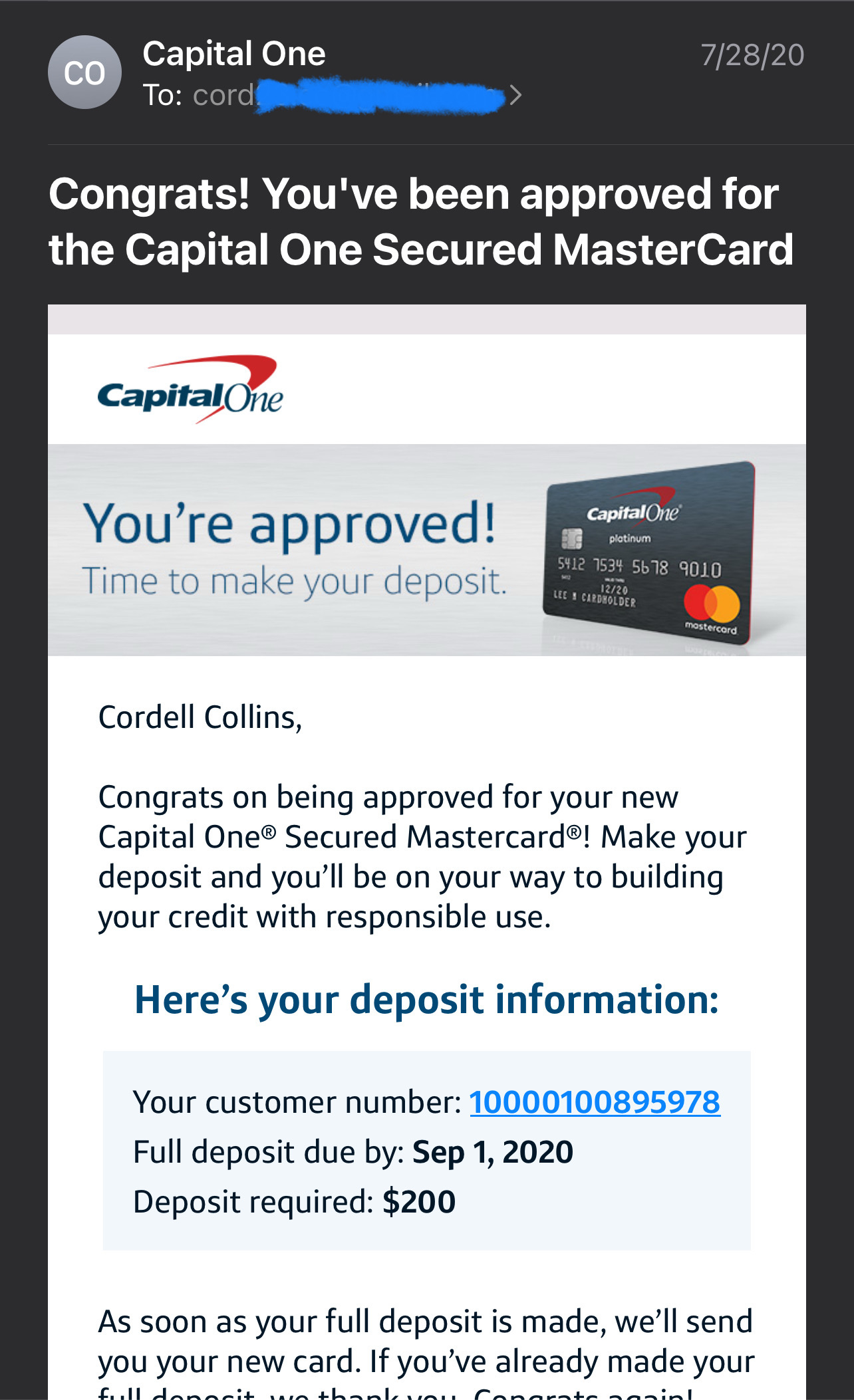
Credit Limit Increased to $1,400
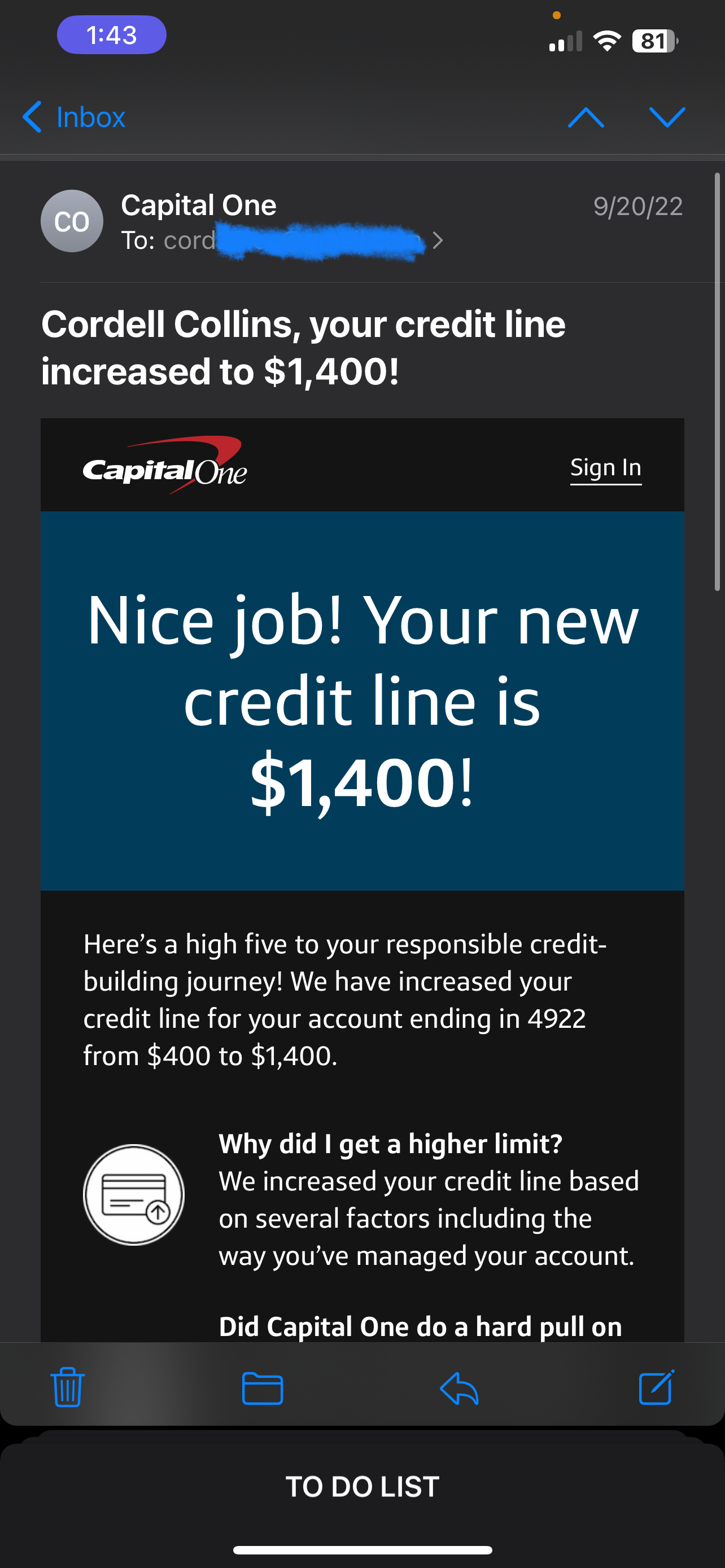
Now At $5,300 - My Lowest Credit Card Today
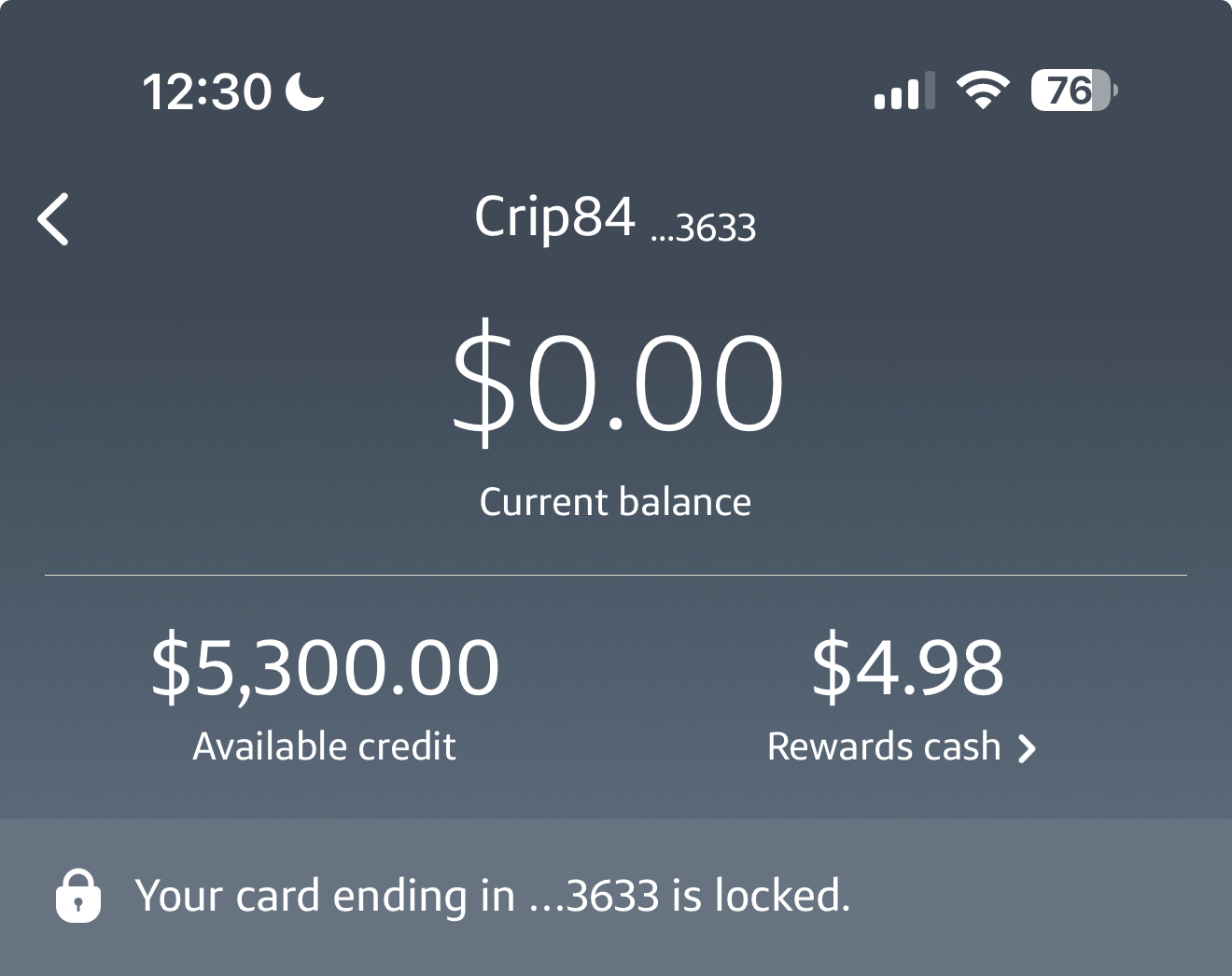
To Do List Step 9
Sign Up For 3-5 Credit Builder Accounts (the more the better)
Important Note: You want to make sure something is reporting to all 3 bureaus.
- THE PURPOSE OF THIS IS TO BUILD PAYMENT HISTORY & To Create A Good Credit Mix
- Before You Can Apply For Anything You Need To Establish Some Type Of Payment History.
- I have recommended the same exact ones I used when building my personal credit. But I want to stress the importance that YOU DO NOT HAVE TO SPEND ALL OF YOUR MONEY ON THIS. Do whatever is comfortable within your budget.
- Get A Minimum 3, The More The Better But You DO NOT NEED THEM ALL. (you don't want all revolving or all installments)
Self - $35 - Installment (whatever fits your budget)
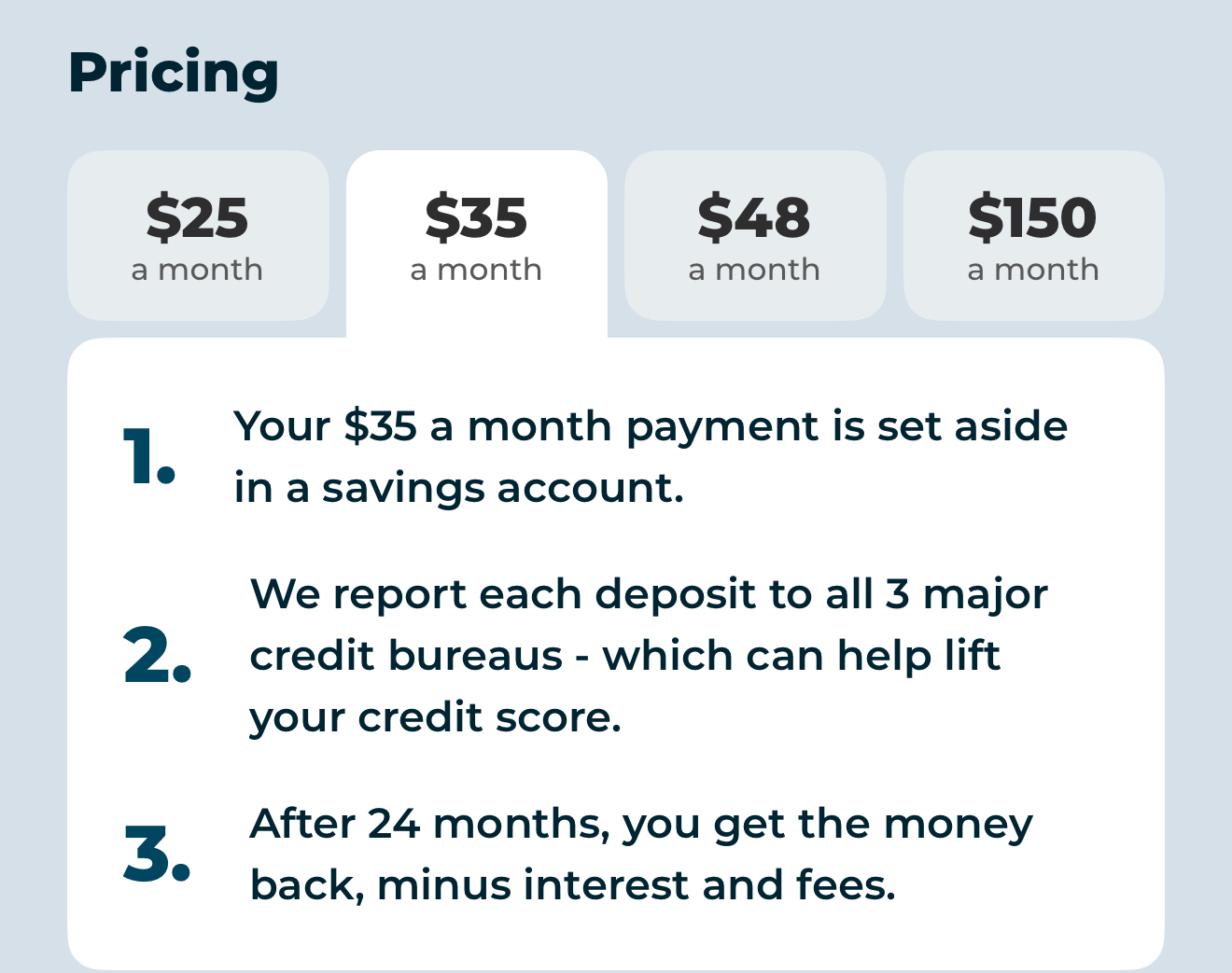
Kickoff - $20 (Revolving)
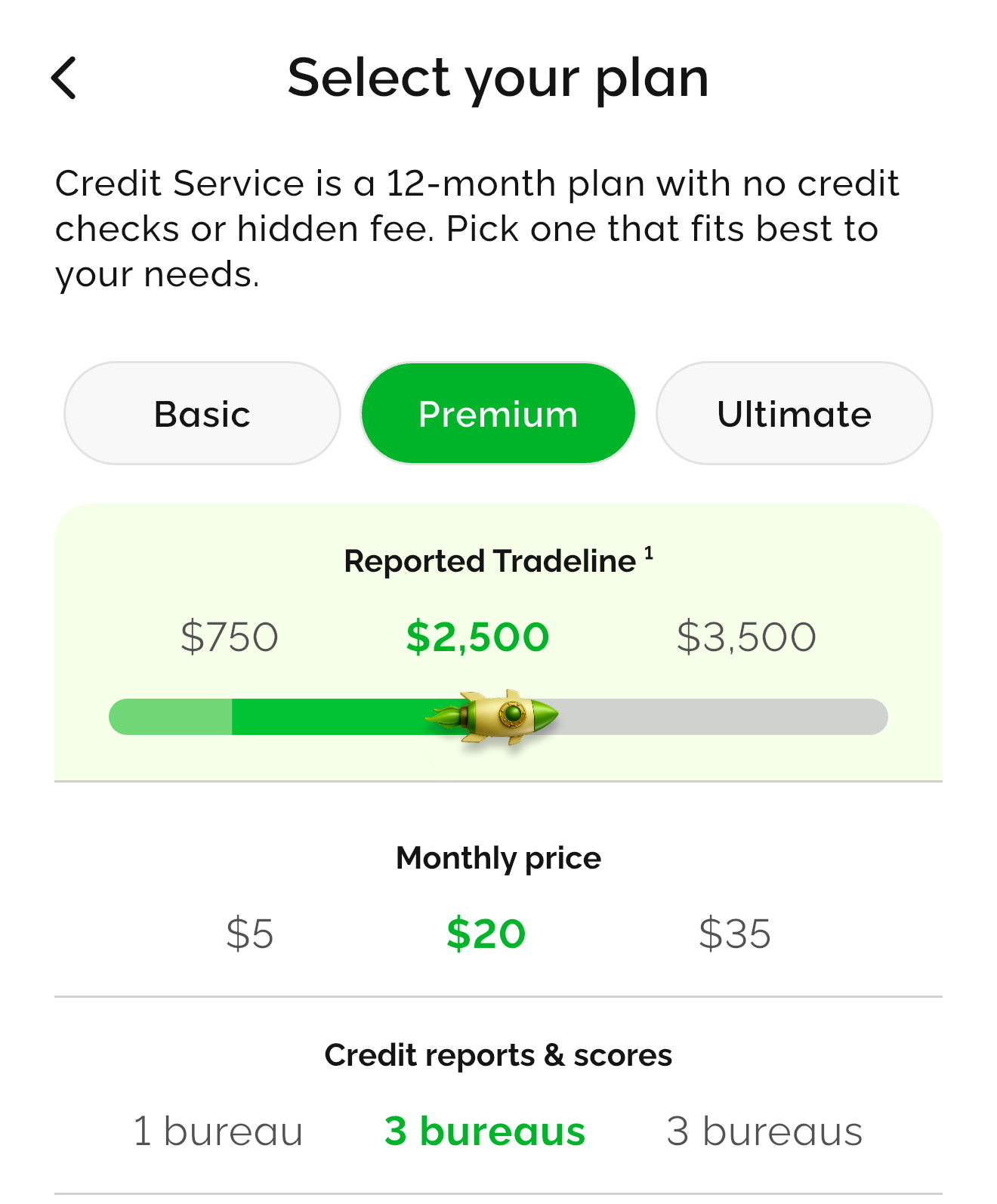
EXPERIAN BOOST - FREE TO JOIN
Experian Boost detects bills you pay like:
Phone & Telecom: Cell phone bills, Landline phone bills, Cable or satellite TV, Internet service
Utilities: Electricity, Gas, Water, Sewer, Trash / waste management
Housing: Rent payments (usually paid online or through a supported platform)
Subscriptions & Streaming: Netflix, Hulu, Disney+, Spotify, HBO / Max, Other streaming services
Insurance (monthly payments only): Auto insurance, Homeowners insurance, Renters insurance, Life insurance, Pet insurance
(Health insurance does NOT qualify.)
Those payments get added to your Experian credit file.
Sign Up For Experian Boost Here
AVA - Installment $26
Pay $26/mo for 12 months towards a secured Ava loan.
After 12 months, you'll get your $300 loan back - just like saving $300
Credit Strong - $30 (Installment)
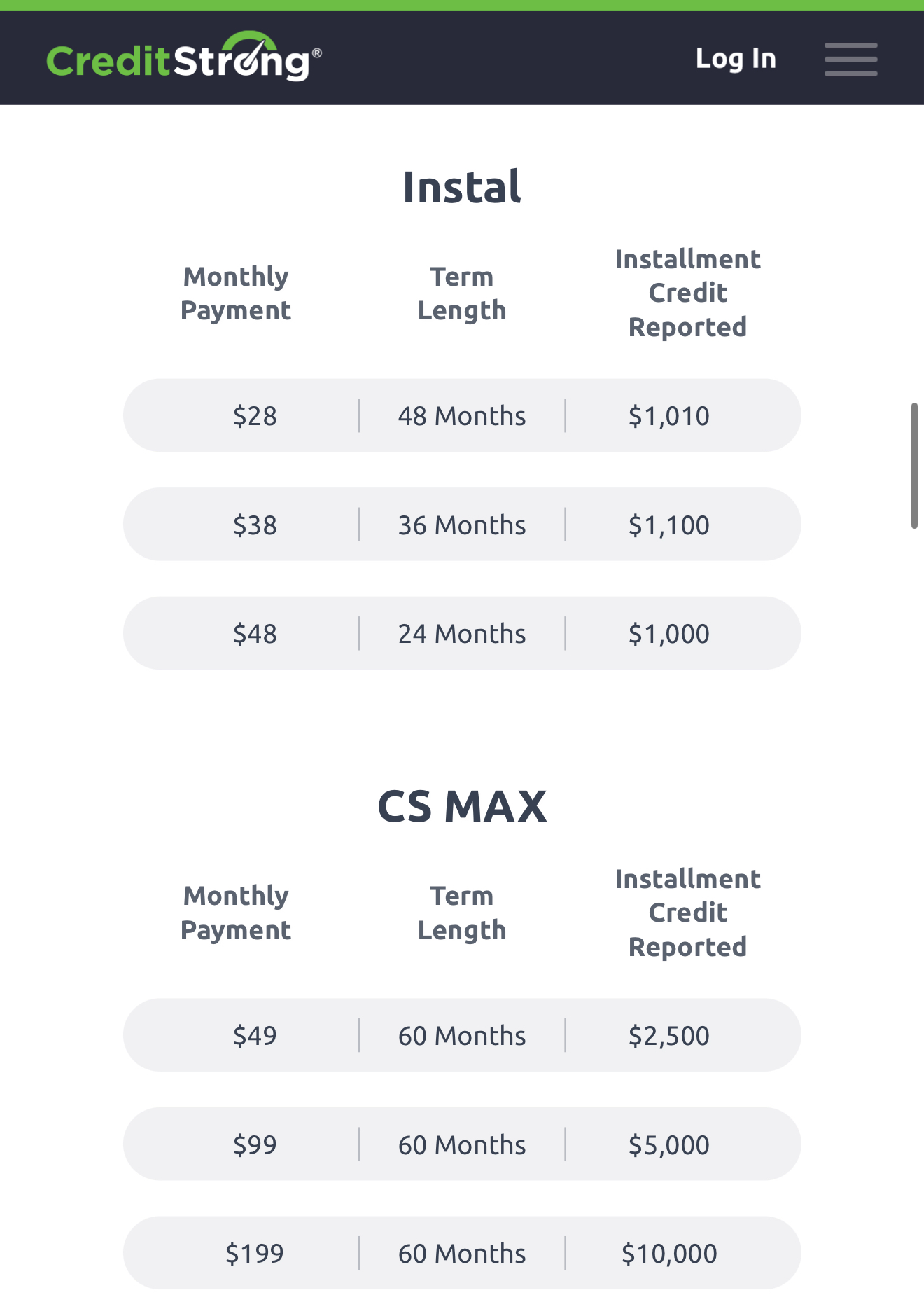
Sign Up For Credit Strong Here
When it comes to adding open credit such as rent and utility bills - ONLY DO THIS IF YOUR RENT & BILLS ARE ALWAYS PAID ON TIME
Credit Builder Account Summary
| Secured Loan | Installment - Whatever Is In Your Budget |
| Secured Credit Card | Revolving - Minimum $500 Limit (Which You Can Spend) |
| Kickoff | Revolving $20/Month |
| Tomo Credit Card | Revolving - Approvals Based off transactions |
| Credit Strong | Installment $30/Month |
| Ava | Installment $26/Month |
| Self | Installment $35/Month |
| Experian Boost | Open Credit (Phone, Cable, Light, Gas, Water, Auto Insurance, Homeowners Insurance, Subscription Apps Etc) |
If You Signed Up For Every Single Credit Builder Account It Will Cost You $111/Month. Look At It Like You're BUYING GOOD PAYMENT HISTORY.
To Do List Step 10
🎓 Pay Down Student Loans Back To Current
If you do not have student loans please skip this step and move on to Step 11
The size of your student loan doesn’t change the basic strategy.
Short Answer: This may seem like a lot because I am providing a lot of knowledge for those who may not understand exactly how student loans work. They are all important but the main ones are 4, 5, 6, 8, 9, 10, 17, & 18
Whether you owe $3,500, $35,000, or $100,000+, you need to do 11 things:
THE SIMPLE FORMULA 🧠
- KNOW WHAT YOU OWE 💵
- KNOW WHEN PAYMENTS ARE DUE 📆
- NEVER IGNORE THE SERVICER 📄
- CHECK FOR FORGIVENESS PROGRAMS BEFORE PAYING EVERYTHING OFF 🏛️
- MAKE THE REQUIRED PAYMENT ✅
- UNDERSTAND HOW MUCH INTEREST IS ACCRUING 🧮
- PAY EXTRA WHEN POSSIBLE 💸
- TARGET HIGH-INTEREST LOANS FIRST 🔎
- USE EXTRA INCOME TO ATTACK THE BALANCE 🧾
- REVIEW YOUR BALANCE EVERY MONTH 🧐
- REPEAT UNTIL THE BALANCE = $0 👏🏾
If you want to know what this actually looks like step by step… I will explain in more detail below ⬇️
- Ignoring emails from loan servicer
- Forgetting to update their address, phone number, or email
- Assuming payments don’t start yet
- Thinking loans are still paused (like during COVID)
- Drop below half-time enrollment without realizing their grace period may begin
- Know a payment is due but ignore it because money is tight
- Don’t contact their servicer when they can’t afford the payment
👉 Late = 30 days past due → hits your credit
IMPORTANT: Missing a payment makes a federal student loan delinquent. Federal Student Aid states that delinquency of 90 days or more can be reported to the three major credit bureaus.
To avoid this you have to actually begin paying down the loan. If you can’t—The solution is to address the problem BEFORE it reaches that point.
STEP 1 — CHECK YOUR ACCOUNT
Go to:
👉 StudentAid.gov
Log in and review:
- Total student-loan balance
- Individual loan balances
- Original loan amounts
- Interest rates
- Loan types
- Loan status
- Loan servicer
- Repayment plan
- Upcoming payment information
Then log directly into your loan servicer’s website and review your billing information.
Your servicer may be a company such as Nelnet, Aidvantage, MOHELA, Edfinancial, etc.
Don’t depend solely on emails to tell you what’s happening. Check the account yourself.
Before worrying about paying a loan off faster, figure out exactly where you stand.
IDENTIFY YOUR CURRENT STATUS 🔎
Your strategy depends on the status of your loan.
🎓 IN SCHOOL
If you’re enrolled at least half-time, qualifying federal student loans generally don’t require paym ents yet.
⏸️ GRACE PERIOD
For Direct Subsidized and Direct Unsubsidized Loans, there is generally a 6-month grace period after graduating, leaving school, or dropping below half-time.
💰 REPAYMENT
Your scheduled monthly payments are now required.
⚠️ DEFERMENT / FORBEARANCE
Your required payments may be temporarily postponed or reduced, but interest may continue accumulating, depending on the loan and situation.
🚨 DELINQUENT / DEFAULT
This requires immediate attention. Contact your servicer and determine what options are available.
Don’t assume:
“I’m still in school, so I don’t have to pay.”
The important question is whether your school considers you enrolled AT LEAST HALF-TIME.
“Drop below half-time” means you’re still attending school, but you’re no longer taking enough classes or credit hours to be considered at least a half-time student.
For federal student loans, your school determines what counts as half-time enrollment based on its academic program.
For example, if your school considers:
- 12 credit hours = full-time
- 6 credit hours = half-time
Then:
As long as you have a minimum 6+ credit hours: You’re at least half-time.
But if you droppped Below 6 credit hours: You’ve dropped below half-time.
So you do not necessarily have to graduate or completely leave school for the grace period to begin. If you reduce your course load enough that your school reports you as less than half-time, that can trigger the typical 6-month grace period for certain federal student loans.
So for your educational material, I’d frame it as:
January: You drop below half-time → grace period begins
January–June: Approximately 6-month grace period
Around July: Required monthly payments may begin
Dropping below half-time isn’t necessarily a bad thing, but it can start the clock toward repayment. Even if you haven’t graduated, your student loans may eventually require monthly payments because you’re no longer enrolled at least half-time.
What happens if you go back to school?
If you return to at least half-time BEFORE your 6-month grace period expires, your loans generally return to in-school status. You don’t have to make monthly payments, and you regain the full 6-month grace period for the next time you graduate, leave school, or fall below half-time.
However, If you were below half-time long enough that your 6-month grace period already ended and payments actually started, returning to school at least half-time can still qualify you for an in-school deferment. That means your required payments can stop while you remain enrolled at least half-time. However, if you later drop below half-time AGAIN or GRADUATE, payments may resume immediately because you’ve already used the grace period.
In Conclusion, KNOW THE DATE. Don’t guess.
BEFORE YOU PAY ANYTHING, see what can be waived FOR GOOD. Aggressively paying thousands of extra dollars toward a balance that may ultimately qualify for forgiveness could work against your financial objective. Determine whether you may qualify for a legitimate federal forgiveness or discharge program. This is separate from deferment, forbearance, and repayment plans.
Example: PSLF Program.
PSLF Stands For Public Service Loan Forgiveness 🎓💰
Ask your pastor if they are familiar with this program. Many churches are nonprofit organizations and can be qualifying PSLF employers. But the KEY WORD is EMPLOYER — you generally need to work for the church, not just attend or be a member. Federal Student Aid specifically says PSLF eligibility is based on who you work for, and eligible employers can include qualifying 501(c)(3) nonprofit organizations. You submit a PSLF form, and an authorized official from the church/employer certifies that you actually worked there and your dates of employment. It doesn’t necessarily have to be the pastor; it needs to be someone authorized to certify employment. I’m not saying get your pastor to lie for you 😂 but see if they are willing to help you out. Ask them what would Jesus do? 😭🙏🏾
How Does Interest Work ?
Let’s assume you originally borrowed $3,500 in student loans with a 14.29% interest rate
You can easily find out your daily interest by simply multiplying your Principal Balance × Interest Rate ÷ 365. This gives you an approximation of how much interest accrues PER DAY.
$3,500 X 14.29%
$500 / 365.
The first thing that happens right away is Interest Accrues.
What does this mean:
Student loans usually have daily interest. Even though you only borrowed $3,500, If you don’t make payments for a period of time (or your payments don’t cover all of the interest), your balance can grow because interest has been added to the loan.
EXAMPLE:
$3,500 At a 14.29% interest rate:
- Approximate Interest Per Day: $1.37
- Approximate Interest Per Month: $41.67
- Approximate Interest Per Year: $500
$3,500 + $500
- Your balance is increasing daily, Assuming you make 0 PAYMENTS, your New Balance will be $4,000 at the end of the year Instead Of $3,500.
Now that the balance has reached $4,000. If NOTHING HAPPENS AGAIN… we now treat $4,000 as the balance accruing interest at 14.29% annually. NOT $3,500
This would add up to approximately
- Per Day: $1.57 in interest
- After 3 Months: $142.90 in interest → New Total Balance = $4,142.90 balance
- After 6 Months: $285.80 in interest → New Total Balance = $4,285.80 balance
- After 1 Year: $571.60 in interest → $4,571.60 balance. Obviously these numbers will continue to increase if no payments are ever made.
Although there is no rule that says your BALANCE must stay BELOW the original loan amount. Some lenders and scoring models PREFER profiles where you’ve paid off all accrued INTEREST and are REDUCING the principal you ORIGINALLY BORROWED.
For example:
Original amount borrowed: $3,500
Balance grew to: $4,571.60
You pay $1,071.60
You reduced the balance back to: $3,500
Why Does This Matter?
Notice how your yearly interest changes as your balance decreases.
Remember in the first example you went two full years with 0 payments. If you compare a $3,500 balance with a $4,571.60 balance, both at 14.29% annual interest.
$3,500 Balance ( no additional payments )
- Approximate interest per year: $500.15
- Approximate balance after 1 year: $4,000.15
VS
$4,571.60 Balance ( no additional payments )
- Approximate interest per year: $653.28
- Approximate balance after 1 year: $5,224.88
The Difference
$653.28 − $500.15 = $153.13
By reducing your balance from $4,571.60 to $3,500, you have reduced the amount you owe by a total of $1,071.60. At a 14.29% interest rate, that lower balance means you could save approximately $153.13 in interest PER YEAR in this simplified example. A Penny Saved Is A Penny Earned. 💰
DON’T STOP JUST BECAUSE YOU REACHED THE ORIGINAL BALANCE. From here now you can start making regular payments. The ultimate target is $0.
If you can’t make a large payment to bring the account back to the ORIGINAL BALANCE. Your first priority should ALWAYS be keeping the account CURRENT.
If your required payment is $150:
Pay the $150.
Don’t send $100 just because that’s more than the monthly interest if your required payment is $150. The rule is simple… REQUIRED PAYMENT FIRST → EXTRA PAYMENT SECOND
The idea is that interest is generally calculated based on your outstanding principal balance. The smaller your principal balance, the less interest that can grow over time.
Lower Principal = Less Interest 📉
CREATE YOUR EXTRA-PAYMENT NUMBER. This should be one of your first financial goals. This is RIGHT AFTER you have successfully brought the account back to CURRENT.
If approximately $47.63 of interest is accruing each month Knowing this number gives you a target. 🎯 Paying only $20/month toward the loan isn’t enough to offset $47.63 of new interest.
When possible, you want your payments to cover the interest that is accumulating AND begin reducing principal.
A simple personal target could be:
Monthly Accruing Interest + Extra Principal Payment
For example:
Approximate monthly interest = $47.63
You decide to pay = $100
Approximately $47.63 addresses the interest and the remaining amount can begin helping reduce the balance, subject to how your servicer applies the payment.
The goal is simple:
DON’T JUST MAKE PAYMENTS — MAKE PROGRESS. 📉
Once the required payment is covered, determine how much extra you can realistically afford.
Even an additional:
$25
$50
$100
$250
each month can make a difference over time.
The faster you reduce principal, the less principal remains available to generate future interest.
You don’t necessarily need thousands of dollars. Consistency matters.
🔥 OPTION 1: AUTOPAY
Recommended for borrowers who consistently maintain enough money in their payment account.
Benefits:
💸 Often gives 0.25% interest rate discount
✅ Payment automatically processed
✅ Eliminates the chance of forgetting
Always make sure enough money is in the account before the withdrawal date.
🔥 OPTION 2: MANUAL PAYMENTS
If you prefer controlling every payment:
- Create calendar reminders
- Set reminders 7–10 days before the due date
- Pay before the deadline ( recommended 3 days )
Don’t assume clicking “Submit” means you’re finished. VERIFY THE PAYMENT CLEARED & Later confirm that the payment successfully posted.
Suppose you have:
Loan A → $3,000 at 4%
Loan B → $5,000 at 7%
Loan C → $8,000 at 10%
Continue making the required payments on ALL THREE.
Then consider directing your extra money towards the HIGHEST-INTEREST LOAN FIRST.
In this example:
🔥 Attack Loan C first.
Once Loan C is eliminated, redirect the money you were paying toward Loan C to the next-highest-rate loan.
This is commonly called the Debt Avalanche Method.
Mathematically, this approach generally saves more interest than prioritizing the smallest balance regardless of rate.
You don’t have to rely exclusively on monthly payments.
Consider using part of:
💰 Tax refunds
💰 Bonuses
💰 Commissions
💰 Overtime
💰 Side-hustle income
💰 Birthday/holiday money
💰 Unexpected extra income
toward your student loans.
A $2,000 lump-sum payment today can prevent that $2,000 of principal from continuing to generate interest for years.
The lowest monthly payment isn’t automatically the cheapest option overall.
A lower payment may help your monthly cash flow, but depending on the plan and circumstances, a longer repayment period can mean carrying debt longer. REMEMBER—YOU WANT THIS LOAN GONE AS FAST AS POSSIBLE.”
Compare:
Monthly Payment
vs.
Total Interest
vs.
Payoff Date
Once a month, record:
Beginning Balance: $_____
Required Payment: $_____
Extra Payment: $_____
Interest Charged: $_____
Ending Balance: $_____
Then ask yourself:
DID MY BALANCE GO UP OR DOWN?
If it’s going down:
KEEP GOING. 🔥
If it’s staying roughly the same:
Investigate why.
If it’s increasing:
Determine whether your payments are covering the accruing interest and whether your repayment strategy needs to change.
The goal isn’t PERFECTION. The goal is to STAY CURRENT, CONTROL THE INTEREST, REDUCE THE PRINCIPAL, AND EVENTUALLY REACH $0.
I understand sometimes life happens, But this should be your LAST LINE OF DEFENSE.
You can’t just run from the debt. This is where most people go wrong. PAUSED PAYMENTS DOES NOT ALWAYS MEAN PAUSED INTEREST. Interest may continue accumulating during deferment or forbearance
If you legitimately cannot make payments, temporary relief can be valuable.
If you know for a fact the next upcoming months you won’t be able to make payments on your loans…DO NOT just ignore it ❌
In many cases, lenders are willing to work with borrowers who communicate proactively. If an agreement is approved, it can help bring the account back into good standing and may positively impact your credit over time.
Instead Apply for:
- 💰 Income-Driven Repayment (IDR)
- ⏸️ Deferment
- 🛑 Forbearance
- Consolidate your loan
- Set up a payment arrangement
- Move the past-due balance to the end of the loan
- Offer any hardship assistance programs to prevent additional late payments from reporting
👉 This keeps your account in good standing
Here’s a recommended script:
If your credit scores have already dropped due to student loan late payments, contact your student loan servicer immediately. Explain that you are currently trying to qualify for housing and that the late payments are negatively affecting your approval chances.
Let them know that you were unaware payments had resumed and believed the loans were waived due to the COVID period. Then respectfully ask if there are any options available to help reverse the late payments or prevent further negative reporting.
Most importantly, once an arrangement is made, make sure you begin making payments consistently — if money is still tight consider paying at least $5 more than the amount of interest that accrues each month, or $5 more than your required monthly payment, whichever is greater. This helps ensure your balance continues to DECREASE instead of staying the same or growing.
📈 Student Loan Payment Calculator
Student Loan Payment Calculator
Estimate your daily interest, monthly interest, payment breakdown, extra-payment target, and how much you need to pay to bring your balance back to the original loan amount.
Enter Your Loan Information
If you cannot make a large payment to bring the account back to the original loan amount, your first priority should be making at least your required payment so you can help keep the account current.
Your Estimated Results
To Do List Step 11
Apply For Credit Limit Increases
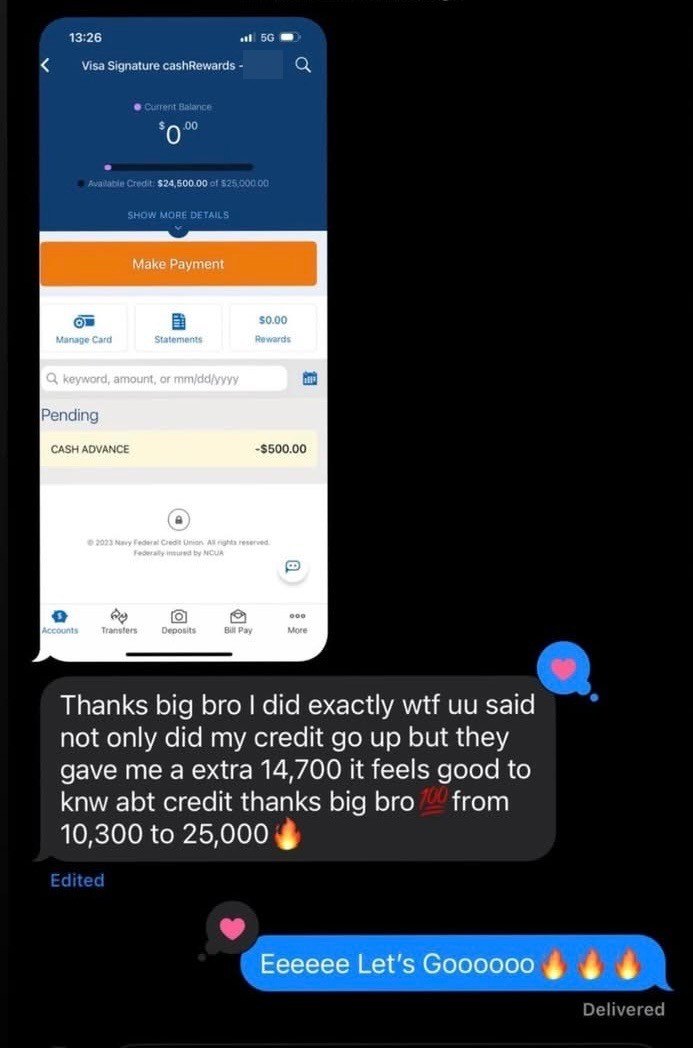
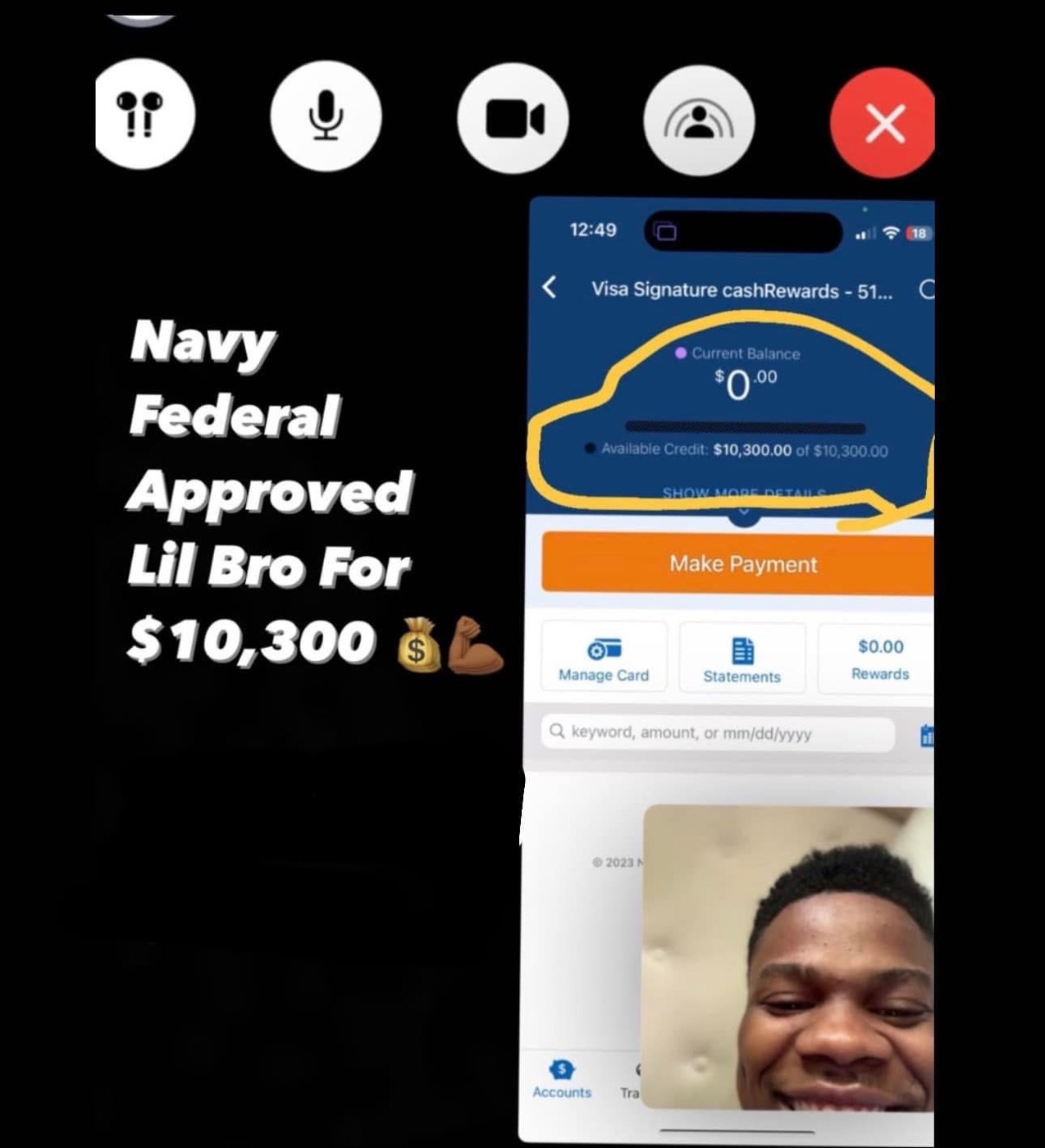
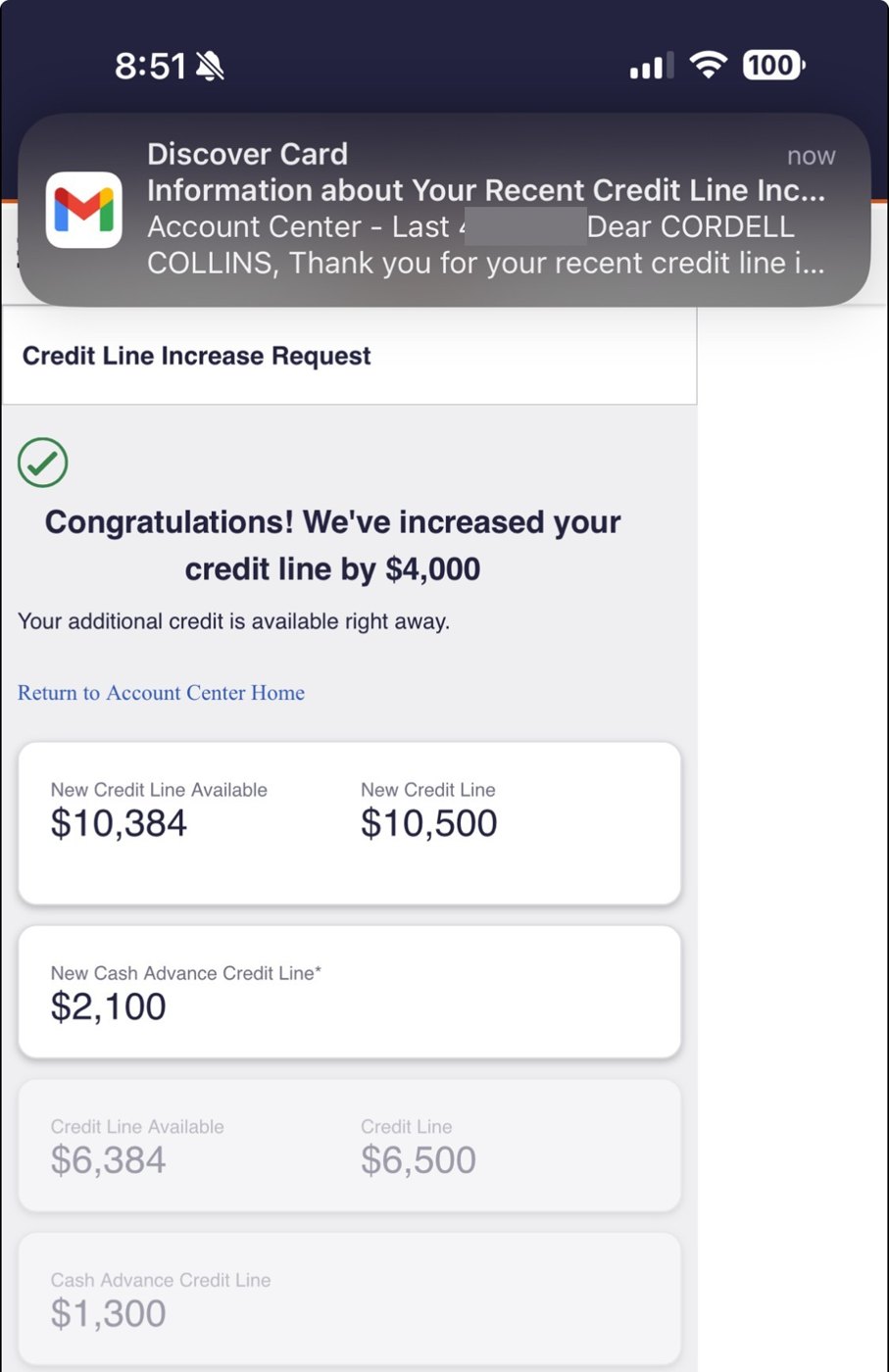
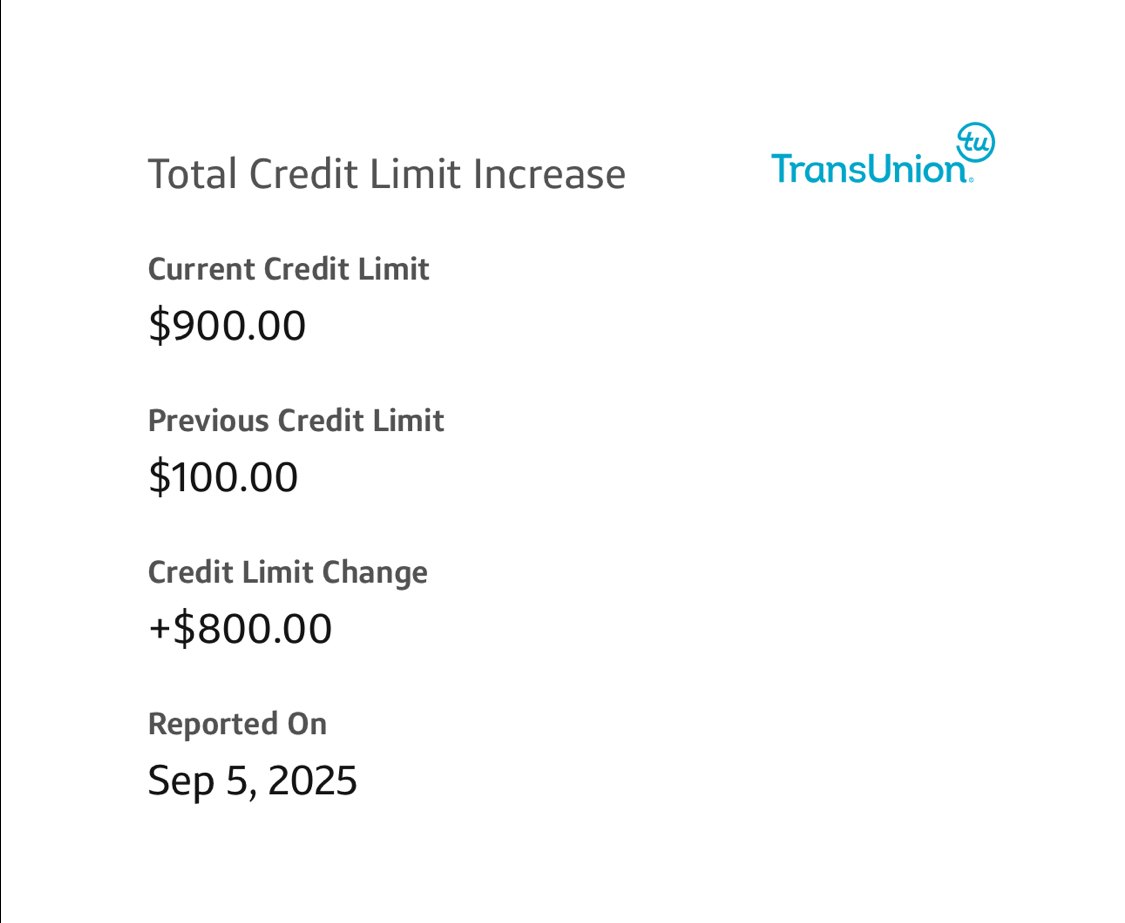
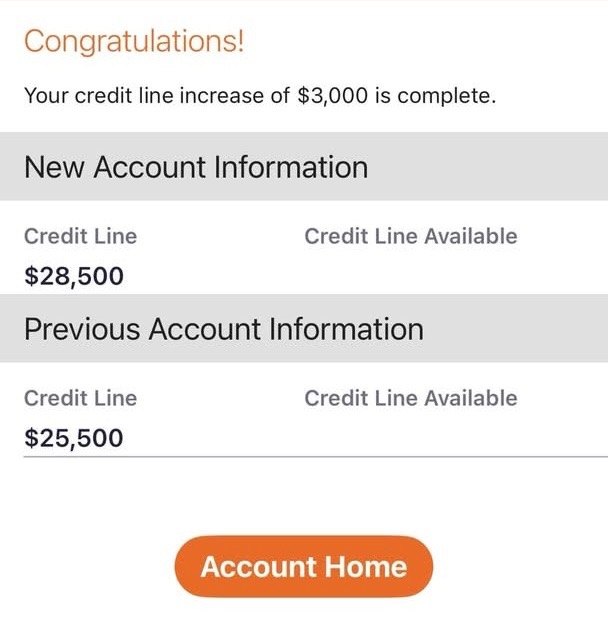
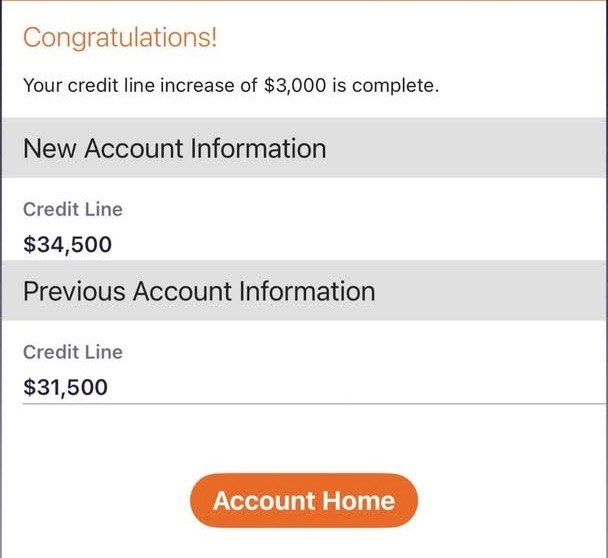
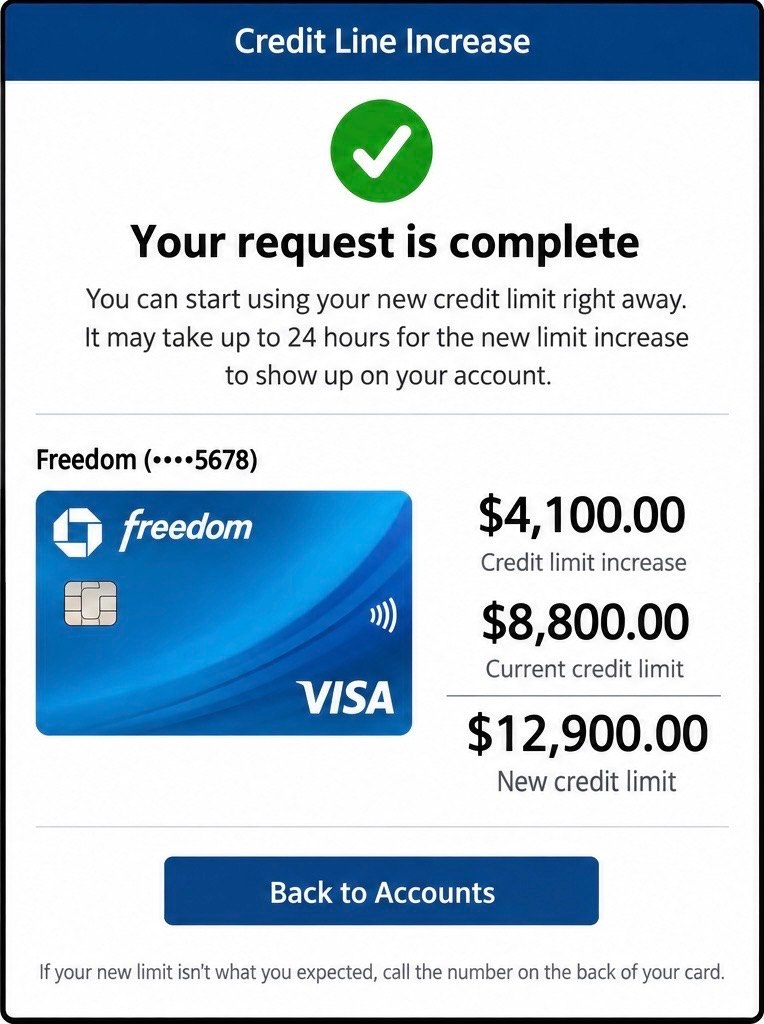
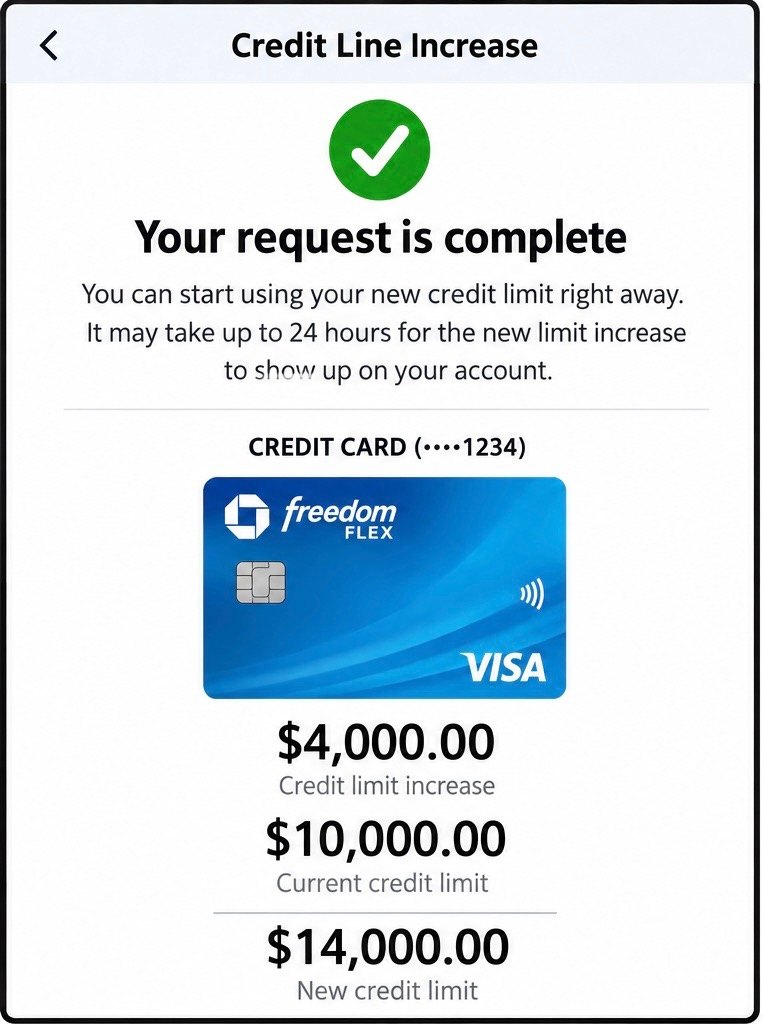
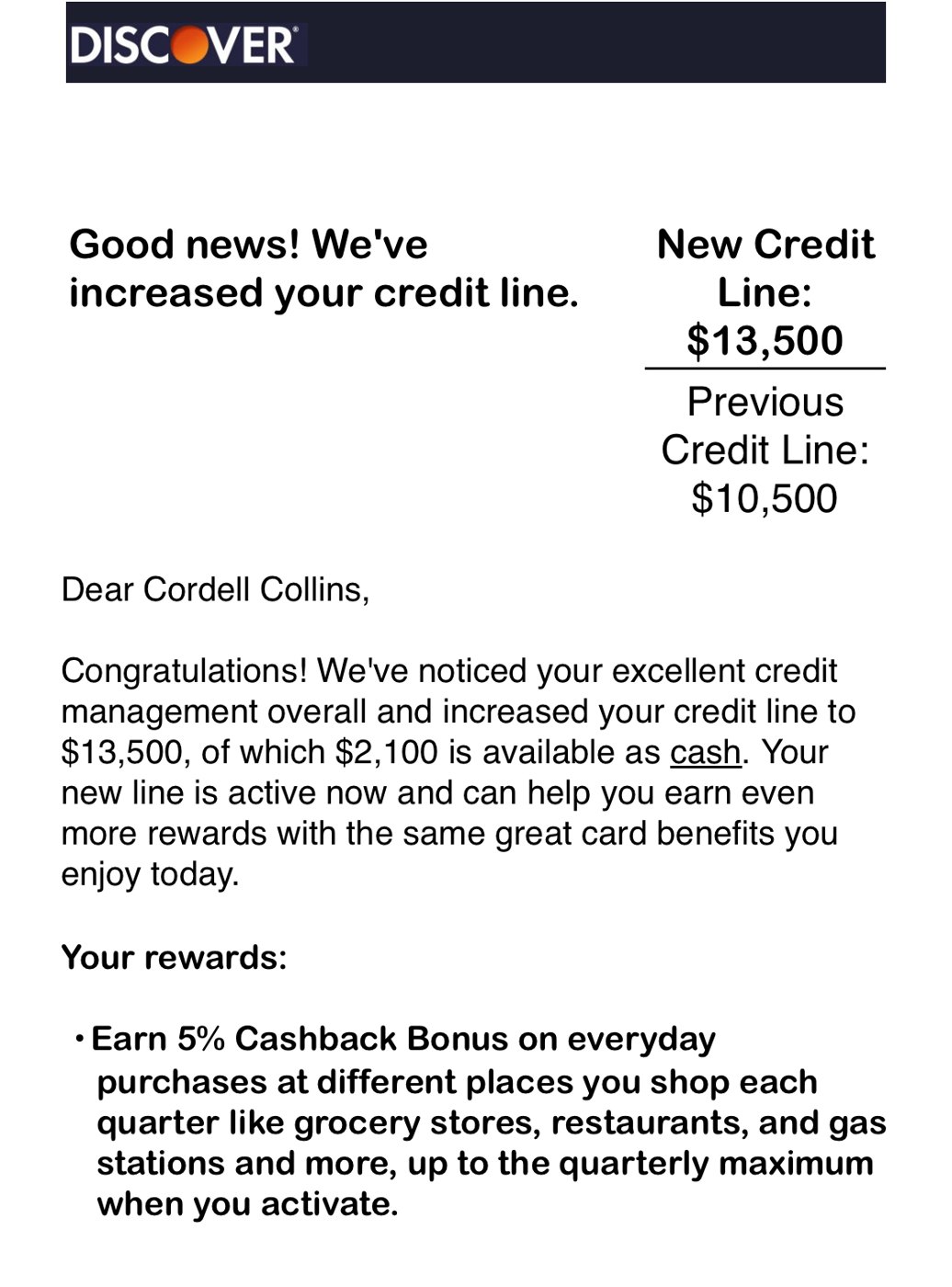
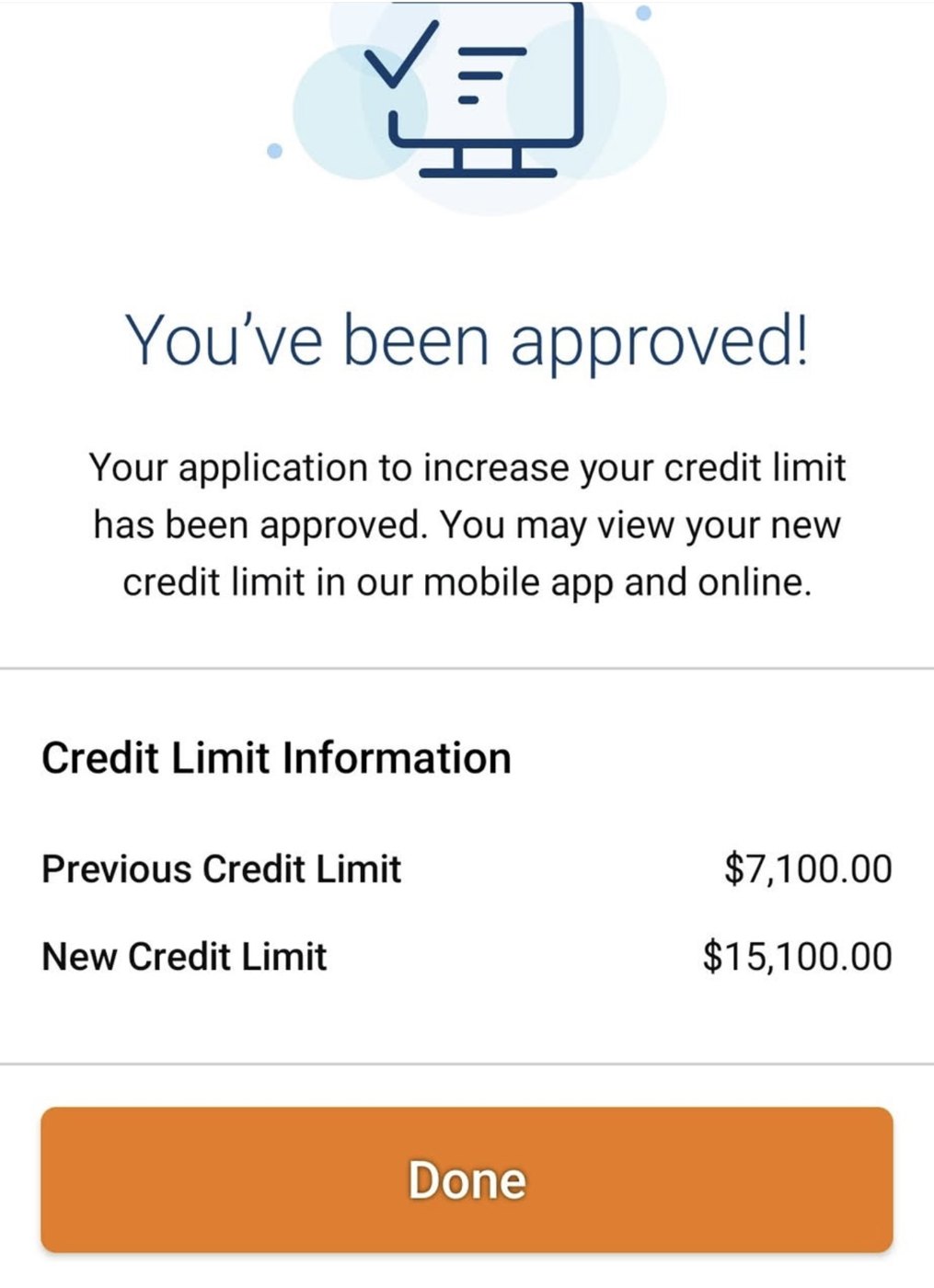
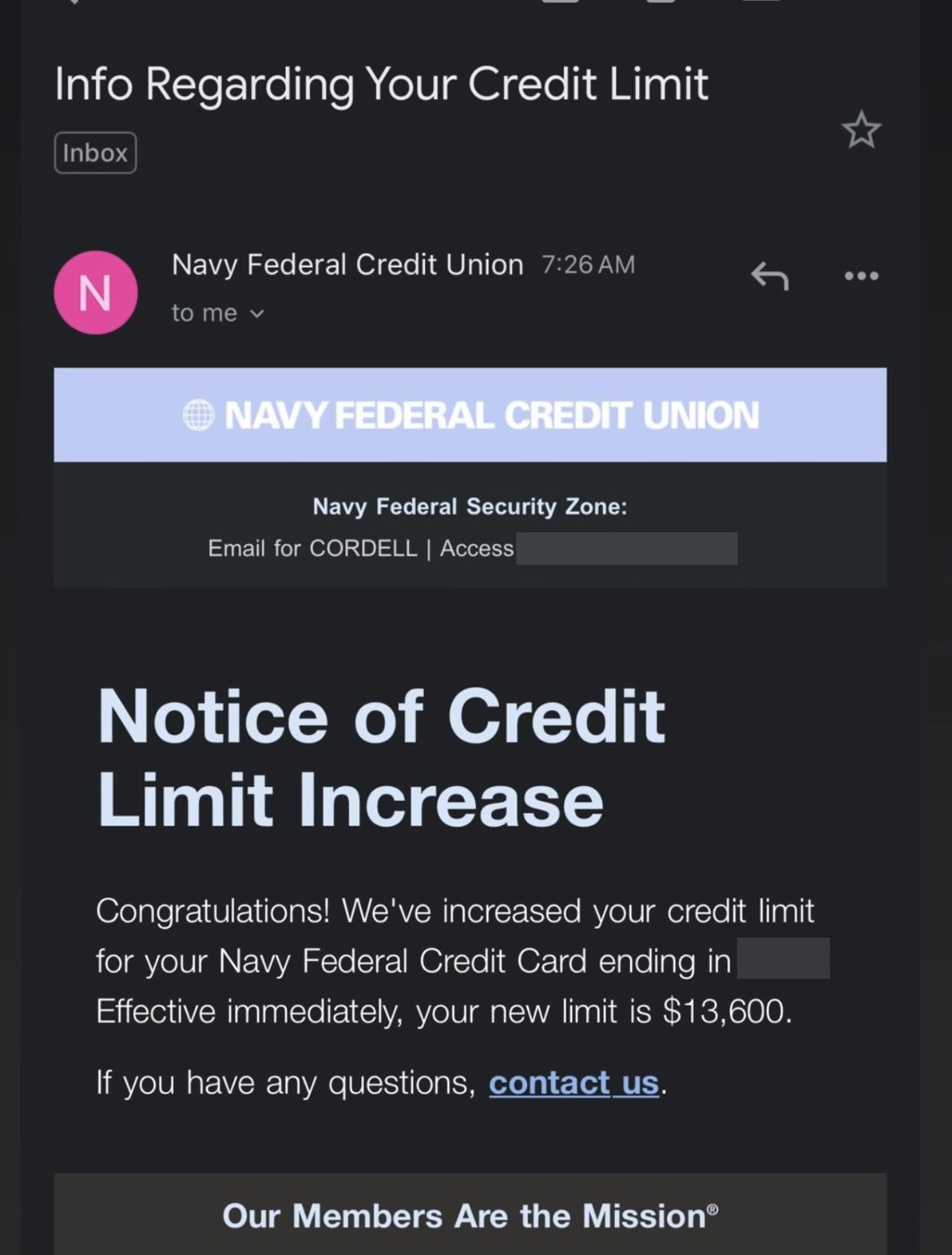
How Credit Limit Increases Work
When a lender reviews your account and decides you can responsibly handle more credit, they increase your limit.
Two Types of Credit Limit Increases
Automatic Credit Limit Increase
The bank increases your limit without you asking.
They usually look at:
- Payment history
- Credit utilization
- Income changes
- Account age
- Overall credit profile
Typical timeframe: 3-6 months of on-time payments (you can call customer service to find out exactly when you will qualify for your next Credit Limit Increase)
Requested Credit Limit Increase
You log into your account or call the bank and ask for a higher limit.
The lender may do:
Soft Pull (no score impact) - Common with many cards today
Hard Pull (temporary score drop) - Some lenders still do this, Navy Federal is one of them.
Factors Lenders Look At
When deciding whether to increase your limit, lenders review:
1. Payment History - Consistent on-time payments
2. Utilization - Ideally below 30%, best under 10%
3. Income - Higher income = higher limits
4. Account Age - Older accounts are more trusted
5. Spending Patterns - If you actually use the card
Example: If someone has a $500 limit but only spends $20 a month, the bank may not increase it because the limit isn't being utilized.
What To Do?
There are two ways you can trigger the bank for a credit limit increase. (there is not right or wrong answer)
Option A:
Make a large purchase, for example an expensive Louis Vuitton Bag - wait until the payment posts and then return the bag.
Option B:
Make large payments for the next 3-6 months & pay the balances back down before the statement date.
Remember not to spend What You Don't ALREADY HAVE. Take Christmas or Birthday shopping as an example. If you were already planning to spend a lot of money due to Christmas, this would be the perfect time to max out your credit cards and pay them back off. But don't just go spending unnecessary money just to get a credit limit increase - it's not that serious.
The Point Is To Get The HIGH CREDIT Section On Your Credit Report To Reflect As If You're Actually Spending Up Most Of Your Limit. As Long As This Is Paid Down 3 Days Before The Statement Date It Will Not Affect Your Credit Score.
High Credit vs Credit Limit - Visual Example
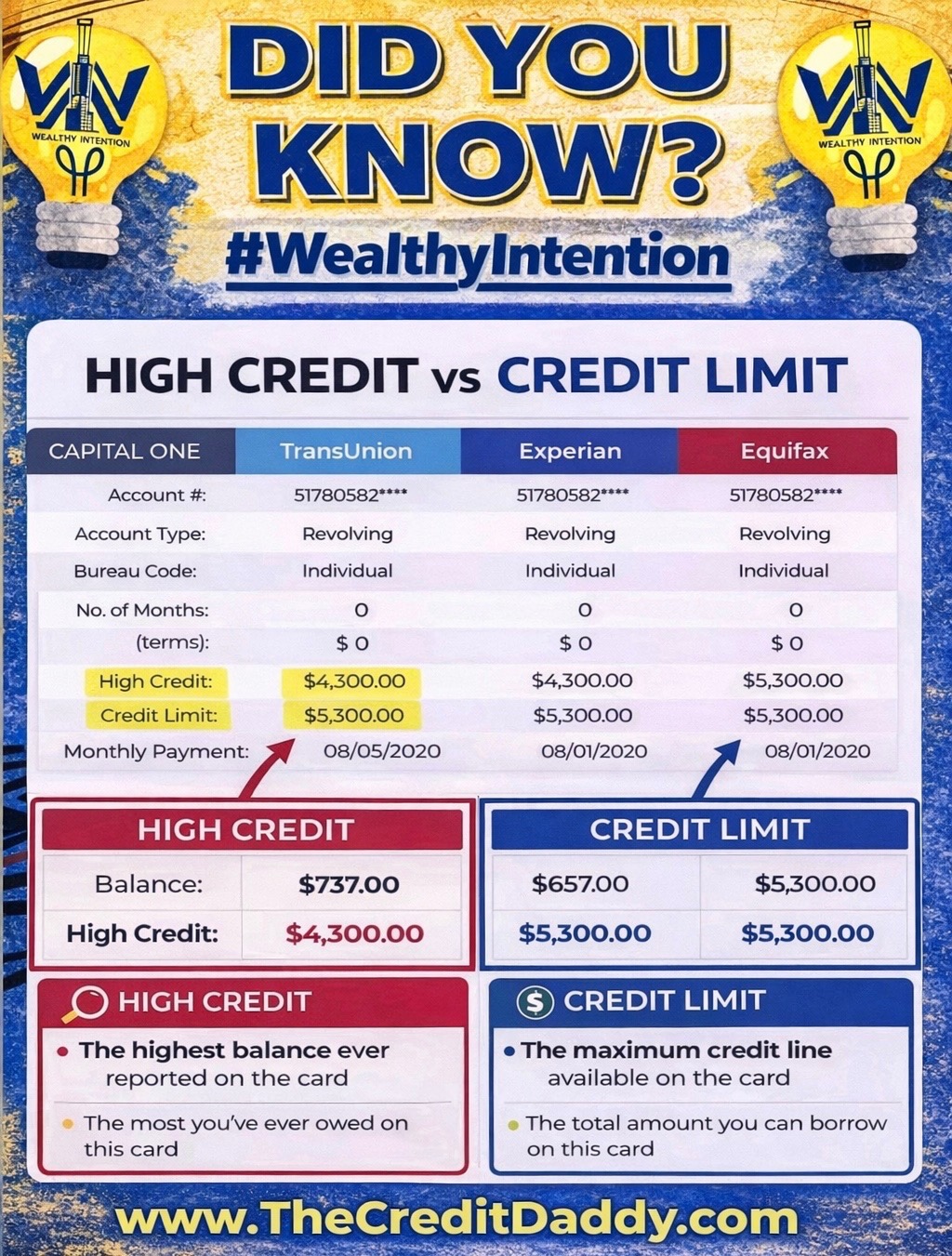
To Do List Step 12
Apply For New Credit
By this stage, most clients have reached what we call the Execution Phase of the program. This is the point where your credit profile should be in a much stronger position, and you may begin strategically applying for new credit.
Before applying for the specific credit product you ultimately want, there are a few steps that can help increase your chances of approval and potentially lead to higher approval amounts or lower interest rates.
You may consider adding one or two additional tradelines or credit cards to your profile — unless you already have 3–5 active credit cards, which is typically an ideal range for a strong revolving credit profile.
Another option is applying for a personal loan. This can serve two purposes:
- Paying down existing credit card balances, which can improve your credit utilization ratio
- Strengthening your relationship with the lender, which may increase your credibility when applying for larger financing (such as a business loan) in the coming months
As long as all negative items have been successfully removed from your credit report, it is generally safe to begin applying for new credit.
Optional — Need Help Applying?
If you would like assistance with the application process, you are welcome to book a consultation. I work directly with relationship managers at various financial institutions and understand how to structure applications in a way that can help maximize approval amounts.
Please note: if I assist you with securing approval for any credit cards or loans, my service fee is 10% of the approved amount.
However, this service is completely optional. You are more than welcome to apply on your own — and by this stage of the program, most clients are in a strong position to qualify independently.
Real Client Results:
- A client applied for a mortgage loan completely on her own and was approved for $434,000 (she then needed $15,000 to put down on the home)
- The same client was then approved for $25,000 on a credit card after I told her exactly what to put on the application
📸 Proof — $434,000 Mortgage (left) & $25,000 Credit Card (right):
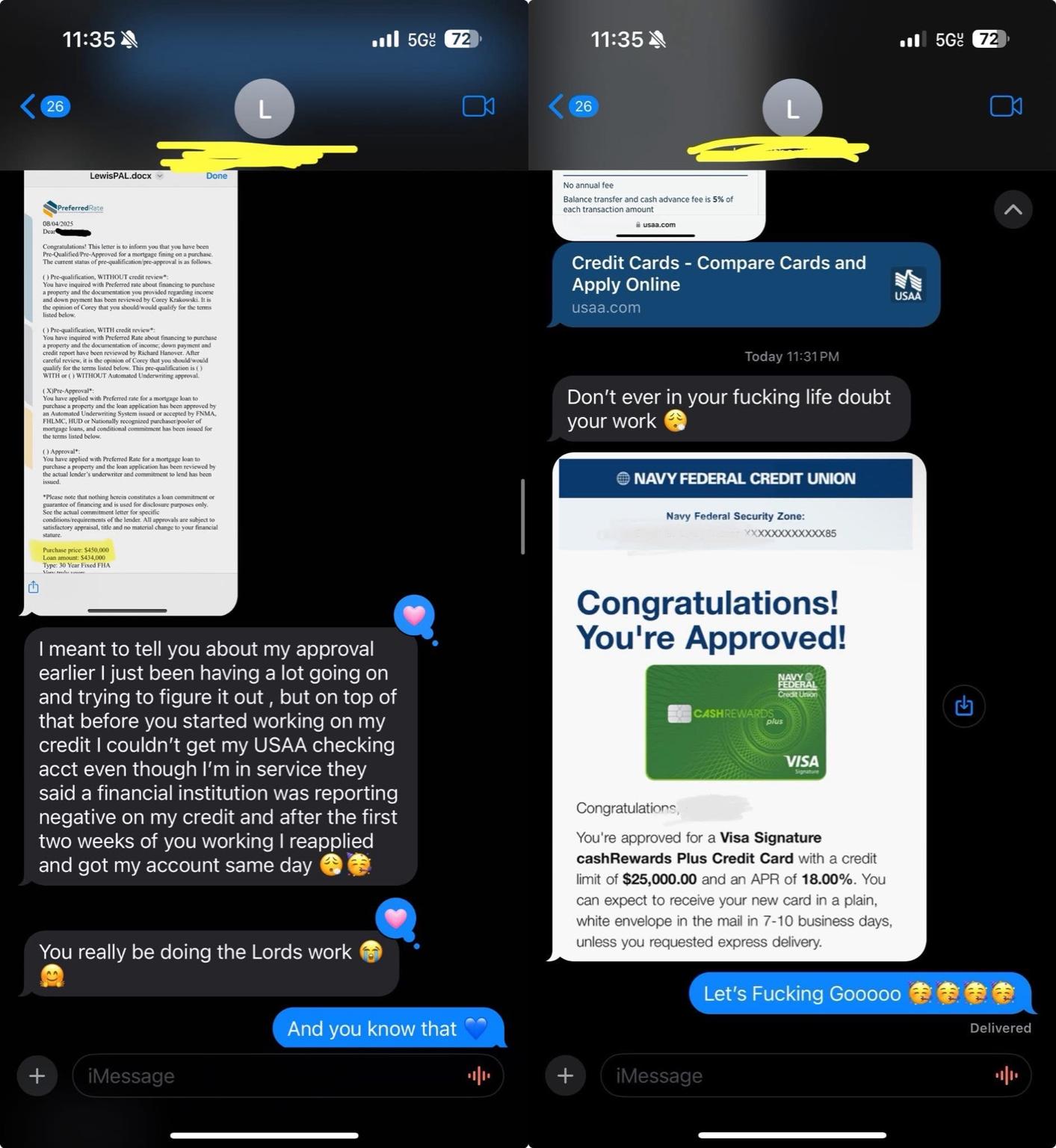
Adding a child as an authorized user on your credit card can help them begin building their credit history early. This can lead to better credit offers, lower interest rates, auto loans, mortgages, and more as they get older.
Our parents weren't taught about credit—and that's not their fault. But today, we know better. You are responsible for your children's financial future. Getting a credit card with one of these banks and adding them as an authorized user can give your children the head start you never had.
Note: Authorized user reporting policies vary by issuer. Responsible use required.
To Do List Step 13
Credit Card Ladder 🪜
Side Note: YOU DO NOT NEED EVERY LAST CREDIT CARD LISTED…. These Are Just EXAMPLES ‼️
Important Reminder
While there's nothing wrong with applying for maybe 2–3 credit cards in the same day, realistically speaking you generally want to wait at least 6 months before every new inquiry.
New credit can lower your CREDIT HISTORY, and too many inquiries back-to-back make you look desperate for money.
So please don't go too crazy just because you have a good credit score and a clean credit report.
Starter Cards 💳
These are the cards we will use to get our credit going 🪜 — considered ENTRY LEVEL CREDIT CARDS. These are specifically for people with bad credit, decent credit OR NO CREDIT.
⭐ Wealthy Intention — Credit Builder Card (Cordell's pick)
- Built by Wealthy Intention LLC — designed specifically for clients in the credit-repair journey
- Reports to all 3 bureaus — great for building a fresh positive trade line
- Graduates after consistent on-time payments (deposit returned, account converts to unsecured)
- Pairs with the rest of the program — no need to bank elsewhere first
💳 Capital One Platinum
- No annual fee — designed for fair / rebuilding credit
- Automatic credit limit increase after on-time payments
- Pre-approval with no hard inquiry first
- Reports to all 3 bureaus (great for building profile)
🏦 Navy Federal Platinum Card
- VERY LOW APR (one of the lowest in the industry)
- No annual fee — great for balance transfers / debt payoff
- Strong limits $2,000–$10,000 with Navy Federal relationship
⚠️ Must be eligible for Navy Federal (military, family, etc.)
Apply Now →✨ Capital One Quicksilver
- Unlimited 1.5% cash back on EVERYTHING
- $200 welcome bonus | 0% intro APR ~15 months | No annual fee
- Good upgrade path from Platinum — daily spender card
🏃 Chase Freedom Rise
- Designed for new credit / low credit history
- Helps build relationship with Chase (VERY important bank)
- Cashback rewards | No annual fee | Higher approval odds if you bank with Chase
🔒 Discover it® Secured Card
- 💳 Builds credit from scratch | Still earns cash back
- 🔁 Can upgrade to unsecured + get deposit back | No annual fee
- Requires deposit ($200+) — Best for clients starting over or rebuilding
👎 Bad Starter Cards (crazy interest rates, low limits) — AVOID: Open Sky, Credit One, First Premier, Store Cards
Beginner Cards 💳 (700+ Credit Score, 2–5 Cards MAX)
By the time you get to this point you should be at a 700+ credit score from 2–5 cards MAX. These cards are the next step up — better rewards, higher limits, and stronger long-term relationships with the major banks.
🍽️ Capital One Savor
- High cash back on dining, entertainment, streaming, groceries
- 💰 Unlimited cash back (no caps) | Strong welcome bonus | No foreign transaction fees
🔵 Discover It
- 5% rotating categories | Cashback Match (DOUBLE all cash back first year)
- Known for credit limit increases over time | No annual fee
- 👉 One of the STRONGEST beginner cards for rewards + growth
💰 Navy Federal Cash Rewards (Up To $25,000)
- Up to 2% cash back | $250 bonus | HIGH LIMITS (10K–25K+)
- Rewards don't expire | No annual fee | Best for funding plays + BIG limits early
⚠️ Must qualify for Navy Federal (military / family)
Apply Now →✈️ Chase Sapphire (Min $5,000 Limit)
- Top-tier travel rewards | 3X dining, 2X travel | Huge welcome bonus (60K–75K+ points)
- Travel protections | $5,000 minimum limit (Visa Signature)
- 👉 Best for travel + building a premium credit profile
Amateur Credit Cards 💳 (Higher Limits $10,000+ | 3–6 Months)
After 3–6 months of consistent payments and clean profiles you can step up to these. Expect higher limits ($10,000+), stronger rewards, and bigger sign-up bonuses. These are the cards that start unlocking real funding power.
💵 American Express Blue Cash Everyday®
- 💰 3% Cash Back on groceries, gas, online shopping | $0 Annual Fee
- 0% Intro APR (12–15 months) | Welcome bonus $150–$250+
- 👉 Good for: beginners, everyday spenders, clean profiles
🍎 Apple Card (Up To $30,000)
- 2% Cash Back on Apple Pay | 3% at Apple + select partners
- 📲 Instant approval (soft pull first) | Daily Cash paid out daily
- Can get limit increases fast | Great for Apple product financing (0% plans)
🔄 Chase Freedom Flex
- 💰 5% rotating categories | 3% dining + drugstores | 5% travel (Chase portal)
- 0% APR ~15 months | $0 Annual Fee | $200+ bonus
♾️ Chase Freedom Unlimited
- 💰 1.5% unlimited cash back on EVERYTHING | 3% dining + drugstores
- 0% APR ~15 months | $0 Annual Fee | $200–$250 bonus
- 👉 This is your "daily swipe" card — no thinking, just earn on everything
Free Travel Cards 💳 (Annual Fees, MAX REWARDS, Best Benefits)
The Goal Is To Travel FOR FREE. Only if you travel at least 1–3X per year.
🥇 American Express Gold Card ($325/yr)
- 🍽️ 4X Points on Dining Worldwide | 🛒 4X Points on Groceries
- 🎁 Monthly credits (Uber, dining, etc.) — total $500+ yearly value
- Can out-earn the annual fee with credits | Builds strong Amex relationship
- 👉 Perfect for stacking points FAST — daily spender card
👑 American Express Platinum Card ($895/yr)
- ✈️ 5X Points on Flights & Hotels | 🛫 1,400+ Airport Lounges Worldwide
- 💼 NO preset spending limit | Airline, Uber, Hotel, Streaming credits
- 👉 Best for business owners, travelers, and high spenders
⚓ Navy Federal Flagship Card (Up To $50,000)
- 💳 HIGH LIMIT approvals | ✈️ 3X Points on Travel | 💰 2X Points on Everything
- FREE Amazon Prime (~$139) | TSA PreCheck / Global Entry credit (up to $120)
- Low annual fee (~$49) | No rewards cap or expiration
- 👉 Hidden gem for funding + travel combo
Business Credit Cards 💳
Max Travel, Crazy Rewards, High Limits, And 0% Offers 8–18 Months
| Card | Best For | Key Perk |
|---|---|---|
| Capital One Venture X Business | Best overall travel | 2X–10X miles, $300 travel credit, lounge access |
| Amex Business Platinum | Status + big funding | 5X on flights/hotels, 1,500+ lounges, no preset limit |
| Chase Ink Business Preferred | Chase ecosystem | 3X travel/shipping/ads, $1K+ signup bonus |
| Chase Ink Business Cash | Easy approval + 0% | 0% APR 12 months, 5% cash back, $0 annual fee |
| Chase Ink Business Unlimited | Simple stacking | 0% APR 12 months, 1.5% unlimited, $750 bonus |
| Amex Blue Business Cash | Clean profiles + Amex | 0% APR 12 months, 2% cash back, no annual fee |
| Amex Blue Business Plus | Low-key travel points | 0% APR 12 months, 2X points everything, no annual fee |
| U.S. Bank Triple Cash Business | Longest 0% offer | 0% APR 12–18 months, 3% categories, $500 bonus |
| BofA Business Advantage Travel | Travel + 0% combo | 0% intro APR, travel rewards, no annual fee |
| Wells Fargo Signify Business | High spend + simple | 0% APR 12 months, 2% flat cash back, no annual fee |
To Do List Step 14 — Interested In Business Funding? 💼
A lot of people think having a good credit score and a clean credit report automatically guarantees business funding, but that is not always the case. You can have excellent personal credit and still get denied if your LLC is not set up properly. Your personal credit may help get you in the door, but a properly structured LLC helps determine how much trust and funding potential your business actually has. That said, I will explain how to properly set up your LLC to MAXIMIZE the amount of funding your business can potentially receive.
Start Now Or Wait?
Truthfully this is a step that can be done immediately, especially if you already have a business that is consistently generating a Minimum 10K/Month. You do not necessarily have to wait to complete the other steps to begin this step.
However, if you do not currently have an established business, sometimes it may be better to wait before starting your LLC — which is why this step was placed towards the bottom of the list. There are pros and cons to both decisions, and ultimately you have to decide what is in your best interest based on your goals, situation, and budget.
The 2-Year Rule 📆
One important thing to understand is that banks and lenders typically prefer to see LLCs that have been established for at least two years. The reason is that many new businesses fail within the first couple of years, so longevity helps show stability and credibility.
Because of that, when it comes to applying for funding, the longer your LLC has been established, the stronger your profile may appear to lenders. For example, there is not a huge difference between an LLC that has been open for 3 months, 6 months, or even 9–12 months — because either way, the business is still considered relatively new and under that 2-year mark.
However, if you start your LLC now, you are giving yourself a head start toward reaching that 2-year milestone. Waiting 6 months to start simply means you will also delay reaching that point by another 6 months.
The Cost Of Owning An LLC 💵
At the same time, it is important to understand that owning an LLC comes with expenses. You may have monthly or yearly costs such as:
- Business email
- Business website
- Business phone number
- Business address
- Domain and hosting fees
- Other business-related expenses
Now, many of these expenses can potentially become tax write-offs, but you still need to make sure they fit comfortably within your current budget.
So if these costs will not hurt you financially, then I would say go ahead and start your LLC now.
But if money is tight at the moment, I would personally recommend focusing on fixing and strengthening your personal credit first. Once your personal credit improves and you are approved for credit cards with strong limits, you can then use that leverage to help fund everything that comes with building your business properly.
That is personally the route I took, and it is also the route I would recommend for people who may benefit more from waiting a little longer before starting their LLC.
At the end of the day, there is no right or wrong answer. The best decision is the one that aligns with your financial situation, your goals, and your overall strategy.
Setting Up Your LLC PROPERLY
Do These In This EXACT ORDER. Because When You Do Step 6, You Will Need To Put Steps 1–5 On The Application.
| Step 1 | Business Name | Not In A Restricted Industry |
| Step 2 | Business Address | Brick & Mortar |
| Step 3 | Business Phone | 800 Number |
| Step 4 | Business Email | Not A Gmail |
| Step 5 | Website | Nothing Related To Anything Restricted (Social Media Not Enough) |
| Step 6 | Apply For Business Entity | LLC |
| Step 7 | E.I.N | Your business social |
| Step 8 | Open Business Checking & Savings Bank Account | No Personal Bank Account. (MUST NOT BE IN CHEXSYSTEMS) Put $100 In Checking & Savings |
| Step 9 | Duns & Bradstreet Number | Making Sure Your Company Is Verified |
| Step 10 | Ask For Money | You have 30 days to remove the inquiries before they hit your credit report |
Picture A $50,000 Line Of Credit Waiting On You. For Every Red Flag 🚩 You Lose $5,000
| Find Out If Your Business Is In A High Risk Industry | $50,000 | https://fairfigure.com/blog/low-risk-naics-codes |
| Wrong Business Name? -$5,000 | $45,000 | Search For The Business Name Here — https://apps.ilsos.gov/businessentitysearch/ |
| No Business Email? -$5,000 | $40,000 | Google Workspace — $7–$14/Month https://workspace.google.com/business/signup/welcome |
| No Business Address? -$5,000 | $35,000 | Google Registered Agent For Your State ( Ex: Registered Agent Illinois ) |
| No Business Number -$5,000 | $30,000 | Google Voice, Grasshopper, RingCentral, SideLine, TextNow |
| No Business Website -$5,000 | $25,000 | Contact Harry — He's The One Who Created My Website. harry-castaner.vercel.app |
| No Duns & Bradstreet -$5,000 | $20,000 | Get Your D&B Number https://www.dnb.com/en-us/smb/duns/get-a-duns.html |
| No Business Bank Account | $0.00 | Must Have An ACTUAL BUSINESS BANK ACCOUNT To Receive A Business Loan |
Ready To Apply For Funding?
With this information I have now educated you on how to properly set up an LLC, establish relationships with banks, and position yourself to qualify for business funding. My goal is to teach clients how to apply independently.
However, if you choose to have me assist directly with applications, I charge a 10% success fee based on the approved amount.
I also work with relationship managers at major institutions, including:
These relationship managers are the individuals who actually review and approve applications and say APPROVED OR DENIED. I refer my clients directly to them. Due to them being my relationship managers, essentially the more money you get approved for, the more they make as well — which is why although you may have to pay a 10–15% referral fee, it can still help you lock in a substantial amount of capital for your business.
Additionally, I offer tradelines & shelf corporations, which function similarly to tradelines but for an LLC. Please book a consultation if you are interested in one of those, or going through one of my relationship managers for funding.
To Do List Step 15 — Congratulations 😎🥂
Congratulations On Completing Your Program!
By this time you should be somewhere between a 700–750+ Credit Score.
✅ Ready For Funding?
If you are a client who is ready to pursue personal or business funding, you should be able to apply independently. However, if you choose to have me assist directly with applications, I charge a 10% success fee based on the approved amount.
I also work with relationship managers at major institutions, including:
These relationship managers are the individuals who actually review and approve applications, and I refer my clients directly to them — which means larger approvals.
I also offer tradelines & shelf corporations, which function similarly to tradelines but for an LLC. If you are interested, feel free to book a consultation.
🙌 Not Interested In Funding? That's Totally Fine.
Please understand that you're pretty much done. At this point the only things that will help you strengthen your profile are:
- Adding a Mortgage — which is NOT mandatory. I personally don't have a mortgage and I have a 798 credit score.
- The only other thing that will help you is TIME.
✅ What To Keep Doing From Here:
- Continue to keep your utilization down
- Keep making on-time payments
- Let time do its thing — payment history builds over time
- Stay away from new late payments & collections
- Stay away from unnecessary inquiries
That's literally it. There's no extra special sauce. 🎯
Congratulations On Completing Your Program 😎🥂
You put in the work. Now enjoy the results and build on them.
TO DO LIST ZOOM RECORDINGS
Recorded Zoom walkthroughs to guide you step by step
Zoom Recordings
Go to your email and search for "Dear Credit Client" or wealthyintentionllc@gmail.com to access the recorded Zoom walkthroughs where I break down how to build up your credit scores, credit report, and credit profile step by step. If you do not see this email, please text (312) 584-9969 and we will make sure it gets resent out.
Resources
Helpful links, tools, and additional resources for your success
TO DO LIST
Credit Building Accounts To Help Increase Your Credit Score
The Following Accounts Below You Can Sign Up For While Undergoing Credit Repair. These Accounts WILL NOT ADD AN INQUIRY To Your Report And They Will Help Increase Your Score.
- Kikoff ( Revolving ) Sign Up Here
- Grow Credit ( Installment ) Sign Up Here
- Self ( Installment ) Sign Up Here
- Chime Credit Builder Card ( Revolving ) Sign Up Here
- Credit Strong $30 ( Installment ) Sign Up Here
IMPORTANT RULES:
• If you have a secured credit card or any active revolving account, your credit card bill should be paid the same day you make a purchase or your statement balance should NEVER exceed 10% of your limit.
• Example: If you have a $300 limit, never let your balance go above $30 (10%).
• ONLY use it for small purchases like gas ⛽, food 🍔, or subscriptions 💳
🚨 COMING SOON 🚨 NEW RESOURCES 🔎 & SERVICES 🏆
🚨 COMING SOON 🚨
New Resources & Services — Stay Tuned!
⚖️ Financial & Legal Solutions
📈 Credit & Wealth Building
🏢 Business & Brand Development
🚗 Automotive & Income Opportunities
🏠 Real Estate & Lifestyle
🚀 Opportunities
Important Links & Resources
View My Reports & Scores — Sign Up Here:
Credit Building Services:
Customer Support:
📞 Phone: (312) 584-9969
📧 Email: support@wealthyintention.org
🕒 Hours: Monday-Thursday, 12:00 PM - 5:00 PM
How To Contact Me
Booking, customer service, and social media
- Please Do Not Message Me On Facebook Messenger Or Instagram. Most Of The Time Your Name On Social Media Isn't Your Real Name & I Have No Idea Who I'm Speaking To.
- I Do Not Answer Random Phone Calls. The Best way to get my attention is to book a consultation.
- Due to the volume of clients I serve, it is not feasible to answer or return hundreds of unscheduled calls and text messages each day.
- Just because it's a quick question doesn't mean it's a quick answer.
- For this reason, all questions and concerns must be addressed through a booked consultation to ensure no one goes unanswered.
- As an active client, you may schedule a consultation at no additional cost.
- Please note that I may not have my business phone on hand outside of my business hours so it is Important to book me so that your questions or concerns don't go unanswered.
- The More Convenient It Is For Me The More Effective I Can Be To Make Sure Everyone Gets The Best Results.
Booking Link:
Contact Information
📧 Email: support@wealthyintention.org
📞 Phone/Text: (312) 584-9969
Please allow 24-48 hours for a response. Text or email is preferred. Do not call multiple times - your message will be seen and addressed.
Yours Truly, TheCreditDaddy